New RIN member publication: Sandro Jung, ‘James Thomson’s The Seasons, Print Culture, and Visual Interpretation, 1730-1842’

New RIN member publication: Special Promotion 

Sandro Jung, James Thomson’s The Seasons, Print Culture, and Visual Interpretation, 1730-1842 (Lehigh University Press, May 2015)

Get 20% off with this downloadable flyer.

“Sandro Jung’s study of The Seasons is a fresh and stimulating history of the publishing and marketing of one of the most popular texts of the eighteenth century. But it is also far more than that. This book radically extends our understanding of the cultural and economic value of Thomson’s poem by investigating its visual readings and its complex cultural afterlife within and far beyond Britain as the poem’s imagery morphed across an astonishing range of visual arts, including engravings in books, prints, cartoons, ceramics, furniture, and music. The result is a persuasive demonstration of the intersections between technology, aesthetics, commerce, market, and reception.”

— James Raven, University of Essex and Magdalene College, University of Cambridge

“Here is the writing of a fresh new chapter in the scholarship of The Seasons. Consideration of print, paratexts, pictures, price, and pocket diaries all make for the richest contextualisation yet of the production and consumption of James Thomson’s poetic masterpiece from its first appearance to the early decades of the nineteenth century.”

— Gerard Carruthers, Francis Hutcheson Professor of Scottish Literature, University of Glasgow

Drawing on the methods of textual and reception studies, book history, print culture research, and visual culture, this interdisciplinary study of James Thomson’s The Seasons (1730) understands the text as marketable commodity and symbolic capital which throughout its extended affective presence in the marketplace for printed literary editions shaped reading habits. At the same time, through the addition of paratexts such as memoirs of Thomson, notes, and illustrations, it was recast by changing readerships, consumer fashions, and ideologies of culture. The book investigates the poem’s cultural afterlife by charting the prominent place it occupied in the visual cultures of eighteenth- and early nineteenth-century Britain. While the emphasis of the chapters is on printed visual culture in the form of book illustrations, the book also features discussions of paintings and other visual media such as furniture prints. Reading illustrations of iconographic moments from The Seasons as paratextual, interpretive commentaries that reflect multifarious reading practices as well as mentalities, the chapters contextualise the editions in light of their production and interpretive inscription. They introduce these editions’ publishers and designers who conceived visual translations of the text, as well as the engravers who rendered these designs in the form of the engraving plate from which the illustration could then be printed. Where relevant, the chapters introduce non-British illustrated editions to demonstrate in which ways foreign booksellers were conscious of British editions of The Seasons and negotiated their illustrative models in the sets of engraved plates they commissioned for their volumes.

About the Author

Sandro Jung is research professor of early modern British literature and founding director of the Centre for the Study of Text and Print Culture at Ghent University.
Podcasts available: RIN 3, ‘The Literary Galleries’, February 2015, Tate

Podcasts of our third event ‘The Literary Galleries: Entrepreneurship and Public Art’, held at the Tate on February 27th 2015, are now available to listen to and to download on Vimeo here.

The programme for the symposium is downloadable from https://romanticillustrationnetwork.wordpress.com/events/, but the speakers were:

1) Rosie Dias (Warwick), ‘Viewers, Patrons, Readers, Consumers? John Boydell’s Shakespeare Gallery and its Public’

2) Ian Haywood (Roehampton), ‘Macklin’s Poets Gallery and the age of Terror’

3) Luisa Calè (Birkbeck), ‘The Hours’

4) Frederick Burwick (UCLA), ‘Painting and Performance: Tableaux Vivants on the London Stage’

5) Martin Myrone (Tate), ‘Blake and the Limits of Illustration’

British Museum: Napoleon Exhibition and Events

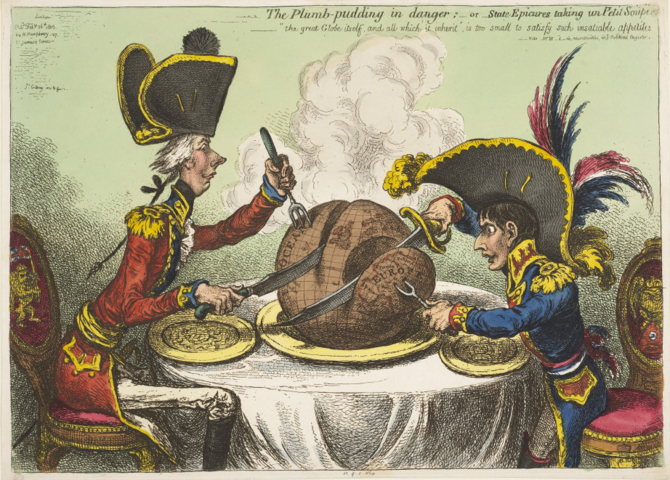
Napoleon caricature BM
©The Trustees of the British Museum

Bonaparte and the British: prints and propaganda in the age of Napoleon

5 February – 16 August 2015

Venue: British Museum
Entry: Free
Address: Great Russell Street, London, Greater London, England. WC1B 3DG

This exhibition will focus on the printed propaganda that either reviled or glorified Napoleon Bonaparte, on both sides of the English Channel. It explores how his formidable career coincided with the peak of political satire as an art form. 2015 marks the 200th anniversary of the Battle of Waterloo – the final undoing of brilliant French general and emperor Napoleon Bonaparte (1769–1821). The exhibition will include works by British and French satirists who were inspired by political and military tensions to exploit a new visual language combining caricature and traditional satire with the vigorous narrative introduced by Hogarth earlier in the century. This exhibition includes work by James Gillray, Thomas Rowlandson, Richard Newton and George Cruikshank.

Download a list of exhibition-related events at the British Museum here.


CFP: RIN panel at Romantic Imprints, BARS’ 2015 International Conference

Romantic-Imprints-image The deadline for submission of abstracts to the RIN panel at BARS 2015 approaches: February 15th.


Of particular interest for RIN members is the RIN panel ‘Romantic Illustration’: see the panels page on the BARS 2015 website here.

The full CFP is below:

———————————————————————————————————-

2nd Call for Papers: Romantic Imprints

British Association for Romantic Studies, 14th International Conference

Cardiff University, 16–19 July 2015

Proposals are invited for the 2015 British Association for Romantic Studies international conference which will be held at Cardiff University, Wales (UK) on 16–19 July 2015. The theme of the interdisciplinary conference is Romantic Imprints, broadly understood to include the various literary, cultural, historical and political manifestations of Romantic print culture across Europe, the Americas and the rest of the world. Our focus will fall on the ways in which the culture of the period was conscious of itself as functioning within and through, or as opposed to, the medium of print. The conference location in the Welsh capital provides a special opportunity to foreground the Welsh inflections of Romanticism within the remit of the conference’s wider theme. The two-hundredth anniversary of Waterloo also brings with it the chance of thinking about how Waterloo was represented within and beyond print.

The confirmed keynote speakers for Romantic Imprints will be John Barrell (Queen Mary, London), James Chandler (Chicago), Claire Connolly (Cork), Peter Garside (Edinburgh) and Devoney Looser (Arizona State).

The conference is open to various forms of format:  we encourage proposals for special open-call sessions and for themed panels of invited speakers as well as individual proposals for the traditional 20-minute paper. Subjects covered might include:

  • Nation and print: the British archipelago; cities of print; transatlantic and transnational exchanges; Romantic cosmopolitanism and print; translation; landscape and/in print; Wales and its Romantic contexts; national (especially Welsh) patterns of influence and exchange in the international context.
  • Producing and consuming print: Romantic readerships; publishers; circu­lating print; legislation, copyright and print; technologies of print; plagiarism, forgery and piracy; popular and subaltern cultures of print; periodicals and journalism; gender and genre; print as new and old, ephemeral and collectable objects; print beyond reading (paper money, cards, etc.); the fate of print as ‘rubbish’.
  • Intertextual exchanges: politics and print (e.g. revolution and radicalism, war, Napoleon, Waterloo); satire and parody; science and print culture; performance and print; Romantic visual cultures (including art and illustration); representations of print and printing; fashion; adaptation and remediation; the Romantic essay; print and its others – epitaphs, manuscripts, marginalia, etc.; print and imprint as Romantic metaphor or ideology; popular pastimes.
  • Textual scholarship: editing texts; bibliography and book history; manuscripts, correspondence and diaries; analysis and quantification; digital humanities.
  • Romantic legacies: physical traces and imprints; architecture; Romantic anti­quarianism; Victorian Romanticism; Romanticism and modernity; Romanticism and new media; Romantic biography; lives in print; Romantic afterlives; celebrity and print; adapting the Romantics (film, art, literature).

Format of conference proposals

  • Traditional 20-minute paper proposals (250-word abstracts), submitted individually.
  • Poster presentations showcasing innovative projects or digital outputs (250-word abstracts), submitted individually.
  • Proposals for open-call sessions (350-word descriptions of potential session, outlining its importance and relevance to the conference theme). Accepted open-call sessions will be advertised on the BARS 2015 conference website from mid-January 2015. Please note: the deadline for submission of open-call panels has now expired.
  • Proposals for themed panels of three 20-minute or four 15-minute papers (250-word abstracts for each paper with speakers’ details and an outline of the panel’s rationale from the proposer).

Extended deadline for submission of abstracts: 15 February 2015. Submissions can comprise proposals for individual papers, poster presentations and submissions to open-call panels (which will be published online from mid-January 2015). If you are applying to an open-call session, you should include the name of the session on your proposal.

All proposals should include your name, academic affiliation (if any), preferred email address and a biography of 100 words. Please send proposals and direct enquiries to the BARS 2015 conference organisers, Anthony Mandal and Jane Moore (Cardiff University) at BARS2015@cardiff.ac.uk.

For the latest updates about the conference, follow us on Twitter @2015BARS and join our Facebook group at https://www.facebook.com/groups/BARS2015/.

Lecture: Rosie Dias (Warwick), ‘From Counting House to Country House: Building the Image of the East India Company’

The Birkbeck Eighteenth-Century Research Group is delighted to announce a lecture in the new year by Rosie Dias, Associate Professor in History of Art at the University of Warwick.

‘From Counting House to Country House: Building the Image of the East India Company’

6pm, Thursday 15th January
Room 407, 30 Russell Square

Rosie Dias’s research focuses on eighteenth and early nineteenth-century British art and visual culture. Her monograph, Exhibiting Englishness: John Boydell’s Shakespeare Gallery and the Formation of a National Aesthetic, was published by Yale University Press in 2013.

All very welcome! For further information, please contact Kate Retford: k.retford@bbk.ac.uk

best wishes,
Ann Lewis, Kate Retford, Luisa Cale and Emily Senior

Meet your fellow-RIN members (2)

In the second of this series, Danielle Barkley from McGill introduces herself:

Hello, members of the Romantic Illustration Network! I’m very pleased to have a chance to introduce myself. I am currently a lecturer at both McGill University and Bishop’s University in Montreal, Canada. I am awaiting a defense date for my doctoral thesis, Reading The Details: Realism and the Silver Fork Novel, 1825-1845. This research focused on the narrative strategies of silver fork novels, arguing that the accumulation of detail was the genre’s major priority, and that in order to represent that detail as fully as possible, these novels  often depart from the narrative norms widely viewed as central to prose fiction.  As I work to turn the thesis into a book manuscript, I’m planning to incorporate new material on illustrations in silver fork fiction, looking at how illustrations furthered the work of presenting detailed accounts of elite lifestyles (or the illusion thereof). I’m also interested in giftbooks and literary annuals, and the role of illustration there. Feel free to contact me at danielle.barkley@mail.mcgill.ca.

Meet your fellow-RIN Members (1)

In the first of what will hopefully be come a series, RIN member Michael Demson tells us about his current research:

‘Hello, I’m Michael Demson, and I am an assistant professor of English at Sam Houston State University in Huntsville, Texas, where I teach undergraduate and graduate courses in Romanticism, World literature, and literary theory. Currently, I am working on a book-length study on transatlantic radicalism, agrarian politics, and Romantic literature, a project supported by an American Council of Learned Societies’ Fellowship for 2014-2015.

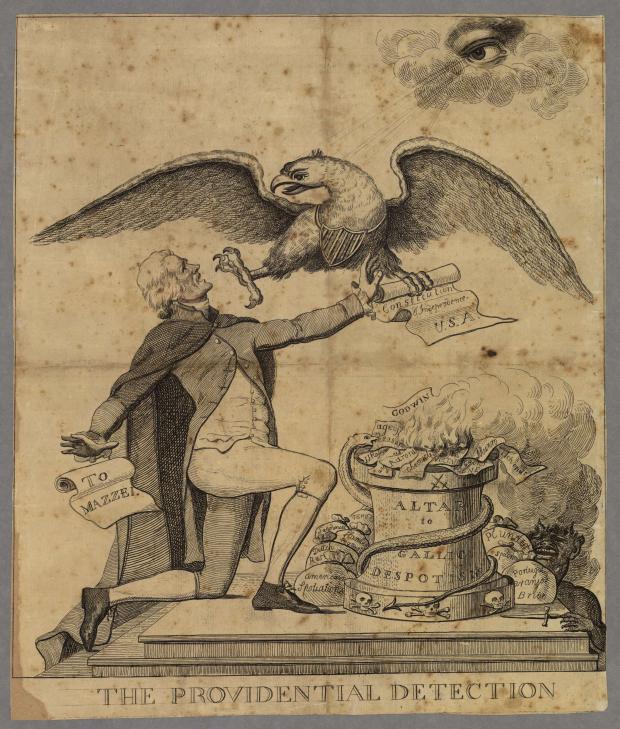
The first few chapters of this book will explore critiques of agricultural improvement in literary, philosophical, and political correspondences during the 1790s between such figures as Thomas Jefferson, Constantin-François Volney, and William Godwin (a transatlantic network of radicals that this anonymous 1798 cartoon sought to expose, figure 1.). The subsequent chapters explore later Romantic novels (Cooper, Hugo, Trollope) profoundly affected by the radical critique of improvement developed during the decade of revolutions.

Figure 1

Figure 1

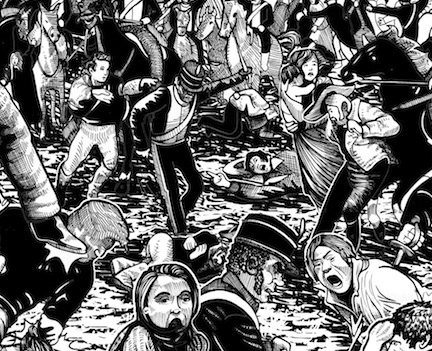
I’ve also published articles in Romanticism, European Romantic Review, Nathaniel Hawthorne Review, among others, and my graphic novel, Masks of Anarchy: The History of a Radical Poem, about the second life of Percy Shelley’s 1819 lyrical satire among garment workers in New York City at the turn of Twentieth Century, was published by Verso Books in 2013 (figure 2.). You can reach me at demson@shsu.edu.’

Figure 2

Figure 2