Early Career Researchers network for historians of British art

We would like to invite you to join our new Early Career Researchers network for historians of British art. The aim of this network is to provide a forum for Early Career Researchers (ECRs) working in the field of British art history to meet and connect, share work and provide supportive criticism. The Paul Mellon Centre for Studies in British Art will host regular afternoon gatherings where members can present short papers, offer one another feedback, discuss their experiences and share information about career-related topics. 

Meetings in the coming semester will held on 12th November, 26th November, and 10th December 2015 between 4.30-6pm at the Paul Mellon Centre, 15-16 Bedford Square, WC1B 3JA. Meeting 1 will be a chance for us to get to know one another, to talk a bit about our work, and for some of us to present research and gain feedback.

At Meeting 2 Oriana Baddeley, Dean of Research at University of the Arts London, will be on hand to discuss REF and how best to approach it. We will also have time to share research. Meeting 3 will be our last before Christmas, and Samuel Bibby, Associate Editor of Art History, will join us to discuss preparing manuscripts for submission to journals. Again, we will also have time to discuss our own research. We anticipate that this session will end with a sociable trip to the pub.

Members are invited to share their research journeys and profile information via our blog. Please contact us via ecrbritart@gmail.com.

We define Early Career Researchers as post-doctoral scholars who are within 5 years of receiving their doctorate, or preparing for their viva. This definition can be flexible, so please do get in touch if you think the ECR network might be useful for your situation.

With very best wishes,

Dr Hannah Leaper, Paul Mellon Centre for British Art

Dr Sophie Hatchwell, University of Bristol

A very Richardsonian experience: New BBC4 series on the origins of the novel, starts 8th October at 9pm

A very Richardsonian experience

By Lynn Shepherd

I’m sure a lot of people will remember the BBC4 series A Very British Murder (currently available again on the iPlayer, incidentally). What you may not know is that BBC Arts has been filming a follow-up, which will start airing in the next couple of weeks. It’s A Very British Romance this time, exploring the origins of the romantic novel, and how our notions of love and marriage have evolved over the last 200 years. To the Beeb’s immense credit, they’re starting their jaunt through romantic fiction with Samuel Richardson. And that, dear reader, is how I found myself in Spitalfields, on a bright cold day in April, talking Pamela, passion, and pictures with Lucy Worsley.

Still

The house we shot the footage in must be one of the most popular film locations in London, judging by the people going in and out. It’s an 18th century house in Princelet Street that’s been stripped back to how it must have looked when it was first built, closets, candles, wainscots and all. I’ve done some filming before, but it’s always fascinating to watch the pros at work, and see how many takes it takes to capture even a few seconds of the finished article.

Making the literary interesting on screen isn’t always easy, but in Richardson’s case, of course, we have the illustrations to Pamela to help bring the text to life. Basing our discussion on prints of Highmore’s ‘novel-in-pictures’ gave Lucy and me the chance talk through the plot and themes of the novel, and then broaden the conversation out to 18th-century attitudes to love and sex, as well as the significance of the prints themselves, as examples of the ‘multi-media event’ that Pamela became.

The series starts on BBC4 on 8th October at 9pm and I think you’d enjoy watching it – I certainly enjoyed being part of making it.

Pre-Raphaelite Fellowship: A Joint Fellowship from the University of Delaware Library and the Delaware Art Museum

Pre-Raphaelite Fellowship: A Joint Fellowship from the University of Delaware Library and the Delaware Art Museum

Deadline: November 1, 2015

The University of Delaware Library, in Newark, Delaware, and the Delaware Art Museum are pleased to offer a joint Fellowship in Pre-Raphaelite studies. This short-term, one-month Fellowship, awarded annually, is intended for scholars conducting significant research in the lives and works of the Pre-Raphaelites and their friends, associates, and followers.  Research of a wider scope, which considers the Pre-Raphaelite movement and related topics in relation to Victorian art and literature, and cultural or social history, will also be considered. Projects which provide new information or interpretation—dealing with unrecognized figures, women writers and artists, print culture, iconography, illustration, catalogues of artists’ works, or studies of specific objects—are particularly encouraged, as are those which take into account transatlantic relations between Britain and the United States.

Receiving the Fellowship:
The recipient will be expected to be in residence and to make use of the resources of both the Delaware Art Museum and the University of Delaware Library. The recipient may also take advantage of these institutions’ proximity to other collections, such as the Winterthur Museum and Library, the Philadelphia Museum of Art, the Princeton University Library, and the Bryn Mawr College Library. Each recipient is expected to participate in an informal colloquium on the subject of his or her research during the course of Fellowship residence.

Up to $3,000 is available for the one-month Fellowship. Housing may be provided. Personal transportation is recommended (but not mandatory) in order to fully utilize the resources of both institutions.

The Fellowship is intended for those who hold a Ph.D. or can demonstrate equivalent professional or academic experience. Applications from independent scholars and museum professionals are welcome. By arrangement with the Yale Center for British Art, New Haven, CT, scholars may apply to each institution for awards in the same year; every effort will be made to offer consecutive dates.

To Apply:
Send a completed application form, together with a description of your research proposal (maximum 1 page) and a curriculum vitae or resume (maximum 2 pages) to the address given below. Letters of support from two scholars or other professionals familiar with you and your work are also required. These materials may also be sent via email to: fellowships@delart.org.
Pre-Raphaelite Fellowship Committee Delaware Art Museum 2301 Kentmere Parkway Wilmington, DE 19806
Application Form: http://www.delart.org/about/opportunities/#preraphfellowship Important Dates:
The deadline to apply for the 2016 Fellowship is November 1, 2015. Notification of the successful applicant will be announced by December 1, 2015. The chosen candidate will then be asked to provide a date for assuming the Fellowship by January 1, 2016.
If you have any questions or would like to request more information, please contact:
Margaretta S. Frederick Pre-Raphaelite Fellowship Committee Direct line: 302.351.8518 E-mail: fellowships@delart.org

Romantic London: new digital project

Romantic London is a research project by Dr Matthew Sangster (Birmingham) exploring life and culture in London around the turn of the nineteenth century using Richard Horwood’s pioneering ‘PLAN of the Cities of LONDON and WESTMINSTER the Borough of SOUTHWARK, and PARTS adjoining Shewing every HOUSE’ (published between 1792 and 1799). It considers the ways in which the writers and works later grouped under the umbrella of Romanticism interacted with London’s communities and institutions while also examining a wide range of alternative approaches to representing and organising urban existence.

The site is based around a digital version of Horwood’s Plan laid over and georeferenced to modern maps of the city; this allows for detailed examinations and comparisons. As well as considering the Plan and its creator, the site is using Horwood’s work as a means of thinking about the ways in which writers, publishers and artists sought to communicate insights into London’s general character and particularities. By using Horwood’s Plan as a base map and adding other kinds of information to it using annotated markers, the site reflects upon the social, geographical and aesthetic assumptions made in late eighteenth- and early nineteenth-century attempts to make sense and art of the burgeoning metropolis.

Texts brought into conversation with Horwood’s Plan on the site at present include:
•Entries from the dual-language New Guide for Foreigners prepared around 1790 and sold by the printseller S.W. Fores from his shop opposite the Paris Diligence office.
•Descriptions and images from Modern London, an 1804 publication put together by the radical publisher Richard Phillips, which included two sets of plates of the city, one showing major landmarks, the other showing itinerant traders hawking their wares in more out-of-the-way locations.
•The lavish aquatints from Rudolf Ackermann’s Microcosm of London (1808-10), engraved from collaborations between the artist and architectural draftsman Auguste Charles Pugin and the uproarious caricaturist Thomas Rowlandson.
•The text of the 1788 edition of Harris’s List of Covent-Garden Ladies, a disreputable register of London prostitutes.

The site at present is a work in progress; there are a great number of additions still to be made. You can follow the changes and developments on the site’s blog.

NEW Online Resource: The Romantic Illustration Network Shakespeare Gallery

Announcing: The Romantic Illustration Network Shakespeare Gallery
 
Ready for the 2016 anniversary of Shakespeare’s birth, the Romantic Illustration Network is delighted to announce its digitisation of prints from Boydell’s Shakespeare Gallery, courtesy of negatives provided by Professor Frederick Burwick (UCLA).
 
The Boydell Shakespeare Gallery was open to the public on London’s Pall Mall from 1789 to 1805. Featuring paintings of scenes from Shakespeare by major artists of the day, including Fuseli, Reynolds, and Kauffmann, the gallery was a popular if not a financial success.
 
Prints of the paintings were published in volumes (as well as in an illustrated edition of Shakespeare), and are now digitised here by the University of Roehampton for use under a Creative Commons license. Images are arranged alphabetically by play, and new plays will be added over the coming months, so do keep checking back on the site. We have also digitised the front matter from the volumes.
 
Click on the thumbnails to access larger versions of the images, and to view the full-sized image. Once you have clicked on a thumbnail there is space to add comments on each image, and we very much encourage you to do so.
 
If you have any feedback, questions, or suggestions, please do let us know.
 

Podcasts available: RIN 3, ‘The Literary Galleries’, February 2015, Tate

Podcasts of our third event ‘The Literary Galleries: Entrepreneurship and Public Art’, held at the Tate on February 27th 2015, are now available to listen to and to download on Vimeo here.

The programme for the symposium is downloadable from https://romanticillustrationnetwork.wordpress.com/events/, but the speakers were:

1) Rosie Dias (Warwick), ‘Viewers, Patrons, Readers, Consumers? John Boydell’s Shakespeare Gallery and its Public’

2) Ian Haywood (Roehampton), ‘Macklin’s Poets Gallery and the age of Terror’

3) Luisa Calè (Birkbeck), ‘The Hours’

4) Frederick Burwick (UCLA), ‘Painting and Performance: Tableaux Vivants on the London Stage’

5) Martin Myrone (Tate), ‘Blake and the Limits of Illustration’

University of Roehampton Vice-Chancellor’s PhD Scholarships

The University of Roehampton is pleased to announce 50 Vice Chancellor’s Scholarships for PhD study beginning in October 2015. Full funding (tuition fee waiver at Home/EU rate, and stipend of £16,057 per annum) is available for outstanding applicants to undertake research on eligible project areas across all departments.

Applications are due 5 May 2015 for an October 2015 start.

We are seeking bold, innovative postgraduates with a record of achievement to undertake a broad range of thematic and cross-disciplinary projects. You will be supervised by experienced teams of internationally renowned scholars, enjoying extensive opportunities to collaborate with a diverse range of partners and to work within one of our highly acclaimed research networks.

Funding is available for UK/EU and International* students at Home/EU rates (tuition fee waiver at £4,052 and stipend at £16,057 for 2015/16) for three years full-time study (or part time equivalent for five years).

Students will benefit from being part of their Departmental research communities and the Graduate School, which sits at the heart of our supportive doctoral community. All doctoral students further benefit from a range of high-quality training opportunities that foster development both within the academy and beyond.

For full deatils of eligible projects and how to apply see http://www.roehampton.ac.uk/vcscholarships/

*International recipients of VC Scholarships will only be covered to Home/EU rates, and be expected to make up the difference between Home/EU and International tuition fee rates. Current levels can be found on the University’s Finance Pages.


Thoughts wanted: Eighteenth-Century Book Illustration Reader

From Dr. Christina Ionescu, Associate Professor Modern Languages and Literatures, Mount Allison University:

Dear colleagues,

Leigh G. Dillard and I are engaged in the planning stages of a reader on eighteenth-century book illustration that would encompass various traditions (English, French, German, Spanish, etc.). In order to best position the reader, we would be most grateful if those of you who work on book illustration (and perhaps also teach courses on the subject) could provide some feedback on our preliminary ideas.

You could write to us directly (cionescu@mta.ca and Leigh.Dillard@ung.edu) and we will compile a report for the SHARP list.

1) Would you use such a reader in a course? What type of course would you consider using it in? Would your library be interested in purchasing it?

2) Do you have any suggestions about its contents? Any specific texts that you believe should be included? Any translations of seminal texts that we should commission?

This is what is currently on our list:

i) some relevant excerpts from nineteenth-century texts (Dibdin, the Goncourt brothers, etc.)

ii) some reprints/translations of key chapters from important 1980s/1990s studies on eighteenth-century book illustration (Hodnett, Ph. Stewart, etc.)

iii) theoretical approaches to book illustration as it pertains to the chosen timeframe (e.g. book illustration and word and image, book illustration and book history, book illustration and visual culture, etc.)

iv) the mechanics of book illustration (etching, woodcut, copperplate engraving, frontispieces, colour plates, etc.)

v) illustrators (Stothard, Marillier, Chodowiecki, Gravelot, Hogarth, Cochin, etc.)

vi) genres (illustrated travelogues, gothic novels, sentimental fiction, erotica, etc.)

vii) examples of eighteenth-century illustrated bestsellers (The Sentimental Journey, La Nouvelle Héloïse, etc.)

viii) overviews by geographical region (illustration in England, France, Spain, etc.)

3) Would you be interested in contributing a chapter? (The deadline for submission of chapters will likely be December 2016.)

Many thanks,
Christina and Leigh

British Museum: Napoleon Exhibition and Events

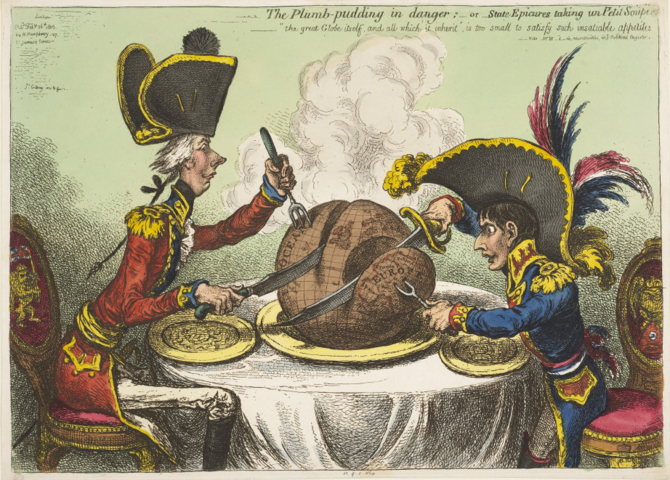
Napoleon caricature BM
©The Trustees of the British Museum

Bonaparte and the British: prints and propaganda in the age of Napoleon

5 February – 16 August 2015

Venue: British Museum
Entry: Free
Address: Great Russell Street, London, Greater London, England. WC1B 3DG

This exhibition will focus on the printed propaganda that either reviled or glorified Napoleon Bonaparte, on both sides of the English Channel. It explores how his formidable career coincided with the peak of political satire as an art form. 2015 marks the 200th anniversary of the Battle of Waterloo – the final undoing of brilliant French general and emperor Napoleon Bonaparte (1769–1821). The exhibition will include works by British and French satirists who were inspired by political and military tensions to exploit a new visual language combining caricature and traditional satire with the vigorous narrative introduced by Hogarth earlier in the century. This exhibition includes work by James Gillray, Thomas Rowlandson, Richard Newton and George Cruikshank.

Download a list of exhibition-related events at the British Museum here.


Update to the William Blake Archive

16 December, 2014

The William Blake Archive is pleased to announce a new wing of the Archive, which contains searchable HTML and PDF editions of thirty-nine past issues of Blake/An Illustrated Quarterly <http://www.blakearchive.org/blake/main.html> published from 2000 through 2009. These issues are accessible via the second entry on the home page, just below “Works in the Archive.” The PDF versions present the journal as originally published, but the HTML versions are re-implemented with many full-colour images from the Blake Archive, making it possible for users to link directly to the Archive for those works that have been published in the Archive.

This publication is the first installment of the Archive’s ongoing project of making freely available and fully searchable over four decades of past issues of Blake/An Illustrated Quarterly, thus making public some of the most important scholarly work done in Blake studies over the past half-century. Issues published within five years of the current issue will remain available only to those who subscribe to the journal <http://blake.lib.rochester.edu/blakeojs/index.php/blake>.

As always, the William Blake Archive is a free site, imposing no access restrictions and charging no subscription fees. The site is made possible by the University of North Carolina at Chapel Hill with the University of Rochester, the continuing support of the Library of Congress, and the cooperation of the international array of libraries and museums that have generously given us permission to reproduce works from their collections in the Archive.

Morris Eaves, Robert N. Essick, and Joseph Viscomi, editors
Joseph Fletcher, project manager, Michael Fox, technical editor
The William Blake Archive