Podcasts available: RIN 3, ‘The Literary Galleries’, February 2015, Tate

Podcasts of our third event ‘The Literary Galleries: Entrepreneurship and Public Art’, held at the Tate on February 27th 2015, are now available to listen to and to download on Vimeo here.

The programme for the symposium is downloadable from https://romanticillustrationnetwork.wordpress.com/events/, but the speakers were:

1) Rosie Dias (Warwick), ‘Viewers, Patrons, Readers, Consumers? John Boydell’s Shakespeare Gallery and its Public’

2) Ian Haywood (Roehampton), ‘Macklin’s Poets Gallery and the age of Terror’

3) Luisa Calè (Birkbeck), ‘The Hours’

4) Frederick Burwick (UCLA), ‘Painting and Performance: Tableaux Vivants on the London Stage’

5) Martin Myrone (Tate), ‘Blake and the Limits of Illustration’

The Visual and the Verbal’, a skills-based training event for postgraduate students using material held at the Ruskin Library, Lancaster University on Wednesday 20th May.

The Visual and the Verbal’, a skills-based training event for postgraduate students using material held at the Ruskin Library, Lancaster University on Wednesday 20th May.

http://www.lancaster.ac.uk/fass/english/events/visual-verbal.htm

The Ruskin Library holds the largest collection of material relating to the life and work of John Ruskin (1819-1900), one of the most important cultural figures of his era in the English-speaking world. Among the most important manuscripts in the collection are 29 diary notebooks, covering the period 1835 to 1888, and c. 4000 manuscript letters. Also in the Library are over 1000 drawings by Ruskin, with others by his associates and pupils, and 125 plates from his collection of daguerreotypes, one of the most important collections of early photographs in the world dating from 1845-1858. The strength of the archive lies in its breadth and depth, enabling research in a number of disciplines, and it will be used at our event to teach the research skills required for work with both manuscript and visual materials. Students working in English, History, Museum Studies, Visual Arts, Art History are welcome to apply for this event.

The event will feature a combination of teaching methods, including intensive, practical hands-on sessions with Ruskin’s manuscripts. The event is being supported by the North West Doctoral Training Consortium. There are limited spaces but the training is open to both AHRC and non-AHRC funded students in the North West. Those nearing the end of their PhDs will be given preference (see below for details on how to apply). The students participating will be asked to prepare a five-minute presentation on their work in advance and to do some advanced reading.

10-11am: introductory seminar discussing what it means to do interdisciplinary research.

11am-12.30pm: students will give their presentations focusing on the ways in which their work is interdisciplinary and on their use of manuscript and/or visual sources. The postgraduate presentations will be filmed and made available on our website.

12.30pm-lunch: students will walk round the current Ruskin Library exhibition (Returned Triumphant: Loans to the Ottawa and Edinburgh exhibition ‘John Ruskin: Artist and Observer’).

2-3.30pm: there will be a hands-on session, where students will work with the full range of archive holdings held in the Ruskin Library, including Ruskin’s manuscript diaries, letters and notes to drawings, watercolours, engravings and photographs. We will teach skills of manuscript handling, palaeography, cataloguing, and discuss issues of transcription and editing.

4-5pm: there will be a workshop on approaches to the visual and verbal; this will focus on the nineteenth-century ‘ut pictura poesis’ debate (‘as in painting so in poetry’) and consider how we can attempt to approach the relationship between meaning in visual and verbal forms by means of analogy; semiotics or the concept of the ‘imagetext’.

5-6pm: there will be a practical session on the use of the notebook and forms of notation as research tools in the museum and archive. The workshop will offer guidance and examples of good practice of how to purposefully apply visual scrutiny, and students will draw from material held in the Ruskin collection.

The teaching team, all from Lancaster University, will include: Professor Sally Bushell (English and Creative Writing), Dr Gerald Davies (Lancaster Institute for Contemporary Art), Dr Andrew Lacey (Senior Research Associate, Davy Letters Project), Professor Sharon Ruston (English and Creative Writing), Dr Andrew Tate (English and Creative Writing), Professor Stephen Wildman (Professor of the History of Art and Director of the Ruskin Library and Research Centre; also former Curator of Fine Art at Birmingham Museum and Art Gallery).

To apply: students need to submit a 500-word abstract of their current research, stating why this event will be of use to them. Please also submit an estimate of travel costs to Lancaster for this event with your application. Applications should be submitted by Friday 10th April. Applications and enquiries should be addressed to Prof Sharon Ruston, s.ruston@lancaster.ac.uk

Event Report: ‘The Literary Galleries: Entrepreneurship and Public Art’, RIN 3, Friday 27 February 2015, Tate Britain

The third ‘Romantic Illustration Network’ symposium took place on Friday 27th February at the Tate Britain. Podcasts of the talks will be available on the website next week.

This symposium brought together the authors of the key scholarship on the literary galleries of the Romantic period: Fred Burwick (The Boydell Shakespeare Gallery, 1996), Rosie Dias (Exhibiting Englishness, 2013), Ian Haywood (Romanticism and Caricature, 2013), Luisa Calé (‘Blake and the Literary Galleries’, 2008; Fuseli’s Milton Gallery 2006) and Martin Myrone (Gothic Nightmares, 2006; John Martin: Apocalypse, 2011) in a venue that is itself a form of literary gallery (Tate Britain) to present new research and to debate the relationship of painting to illustration, text, and print.  To what extent did the literary galleries change the role of illustration in the Romantic period?

RIN 3 attendees at the tea break, enjoying tea and pastries.

RIN 3 attendees at the tea break, enjoying tea and pastries.

Martin Myrone, Lead Curator in Pre-1800 British Art, welcomed everyone to the Tate, before we heard from our first speakers: Rosie Dias and Ian Haywood. Dias showed us how the location of Josiah Boydell’s shop on Cheapside and Shakespeare Gallery in Pall Mall fitted in to the cultural geography of 18th century London. She drew upon Luisa Calé’s work to demonstrate that at the Shakespeare gallery the textual and the visual – the catalogue of Shakespeare extracts and the paintings themselves – were presented as autonomous realms that could be separated or united at will, and that attendees could choose by their physical actions to be either readers or spectators.

Ian Haywood gave a paper on Macklin’s shop the Poets’ Gallery and his exhibition and publication Gallery of British Poets. He presented a subversive close reading of the text and images published in 1794 in the fourth issue, at the height of the Terror in Paris. Luisa Calé gave a fascinating analysis of Maria Cosway’s ‘The Hours’ (the lead image on the RIN blog).

After lunch all together in the Tate café, Fred Burwick gave a paper on tableaux vivants, which argued that the stage was a kind of literary gallery in the early nineteenth-century, as artists and dramatists recreated famous paintings on stage, and in some instances turned narrative paintings into plays.

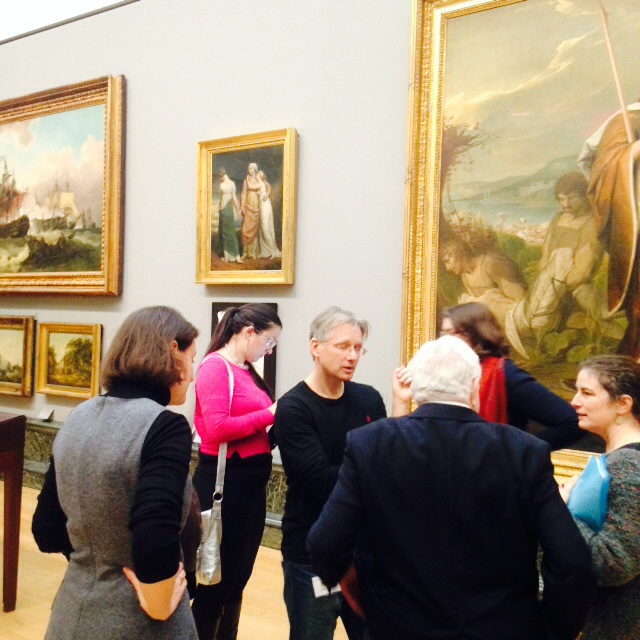
RIN 3 attendees in the Tate's galleries, in front of Barry's 'Lear'.

RIN 3 attendees in the Tate’s galleries, in front of Barry’s ‘Lear’.

We were then treated to guided tours of the Print Room and the Galleries by Assistant Curators Désirée de Chair and Clare Barlow. We looked at prints by Blake and Fuseli, as well as illustrated pages from Bell’s British Poets and a print of Barry’s ‘Lear and Cordelia’. In the galleries, we heard about Fuseli’s ‘Lady Macbeth seizing the daggers’, as well as looking closely at Barry’s enormous finished oil painting of Lear and the dead Cordelia.

After the presentation of the Bibliographical Society Studentship to Naomi Billingsley (Manchester) for her project on Blake and religious art, Martin Myrone spoke about gaps, misapprehensions, and questions of scale and authority in relation to the study of relationships between text and images, and between disciplines (such as literature, art history, book history, visual culture studies, theatre studies, etc). We rounded off the day with a discussion about the relationship between images, literature, and theatre, before heading to the White Swan for a companionable drink. The next symposium is on Saturday June 6th at the House of Illustration, and we are sure it will be as enjoyable and productive as this one! Keep an eye on the blog and the events page for details of the programme and registration.

Thoughts wanted: Eighteenth-Century Book Illustration Reader

From Dr. Christina Ionescu, Associate Professor Modern Languages and Literatures, Mount Allison University:

Dear colleagues,

Leigh G. Dillard and I are engaged in the planning stages of a reader on eighteenth-century book illustration that would encompass various traditions (English, French, German, Spanish, etc.). In order to best position the reader, we would be most grateful if those of you who work on book illustration (and perhaps also teach courses on the subject) could provide some feedback on our preliminary ideas.

You could write to us directly (cionescu@mta.ca and Leigh.Dillard@ung.edu) and we will compile a report for the SHARP list.

1) Would you use such a reader in a course? What type of course would you consider using it in? Would your library be interested in purchasing it?

2) Do you have any suggestions about its contents? Any specific texts that you believe should be included? Any translations of seminal texts that we should commission?

This is what is currently on our list:

i) some relevant excerpts from nineteenth-century texts (Dibdin, the Goncourt brothers, etc.)

ii) some reprints/translations of key chapters from important 1980s/1990s studies on eighteenth-century book illustration (Hodnett, Ph. Stewart, etc.)

iii) theoretical approaches to book illustration as it pertains to the chosen timeframe (e.g. book illustration and word and image, book illustration and book history, book illustration and visual culture, etc.)

iv) the mechanics of book illustration (etching, woodcut, copperplate engraving, frontispieces, colour plates, etc.)

v) illustrators (Stothard, Marillier, Chodowiecki, Gravelot, Hogarth, Cochin, etc.)

vi) genres (illustrated travelogues, gothic novels, sentimental fiction, erotica, etc.)

vii) examples of eighteenth-century illustrated bestsellers (The Sentimental Journey, La Nouvelle Héloïse, etc.)

viii) overviews by geographical region (illustration in England, France, Spain, etc.)

3) Would you be interested in contributing a chapter? (The deadline for submission of chapters will likely be December 2016.)

Many thanks,
Christina and Leigh
CFP: ‘Romanticism and the Arts’ SAMLA, Durham, North Carolina, USA (13-15 Nov. 2015)

Call for Papers
‘Romanticism and the Arts’
an affiliated session of the Keats-Shelley Association of America South Atlantic Modern Language Association Conference
Durham, North Carolina, USA (13-15 Nov. 2015)
Deadline: 15 May 2015

This panel seeks papers related to second-generation Romantic-era British writers and/or their literary circles, so proposals addressing the works of John Keats, Percy and Mary Shelley, Lord Byron, Leigh Hunt, and William Hazlitt will receive priority. Proposals that engage with the conference theme (“In Concert: Literature and the Other Arts”) are especially welcome. Subjects to be considered might include (but are not limited to) Romantic literature in relation to music, concerts, songs, painting, engravings, caricatures, drawings, panoramas, book arts, calligraphy, dance, theatre, opera, architecture, sculpture, china, pottery, ceramics, textiles, and, in later contexts, electronic art, film, and photography.

Please send a 250-word abstract, bio or CV (one page only), and audio-visual requests to Ben P. Robertson, Troy University, (bprobertson@troy.edu) by 15 May 2015.

QMCECS Seminar: ‘Exhibiting the Eighteenth Century’: 11 March 2015

Queen Mary Eighteenth-Century Studies Seminar 2014-2015
‘Exhibiting the Eighteenth Century’

Joint meeting with the IHR British History in the Long 18th Century Seminar
Wednesday 11 March 2015
Time: 5.15pm.
Venue: Clore Learning Centre, Kensington Palace State Apartments, Kensington Gardens, London W8 4PX

Joanna Marschner (Historic Royal Palaces), Moira Goff (The Garrick Club), Alex Werner (Museum of London).

The seminar will take place in the Clore Learning Centre at Kensington Palace at 5.15 p.m. and will be followed by a drinks reception. As usual the seminar is free and open to all, but as numbers are limited at the venue, you need to reserve a place by emailing Gillian Williamson (gswilliamson@virginmedia.com).

Download a map of Kensington Palace access.

Convenors: Prof Markman Ellis, English (m.ellis@qmul.ac.uk); Prof Colin Jones, History (c.d.h.jones@qmul.ac.uk); Prof Miles Ogborn, Geography (m.j.ogborn@qmul.ac.uk); Prof Amanda Vickery, History (a.vickery@qmul.ac.uk), Prof Barbara Taylor, English and History (b.g.taylor@qmul.ac.uk), Prof John Barrell, English (j.barrell@qmul.ac.uk).

For updates and more information, see our blog: <http://qmcecs.wordpress.com/

CFP: RIN panel at Romantic Imprints, BARS’ 2015 International Conference

Romantic-Imprints-image The deadline for submission of abstracts to the RIN panel at BARS 2015 approaches: February 15th.


Of particular interest for RIN members is the RIN panel ‘Romantic Illustration’: see the panels page on the BARS 2015 website here.

The full CFP is below:

———————————————————————————————————-

2nd Call for Papers: Romantic Imprints

British Association for Romantic Studies, 14th International Conference

Cardiff University, 16–19 July 2015

Proposals are invited for the 2015 British Association for Romantic Studies international conference which will be held at Cardiff University, Wales (UK) on 16–19 July 2015. The theme of the interdisciplinary conference is Romantic Imprints, broadly understood to include the various literary, cultural, historical and political manifestations of Romantic print culture across Europe, the Americas and the rest of the world. Our focus will fall on the ways in which the culture of the period was conscious of itself as functioning within and through, or as opposed to, the medium of print. The conference location in the Welsh capital provides a special opportunity to foreground the Welsh inflections of Romanticism within the remit of the conference’s wider theme. The two-hundredth anniversary of Waterloo also brings with it the chance of thinking about how Waterloo was represented within and beyond print.

The confirmed keynote speakers for Romantic Imprints will be John Barrell (Queen Mary, London), James Chandler (Chicago), Claire Connolly (Cork), Peter Garside (Edinburgh) and Devoney Looser (Arizona State).

The conference is open to various forms of format:  we encourage proposals for special open-call sessions and for themed panels of invited speakers as well as individual proposals for the traditional 20-minute paper. Subjects covered might include:

  • Nation and print: the British archipelago; cities of print; transatlantic and transnational exchanges; Romantic cosmopolitanism and print; translation; landscape and/in print; Wales and its Romantic contexts; national (especially Welsh) patterns of influence and exchange in the international context.
  • Producing and consuming print: Romantic readerships; publishers; circu­lating print; legislation, copyright and print; technologies of print; plagiarism, forgery and piracy; popular and subaltern cultures of print; periodicals and journalism; gender and genre; print as new and old, ephemeral and collectable objects; print beyond reading (paper money, cards, etc.); the fate of print as ‘rubbish’.
  • Intertextual exchanges: politics and print (e.g. revolution and radicalism, war, Napoleon, Waterloo); satire and parody; science and print culture; performance and print; Romantic visual cultures (including art and illustration); representations of print and printing; fashion; adaptation and remediation; the Romantic essay; print and its others – epitaphs, manuscripts, marginalia, etc.; print and imprint as Romantic metaphor or ideology; popular pastimes.
  • Textual scholarship: editing texts; bibliography and book history; manuscripts, correspondence and diaries; analysis and quantification; digital humanities.
  • Romantic legacies: physical traces and imprints; architecture; Romantic anti­quarianism; Victorian Romanticism; Romanticism and modernity; Romanticism and new media; Romantic biography; lives in print; Romantic afterlives; celebrity and print; adapting the Romantics (film, art, literature).

Format of conference proposals

  • Traditional 20-minute paper proposals (250-word abstracts), submitted individually.
  • Poster presentations showcasing innovative projects or digital outputs (250-word abstracts), submitted individually.
  • Proposals for open-call sessions (350-word descriptions of potential session, outlining its importance and relevance to the conference theme). Accepted open-call sessions will be advertised on the BARS 2015 conference website from mid-January 2015. Please note: the deadline for submission of open-call panels has now expired.
  • Proposals for themed panels of three 20-minute or four 15-minute papers (250-word abstracts for each paper with speakers’ details and an outline of the panel’s rationale from the proposer).

Extended deadline for submission of abstracts: 15 February 2015. Submissions can comprise proposals for individual papers, poster presentations and submissions to open-call panels (which will be published online from mid-January 2015). If you are applying to an open-call session, you should include the name of the session on your proposal.

All proposals should include your name, academic affiliation (if any), preferred email address and a biography of 100 words. Please send proposals and direct enquiries to the BARS 2015 conference organisers, Anthony Mandal and Jane Moore (Cardiff University) at BARS2015@cardiff.ac.uk.

For the latest updates about the conference, follow us on Twitter @2015BARS and join our Facebook group at https://www.facebook.com/groups/BARS2015/.

CFP – “Visual Print Culture in Europe 1500-1850”, Venice, December 2015

Visual Print Culture in Europe: techniques, genres, imagery and markets in a comparative perspective, 1500-1850

University of Warwick at: Palazzo Pesaro Papafava, Venice, Italy

December 5-6, 2015

Call for Papers – closing date June 1, 2015

universalmonarchie

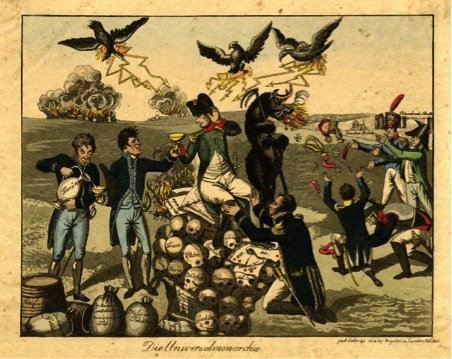
Under Napoleon’s Empire we find London acting as a hub for printing caricatures of Napoleon in a range of languages, and with a number of distinctive styles.  The above print, Die Universalmonarchie, for example, claims to have been published by Boydell & Co. in London in 1815, but the Boydells were based at Cheapside, not – as the print states – at Pall Mall (once the location of the late Josiah Boydell’s famous Shakespeare Gallery). The publication information would seem to be spurious and the British Museum suggests that it was likely published in Paris. Is this print, then, German, French, or even possibly English? Who exactly is its market? How far is its imagery tailored to a particular “national” audience and in what ways might it be distinctively comprehensible to such an audience? Besides London, what other European hubs were important, at what moments and why?

‘Visual Print Culture in Europe 1500-1850’ aims to draw together scholars with a range of disciplinary skills to discuss the methods, representational forms, and distribution of and audience for visual print media in Europe between 1500 and 1850.  Its seeks to de-nationalize the study of visual print culture, and to explore the extent to which interactions between engravers and printers, artists and consumers in Europe, and a range of common representational practices produced a genuinely European visual print culture – with local modulations, but nonetheless with a common core.

Papers can draw on a range of disciplinary backgrounds in exploring the exchange of techniques and processes, the analysis of imagery, and the identification of markets, and in analysing the conditions under which particular generic forms crossed or failed to cross national boundaries.  Although the emphasis is on European visual print culture, the impact of that culture on, and its interaction with, the wider world is also of interest.

The conference language will be English.

The Conference will be held at the University of Warwick’s Palazzo and conference centre in Venice, December 5-6, 2015.

The Conference organisers, acting under the European History Research Centre are:
Mark Philp, History, EHRC Director, Warwick  (mark.philp@warwick.ac.uk)
Kate Astbury, French Studies, Warwick
Mark Knights, History, Warwick
David Taylor, English, Warwick

Proposals for papers should be submitted to t.smith.2@warwick.ac.uk by June 1st 2015 but please feel free to contact Mark Philp in advance with any queries.

The conference may be able to provide some financial assistance to those whose home institutions are unable to support their attendance, especially postgraduate students.

CFP: The Romantic Eye (Yale, 17-18 April 2015)

Please see below for a Call for Papers for an exciting-sounding symposium on the Romantic Eye at Yale this April.  The organisers are particularly keen to secure contributions from early career scholars (including people working on their doctorates).  Flights and accommodation will be provided for those invited to speak, so if you’re working on a topic in this area, this could be a really great opportunity.

(Taken from the BARS blog)

— — — — —

The Romantic Eye, 1760–1860 and Beyond
April 17, 2015-April 18, 2015
Yale University
Yale-Conference-300x222

This symposium examines Romanticism as a shape-shifting cultural phenomenon that resists easy categorization. Focusing on the period from 1760 to 1860, the symposium embraces the amorphousness that has been ascribed to Romanticism historically by eschewing any limiting definition of it, seeking instead to explore the broad range of art and visual culture characterized as “Romantic” during this hundred-year span. We are interested in what the Romantic “eye” pursued and perceived, and how it set itself the task of recording those perceptions. In addition to interrogations of the relationship between the visual arts and Romanticism, we welcome papers on writers, composers, scientists, and philosophers whose projects engaged the visual. Papers also are sought for a special panel that will address the legacies of Romanticism in contemporary art.

This symposium coincides with a major collaborative exhibition organized by the Yale Center for British Art and the Yale University Art Gallery, The Critique of Reason: Romantic Art, 1760–1860, which opens March 6, 2015. The exhibition comprises more than three hundred paintings, sculptures, medals, watercolors, drawings, prints, and photographs by such iconic artists as William Blake, John Constable, Honoré Daumier, David d’Angers, Eugène Delacroix, Henry Fuseli, Théodore Géricault, Francisco de Goya, John Martin, and J. M. W. Turner. Talks that respond explicitly to works in the collections of the Yale Center for British Art or the Yale University Art Gallery are particularly encouraged, as are cross-disciplinary and comparative studies.

We are seeking presentations of thirty minutes in length. Graduate students and early career scholars are particularly encouraged to apply. Travel and accommodation costs will be covered by the organizers. Please e-mail abstracts of no more than three hundred words and a short CV or bio (no more than two pages) by February 2, 2015, to romanticism2015@gmail.com.

The symposium is cosponsored by the Department of the History of Art at Yale University, the Yale Center for British Art, the Yale University Art Gallery, and the Yale Student Colloquia Fund.

Third RIN Symposium ‘The Literary Galleries’: REGISTRATION OPEN

Romantic Illustration Network Symposium
The Literary Galleries: Entrepreneurship and Public Art’
Supported by the University of Roehampton, the Bibliographical Society, and Tate Britain

We are  pleased to announce that the third RIN symposium is now OPEN for REGISTRATION.

Friday 27th February 2015, 10am – 5pm
Board Room and Duffield Room, Tate Britain,
Millbank, London SW1P 4RG

This symposium brings together the authors of the key scholarship on the literary galleries of the Romantic period: Fred Burwick (The Boydell Shakespeare Gallery, 1996), Rosie Dias (Exhibiting Englishness, 2013), Ian Haywood (Romantic Caricature, 2013), Luisa Cale (‘Blake and the Literary Galleries’, 2008; Fuseli’s Milton Gallery 2006) and Martin Myrone (Gothic Nightmares, 2006; John Martin: Apocalypse, 2011) in a venue that is itself a form of literary gallery (Tate Britain) to present new research and to debate the relationship of painting to illustration, text, and print.  To what extent did the literary galleries change the role of illustration in the Romantic period?

Registration:

Places are FREE but limited to 15 in total, excluding speakers and organisers. This is due to restricted access to the Print Room. To secure your place, please email Mary.Shannon@roehampton.ac.uk, providing your name, status/job title, and institution (for name badges). Places will be awarded on a first-come, first-served basis and you will receive email notification. However, there will also be a waiting list. If you are unable to take up your place, please NOTIFY US BY EMAIL IN GOOD TIME so that someone else on the list may be offered your place.

We are able to offer 2 postgraduate ‘Bibliographical Society Studentships’ of £60 each to assist with the cost of attending at the symposium. Postgraduate students who live outside London are eligible. To apply, please send a CV and a statement (200 words) to Mary.Shannon@roehampton.ac.uk by Friday 6th February explaining your current research and its relevance to the interests of the Romantic Illustration Network as well as to the aims of the Bibliographical Society. Successful applicants will be notified by Tuesday 10th February.

Subject to permissions, we are hoping to record proceedings for the benefit of those unable to attend.

Programme:
10.00 Registration: meet at Staff Entrance (see map) to transfer to Board Room
10.15
Rosie Dias (Warwick), ‘Viewers, Patrons, Readers, Consumers? John Boydell’s Shakespeare Gallery and its Public’
Ian Haywood (Roehampton), ‘Macklin’s Poets Gallery and the age of Terror’
11.45 tea and coffee
12.15 Luisa Calè (Birkbeck), ‘The Hours’
1-2 Lunch (attendees to make own arrangements)
2.00 Frederick Burwick (UCLA), ‘Painting and Performance: Tableaux Vivants on the London Stage’
3pm Tours of Print Room and Galleries, led by Tate facilitators
4.00 Martin Myrone (Tate), ‘Blake and the Limits of Illustration’
4.45 Open Discussion
5pm Close. Please join us for a drink nearby.

For a full programme and a map of the venue, visit https://romanticillustrationnetwork.wordpress.com/events/