
Simon Grennan, Anthony Trollope, and Hay-on-Wye
Image
2
Ian Hislop, satirist, broadcaster, historian, and editor of Private Eye, chats to Roehampton’s Dr Mary L. Shannon about his new radio play ‘Trial by Laughter’ (co-written with Nick Newman) which dramatizes the trial of William Hone for libel in 1817, press freedom, and the importance of satirical images in the nineteenth century.
Click here to access the podcast and to get the full story.


Dear All,
Thank you so much for continuing to be part of the Romantic Illustration Network, and for following the RIN blog.
We are interested in how membership of RIN has impacted upon the work and interests of all our members who are not university academics: artists, illustrators, independent scholars and everyone with a general interest in visual culture and/or illustration etc.
Has a post on this site generated any new ideas for you? Have you visited an exhibition advertised on the blog? Have you been inspired by something you heard about via RIN? We’d love to hear from you!
Drop me a sentence or two at Mary.Shannon@roehampton.ac.uk, and I will make sure future posts contain more of the info that you find useful and exciting.
AHRC Collaborative Doctoral Partnership: Fully-funded PhD studentship
Modern Mistresses on the Old Masters: nineteenth-century women writers on western European art – their networks and influence
Birkbeck, University of London (School of Arts)
The National Gallery, London
Application Deadline: 12 noon, 22nd April 2016.
Applications are invited for an AHRC-funded PhD studentship on the role of women as disseminators of knowledge about the Old Masters, focusing especially on those who induced a greater interest in the collection at Trafalgar Square. It explores the social and cultural history of the Gallery’s present-day efforts to democratize access to its collections and reach new audiences by examining the understudied critical and art-historical writings of nineteenth-century women, which typically had a more popular reach than that of their male counterparts while also speaking to specialists, then and now.
This studentship is one of a number awarded to the National Gallery, as part of the AHRC’s new Collaborative Doctoral Partnership Scheme.
The supervisors of the project have identified the following issues for research, although the student has the scope to develop both the topic and approach, in conjunction with the supervisors.
What contribution did Victorian women writers make to scholarship on the Old Masters in the National Gallery’s collection? Did women tend to write about particular artists and periods, and if so why? Did their work affect the canon? How was their work received, and what was its reputation? What has been the subsequent fortuna critica? How might it speak to modern audiences?
Through what networks were these women connected with the National Gallery? How important to their success were such networks and relationships? To what extent did these women’s writings affect acquisition and collecting behaviours at the National Gallery and in the private sphere? Were their opinions taken seriously by the institutional art world? What forms did the work of women writers take, and to what audiences was it was addressed? What was the effect of their cross over between different genres and media? What was the role of the penny press in widening access to the Old Masters in the mid nineteenth century? Were women writers interested in the role of the National Gallery and other art institutions as places of advocacy for mass education?
This project will be supervised by Professor Hilary Fraser, Geoffrey Tillotson Chair in Nineteenth-Century Studies and Dean of Arts at Birkbeck, University of London, whose recent work focuses on women writers and the emergence of art history in the nineteenth century, and Dr Susanna Avery-Quash, Senior Research Curator in the History of Collecting at the National Gallery, whose research interests encompass the history of important private and public art collections.
This studentship will provide the student with invaluable academic skills and experience of working in a major national art museum, as well as deep understanding of women and nineteenth-century approaches to the Old Masters. It will involve the student in a range of interdisciplinary research activities, drawing on archival and primary textual material, various types of art collections and the resources of the National Gallery and Birkbeck.
In addition to working directly on the PhD thesis, it is envisaged that the student will also be engaged in a range of related activities, such as the delivery of research papers, assisting with conference organization, and contributing to a Room 1/Sunley Room exhibition at the National Gallery. She or he will also be expected to play a full role in the research cultures of both institutions.
For application details, please visit:
http://www.bbk.ac.uk/arts/research/research-bursaries-studentships-funding/ahrc-collaborative-doctoral-award-fully-funded-phd-studentship
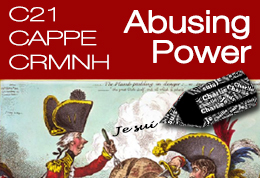 Abusing Power: The Visual Politics of Satire
23rd Sep 2016 9:00am – 24th Sep 2016 6:00pm
Brighton Museum and Pavilion
A conference organised by the University of Brighton in association with the Royal Pavilion and Brighton Museum. Abstracts due: 9th May 2016
Speakers include:
Steve Bell, political cartoonist
Martin Rowson, political cartoonist
Professor Ian Haywood, University of Roehampton
The Curator of the Cartoon Museum, London
The Curator of Fine Art at the Royal Pavilion Museums
In January 2015, 12 of France’s most familiar cartoonists were shot dead in Paris. The aftermath of the attack on Charlie Hebdo raises significant questions about the status and the potential impact of an image and gives this conference a political urgency. The events in Paris underline both the power of the political cartoonist and the dangers of causing offence to political and religious sensibilities.
In 1820, George Cruikshank and his brother Robert were summoned to Brighton Pavilion by George IV, in an attempt to buy them off from reproducing their salacious satirical cartoons. They were paid off, but continued to produce scurrilous images of the royal family and political figures. The Royal Pavilion now houses one of the best collections of Cruikshank, Hogarth and Gillray in the world, three of the most eminent caricaturists in visual history.
The city of Brighton and the University have a long history of association with cartoon and caricature. This conference offers the opportunity to celebrate the rich history of caricature and cartoons associated with Brighton and to address the important ethical questions that now confront the contemporary cartoonist. It celebrates the rich collections of Cruikshank, Gillray and Hogarth at the Brighton Pavilion and brings together the expertise of practitioners, curators, academic historians and cultural analysts. The conference draws upon the research expertise of the University, on the curatorial experience of museum staff and on cartoonists who currently practice.
This conference is organised by three research groupings from the College of Arts and Humanities at the University of Brighton, the Centre for Applied Philosophy Politics and Ethics, the Centre for Research in Memory, Narrative and Histories and C21: Research in Twenty-First Century Writings, which allows for the interdisciplinary focus that the subject merits.
We invite proposals (c300 words) for both papers and panels on topics which may include, but are not limited to:
Comedy and ethics – what are the responsibilities of a cartoonist? || The curation of cartoons – what should be kept? || How far can you go? Are there limits to what a cartoonist can lampoon? || The legacies of Cruikshank, Gillray and Hogarth || Religion and caricature || Representations of history through cartoon || The impact of caricature on popular ideas of politics || Celebrity and caricature || In what contexts does satire flourish and why? || Is satire necessary?
DEADLINE: Email your proposal and short bio to C21Writings@brighton.ac.uk by 9th May 2016
Scrambled Messages Symposium: Frazzled and Dazzled
Friday April 29th 2016
Organised by: Prof. Caroline Arscott, The Courtauld Institute of Art
Free admission
Advanced booking required via eventbrite
Frazzled and Dazzled brings together scholars from literature, art history, media studies and archaeology to focus on the flow of data and scrambling of information as historical sites take on new functions, imagery reaches new audiences and social and natural appearances are understood to be liable to blur and deceive. Nineteenth-century instances are considered alongside key contemporary phenomena. The day will offer broad-ranging discussions of photography, newspaper illustration, and other aspects of communications technology as well as the bafflements and reveals to be found in Victorian detective fiction and evolutionary theory. This symposium is organised by the research project ‘Scrambled Messages: the Telegraphic Imaginary, 1858-1900’ funded by the AHRC and focusing on the cultural effects of telegraphic technology.
Please see http://courtauld.ac.uk/event/frazzled-and-dazzled for further details and booking.
Sequential narration in satiric prints is most famously associated with the “modern moral subjects” of William Hogarth (1697–1764): Harlot’s Progress (1732), A Rake’s Progress (1735), Marriage A-la-Mode (1745), and Industry and Idleness (1747) among others. 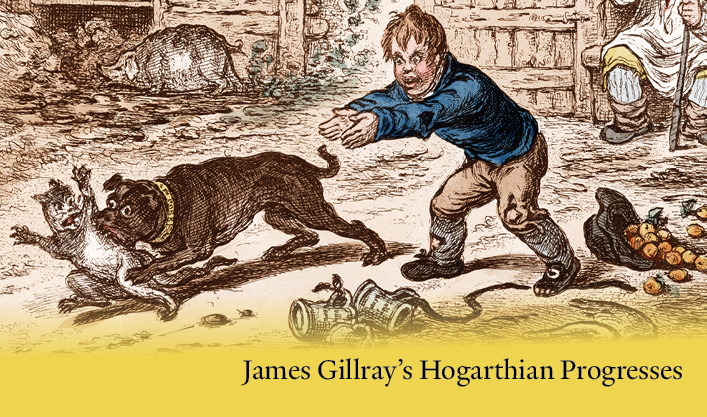 Less well-known is the broad spectrum of legacy “progresses” produced by subsequent generations drawing both on Hogarth’s narrative strategies and his iconic motifs. James Gillray (1756–1815), celebrated for his innovative single-plate satires, was also among the most accomplished printmakers to adopt Hogarthian sequential narration even as he transformed it according to his unique vision. This exhibition presents a number of Gillray’s Hogarthian progresses alongside some selected prints by Hogarth himself.
Curated by Cynthia Roman, Curator of Prints, Drawings, and Paintings, The Lewis Walpole Library.
Exhibition open Wednesdays, 2-4:30 pm, and by appointment
Further information about the exhibition and associated programming

BBC Radio 4 drama ‘Trial by Laughter’ is now available on iplayer for just over 20 days.
Written by Ian Hislop (the editor of Private Eye and a team captain on ‘Have I got News for You’) and his long-term collaborator Nick Newman (a satirical cartoonist for The Sunday Times and Private Eye), ‘Trial by Laughter’ is a comedy drama based on the real transcripts of the trial of William Hone in 1817.
William Hone is the forgotten hero of free speech in Britain. He was a bookseller, publisher, printshop-owner and satirist – George Cruikshank was his friend and collaborator . In 1817, he stood trial for ‘impious blasphemy and seditious libel’. His crime was to be funny. Worse than that he was funny by parodying religious texts. And worst of all, he was funny about the despotic government and the libidinous monarchy.
Original music by Conrad Nelson
Director/Producer Gary Brown
For clips, the cast list, and background information on the trial, see http://www.bbc.co.uk/programmes/b071h2x6.
Click here to read Nick Newman’s article on Cruikshank and Hone for the BBC website.
For information on the William Hone collection at Adelphi University, USA, see http://libraries.adelphi.edu/archives-and-special-collections/special-collectionsfinding-aids/hone-collection/.
Birkbeck Forum for Nineteenth-Century Studies
Spring 2016 Programme
The first event of the spring term for the Birkbeck Forum for Nineteenth-Century Studies will feature Marta Weiss (Victoria & Albert Museum) presenting on ‘Julia Margaret Cameron: New Discoveries’ with Colin Ford (Former head of the National Museum of Photography, Film and Television) responding. This event is presented in collaboration with the History and Theory of Photography Research Centre at Birkbeck, and will take place Tuesday 26 January 2016 from 6.00pm to 8.00pm in the Keynes Library, 43 Gordon Square, London, WC1H 0PD.
This seminar will explore the new material Martha Weiss discovered while researching the current must-see exhibition at the Victoria and Albert Museum, marking the bicentenary of the birth of Julia Margaret Cameron, 150 years after she first exhibited her work there. Colin Ford has worked extensively on this important photographer, most notably in the comprehensive catalogue Julia Margaret Cameron: Complete Photos (Getty, 2002).
The session is free and all are welcome, but since the venue has limited space it will be first come, first seated.
For further information on the exhibition, see: http://www.vam.ac.uk/content/exhibitions/julia-margaret-cameron/about-the-exhibition/
Download Julia Margaret Cameron: Complete Photos (Getty, 2002) here: http://www.getty.edu/publications/virtuallibrary/0892366818.html
For further information on the History and Theory of Photography Research Centre, see: http://www.bbk.ac.uk/arts/research/photography
For further information on the Birkbeck Centre for Nineteenth-Century Studies, see: http://www.cncs.bbk.ac.uk/
From the Birkbeck 19th C Forum website:
‘We are pleased to announce that audio recordings of Keynote Lectures are now available for ‘The Arts and Feeling in Nineteenth-Century Literature and Culture’, a major international conference which took place at Birkbeck, University of London, 16-18 July 2015.
The conference explored the ways in which nineteenth-century authors, artists, sculptors and musicians imagined and represented emotion and how writers and critics conceptualised the emotional aspects of aesthetic response. It aimed to map the state of the field in this growing area of interest for nineteenth-century scholars by locating recent interdisciplinary work on sentimentality and art and writing and the senses within wider debates about the relationship between psychology and aesthetics in the long-nineteenth century.
Speakers investigated the physiology and psychology of aesthetic perception and the mind/body interactions at play in the experience of a wide range of arts. Key questions included: How did Victorian artists represent feeling and how were these feelings aestheticised? What rhetorical strategies did Victorian writers use to figure aesthetic response? What expressive codes and conventions were familiar to the Victorians? Which nineteenth-century scientific developments affected artistic production and what impact did these have on affective reactions?’
To access the recordings and abstracts, click here.
 Romantic Illustration Network