RIN members: request for help

Banner2

Dear All,

Thank you so much for continuing to be part of the Romantic Illustration Network, and for following the RIN blog.

We are interested in how membership of RIN has impacted upon the work and interests of all our members who are not university academics: artists, illustrators, independent scholars and everyone with a general interest in visual culture and/or illustration etc.

Has a post on this site generated any new ideas for you? Have you visited an exhibition advertised on the blog? Have you been inspired by something you heard about via RIN? We’d love to hear from you!

Drop me a sentence or two at Mary.Shannon@roehampton.ac.uk, and I will make sure future posts contain more of the info that you find useful and exciting.


Symposium, The Courtauld Institute of Art: Frazzled and Dazzled

Scrambled Messages Symposium: Frazzled and Dazzled

Friday April 29th 2016

Organised by: Prof. Caroline Arscott, The Courtauld Institute of Art

Free admission

Advanced booking required via eventbrite

Frazzled and Dazzled brings together scholars from literature, art history, media studies and archaeology to focus on the flow of data and scrambling of information as historical sites take on new functions, imagery reaches new audiences and social and natural appearances are understood to be liable to blur and deceive.  Nineteenth-century instances are considered alongside key contemporary phenomena.  The day will offer broad-ranging discussions of photography, newspaper illustration, and other aspects of communications technology as well as the bafflements and reveals to be found in Victorian detective fiction and evolutionary theory.  This symposium is organised by the research project ‘Scrambled Messages: the Telegraphic Imaginary, 1858-1900’ funded by the AHRC and focusing on the cultural effects of telegraphic technology.

Please see http://courtauld.ac.uk/event/frazzled-and-dazzled for further details and booking.

Hone and Cruikshank: BBC Radio 4 Drama by Ian Hislop ‘Trial by Laughter’ now on iplayer

The Gamecock of Guildhall

BBC Radio 4 drama ‘Trial by Laughter’ is now available on iplayer for just over 20 days.

Written by Ian Hislop (the editor of Private Eye and a team captain on ‘Have I got News for You’) and his long-term collaborator Nick Newman (a satirical cartoonist for The Sunday Times and Private Eye), ‘Trial by Laughter’ is a  comedy drama based on the real transcripts of the trial of William Hone in 1817.

William Hone is the forgotten hero of free speech in Britain. He was a bookseller, publisher, printshop-owner and satirist – George Cruikshank was his friend and collaborator . In 1817, he stood trial for ‘impious blasphemy and seditious libel’. His crime was to be funny. Worse than that he was funny by parodying religious texts. And worst of all, he was funny about the despotic government and the libidinous monarchy.

Original music by Conrad Nelson
Director/Producer Gary Brown

For clips, the cast list, and background information on the trial, see http://www.bbc.co.uk/programmes/b071h2x6.

Click here to read Nick Newman’s article on Cruikshank and Hone for the BBC website.

For information on the William Hone collection at Adelphi University, USA, see http://libraries.adelphi.edu/archives-and-special-collections/special-collectionsfinding-aids/hone-collection/.

Researching visual, print and material culture in the UK?

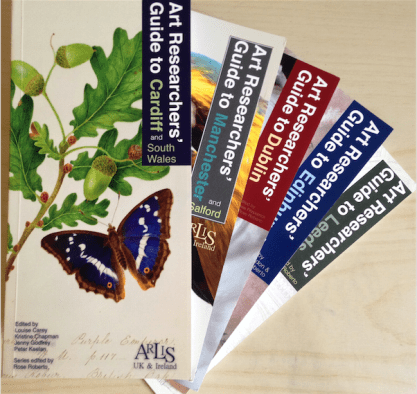
ArtResearchersGuidesLibrarians and archivists around Edinburgh, Dublin, Manchester, Leeds, Cardiff and South Wales, and Liverpool (coming in October 2016) have put together guidebooks that take researchers to treasures such as letters between Cruickshank and his publishers,  centuries-old sketches featuring Kirskstall Abby, and photos of the Cottingley Fairies.  There are botanical illustrations so realistic you feel compelled to stroke petals and illuminated maps, manuscripts and charters with the paintings of Queen Elizabeth I, whose elaborate signature officially classifies as a work of art itself.  Many of these gems are not online.

“These are handy, well designed little booklets,” says art historian, Mark Westgarth, “loosely drawing on the format of the ubiquitous city tourist guides.  They are portable, user friendly and fit in a coat pocket.”

“All these cities have fantastic collections on architecture, design and history broadly defined, but researchers don’t know how to get their hands on everything they might need — this guide helps solve that problem,” says Rose Roberto, book historian at the University of Reading and series editor.

Introductions to each guide have been written by leading scholars such as Christine Casey and Ben Read.  Through a visual narrative, all guides point the way to libraries and repositories with unique and under used resources.  Indexed by over 80 subjects, all guides include citywide maps, navigation icons, and a time-saving subject index to collections and colour images of each place.

“What makes these guides useful is the map and index.  If you’re doing research on fashion history, for example, the visual index shows which places have the right material, and whether it’s a book, archives, or audiovisual format,” says Racher Myers, former design librarian at Leeds University.

Published by the Art Libraries Society of the UK and Ireland (ARLIS), these  pocket sized guides range in price from £4.50-£8.00 each.  The books are available as a set or individually from the ARLIS website, http://arlis.org.uk/periodicals-libraries-sources/publications as well around the different cities featured in the Art Researchers’ Guide series.

A Christmas Workshop: RIN/House of Illustration Partnership

Anna Glendenning is a PhD candidate from Roehampton’s Centre for Research in Romanticism, who works on caricature. She reports here on the Romantic Illustration Network’s collaboration with the House of Illustration on a workshop for Y8 pupils, supported by the University of Roehampton.

On Thursday 3rd December, the House of Illustration in King’s Cross London was home to an exciting day of collaboration between local schoolchildren, RIN member Dr. Mary L. Shannon from the University of Roehampton, and professional illustrator Merlin Evans.

A group of thirty girls aged 12-13 (from Elizabeth Garrett Anderson School in Islington) braved a suitably chilly winter’s morning to visit the House of Illustration, where they immersed themselves in a special workshop on Dickens’s A Christmas Carol .  I also got to help out: it was hugely enjoyable to be part of such an inspiring day of interdisciplinary fun. For the full photostory, see http://www.roehampton.ac.uk/Courses/English-and-Creative-Writing/News/There-s-no-Bah-Humbug-this-Christmas-for-pupils-at-illustration-workshop/.

Dickens’ text has long been a favourite in English classrooms, but it was the aim of this collaboration to give the girls a unique opportunity to explore the crucial role of illustrations – both conceptually and creatively – with two experts.

The HOI’s learning programme, with Head of Education Emily Jost at its helm, is dedicated to bringing illustrations into the limelight. Its core aim is to enhance knowledge of and confidence in visual communication for all. The Romantic Illustration Network (RIN) shares this enthusiasm. RIN’s project to restore the importance of visual culture in the Romantic period involves a commitment to sharing and to promoting access to the research it undertakes.

Mary Shannon, who specializes in Victorian print culture and is a Dickens expert, led a lively session. By contrasting different illustrations of Scrooge with Dickens’s narrative, trying out their own sketches, and learning from Shannon about Victorian Christmas traditions, the girls contributed lots of compelling thoughts and critiques, expanding their understanding of the relationship between illustrations and Dickens’s text.

After taking a look at the House of Illustration’s current exhibition, the girls returned to the studio for a special session with Merlin Evans. Evans brought in tools from her trade and shared some different techniques of collage-making and line work to help the girls to get to grips with the material qualities of producing images. The girls rummaged through photocopies of Victorian illustrations and had the chance to try out the new drawing methods Evans had demonstrated. The results were exquisite. The girls were able to compare their work with the earlier sketches they had made – a great way to show how their understanding of Scrooge’s character had developed over the course of the workshop, and, hopefully, to boost their illustration skills and confidence into the future.

Future collaborative workshops involving RIN’s Professor Ian Haywood (Roehampton) and Dr Susan Matthews (Roehampton) are in the pipeline, so watch this space in the New Year!

Anna Glendenning

Pre-Raphaelite Fellowship: A Joint Fellowship from the University of Delaware Library and the Delaware Art Museum

Pre-Raphaelite Fellowship: A Joint Fellowship from the University of Delaware Library and the Delaware Art Museum

Deadline: November 1, 2015

The University of Delaware Library, in Newark, Delaware, and the Delaware Art Museum are pleased to offer a joint Fellowship in Pre-Raphaelite studies. This short-term, one-month Fellowship, awarded annually, is intended for scholars conducting significant research in the lives and works of the Pre-Raphaelites and their friends, associates, and followers.  Research of a wider scope, which considers the Pre-Raphaelite movement and related topics in relation to Victorian art and literature, and cultural or social history, will also be considered. Projects which provide new information or interpretation—dealing with unrecognized figures, women writers and artists, print culture, iconography, illustration, catalogues of artists’ works, or studies of specific objects—are particularly encouraged, as are those which take into account transatlantic relations between Britain and the United States.

Receiving the Fellowship:
The recipient will be expected to be in residence and to make use of the resources of both the Delaware Art Museum and the University of Delaware Library. The recipient may also take advantage of these institutions’ proximity to other collections, such as the Winterthur Museum and Library, the Philadelphia Museum of Art, the Princeton University Library, and the Bryn Mawr College Library. Each recipient is expected to participate in an informal colloquium on the subject of his or her research during the course of Fellowship residence.

Up to $3,000 is available for the one-month Fellowship. Housing may be provided. Personal transportation is recommended (but not mandatory) in order to fully utilize the resources of both institutions.

The Fellowship is intended for those who hold a Ph.D. or can demonstrate equivalent professional or academic experience. Applications from independent scholars and museum professionals are welcome. By arrangement with the Yale Center for British Art, New Haven, CT, scholars may apply to each institution for awards in the same year; every effort will be made to offer consecutive dates.

To Apply:
Send a completed application form, together with a description of your research proposal (maximum 1 page) and a curriculum vitae or resume (maximum 2 pages) to the address given below. Letters of support from two scholars or other professionals familiar with you and your work are also required. These materials may also be sent via email to: fellowships@delart.org.
Pre-Raphaelite Fellowship Committee Delaware Art Museum 2301 Kentmere Parkway Wilmington, DE 19806
Application Form: http://www.delart.org/about/opportunities/#preraphfellowship Important Dates:
The deadline to apply for the 2016 Fellowship is November 1, 2015. Notification of the successful applicant will be announced by December 1, 2015. The chosen candidate will then be asked to provide a date for assuming the Fellowship by January 1, 2016.
If you have any questions or would like to request more information, please contact:
Margaretta S. Frederick Pre-Raphaelite Fellowship Committee Direct line: 302.351.8518 E-mail: fellowships@delart.org

Romantic London: new digital project

Romantic London is a research project by Dr Matthew Sangster (Birmingham) exploring life and culture in London around the turn of the nineteenth century using Richard Horwood’s pioneering ‘PLAN of the Cities of LONDON and WESTMINSTER the Borough of SOUTHWARK, and PARTS adjoining Shewing every HOUSE’ (published between 1792 and 1799). It considers the ways in which the writers and works later grouped under the umbrella of Romanticism interacted with London’s communities and institutions while also examining a wide range of alternative approaches to representing and organising urban existence.

The site is based around a digital version of Horwood’s Plan laid over and georeferenced to modern maps of the city; this allows for detailed examinations and comparisons. As well as considering the Plan and its creator, the site is using Horwood’s work as a means of thinking about the ways in which writers, publishers and artists sought to communicate insights into London’s general character and particularities. By using Horwood’s Plan as a base map and adding other kinds of information to it using annotated markers, the site reflects upon the social, geographical and aesthetic assumptions made in late eighteenth- and early nineteenth-century attempts to make sense and art of the burgeoning metropolis.

Texts brought into conversation with Horwood’s Plan on the site at present include:
•Entries from the dual-language New Guide for Foreigners prepared around 1790 and sold by the printseller S.W. Fores from his shop opposite the Paris Diligence office.
•Descriptions and images from Modern London, an 1804 publication put together by the radical publisher Richard Phillips, which included two sets of plates of the city, one showing major landmarks, the other showing itinerant traders hawking their wares in more out-of-the-way locations.
•The lavish aquatints from Rudolf Ackermann’s Microcosm of London (1808-10), engraved from collaborations between the artist and architectural draftsman Auguste Charles Pugin and the uproarious caricaturist Thomas Rowlandson.
•The text of the 1788 edition of Harris’s List of Covent-Garden Ladies, a disreputable register of London prostitutes.

The site at present is a work in progress; there are a great number of additions still to be made. You can follow the changes and developments on the site’s blog.

CFP: “Tracing Types: Comparative Analyses of Literary and Visual Sketches (1830-1860)”, Ghent University Belgium, 3-4 June 2016.

“Tracing Types: Comparative Analyses of Literary and Visual Sketches (1830-1860)”, Ghent University Belgium, 3-4 June 2016.

Deadline for abstracts: October 1, 2015

In the wake of the pioneering work of Nathalie Preiss and Martina Lauster, a new wave of scholarship has emerged in recent years, which examines nineteenth-century sketches (sometimes referred to as ‘panoramic literature’) from a transnational perspective.

Two recent examples of this interest are the special issue of Interférences littéraires, “Croqués par eux-mêmes. La société à l’épreuve du panoramique” (2012), directed by Nathalie Preiss and Valérie Stiénon, and the recent NYU conference “Dissecting Society: Periodical Literature and Social Observation (1830-1850)” (March 2015), organized by Christiane Schwab and Ana Peñas Ruiz.

The present call for papers seeks to continue this comparative reflection by placing the spotlight on the comparative analysis of texts and images of specific types and by tracing how these representations vary across sketches from different places, media and editorial contexts.

We welcome presentations that address the following types of questions:

– How do the representations and definitions of a type (or group of related types) vary from one national context to another?
– How do different collections, periodicals or editorial contexts inflect a type in different ways?
– How do visual representations of a type differ from one another or from literary representations of the same figure?
– How does the type transform as it is taken up in other genres, registers or types of discourse?
– Does the type exist in a system? Does it belong to a collection or series of types and if so, how does it relate to or interact with other types in the system? How do different collections position the type within their systems?
In short, we invite each participant to choose a type (or group of related types) and to trace how it shifts or remains the same across different contexts and in relation to different co-texts. Presentations that explore less known types are particularly welcome.

The long term goal of this project is to publish an edited volume exploring these issues. It is our hope that the combined insights of the seminar will allow us to draw a series of general reflections about how portrayals of types shift across contexts, borders and media.

We would like to invite expressions of interest in the form of a short abstract (of around 300 words in English or French) describing your idea. Please submit your idea to Leonoor Kuijk at l.kuijk@ugent.be by October 1, 2015.

http://www.tracingtypes.ugent.be/

Organizers: Leonoor Kuijk, Elizabeth Amann and Marianne Van Remoortel (Ghent University), Valérie Stiénon (Université Paris 13)

NEW Online Resource: The Romantic Illustration Network Shakespeare Gallery

Announcing: The Romantic Illustration Network Shakespeare Gallery
 
Ready for the 2016 anniversary of Shakespeare’s birth, the Romantic Illustration Network is delighted to announce its digitisation of prints from Boydell’s Shakespeare Gallery, courtesy of negatives provided by Professor Frederick Burwick (UCLA).
 
The Boydell Shakespeare Gallery was open to the public on London’s Pall Mall from 1789 to 1805. Featuring paintings of scenes from Shakespeare by major artists of the day, including Fuseli, Reynolds, and Kauffmann, the gallery was a popular if not a financial success.
 
Prints of the paintings were published in volumes (as well as in an illustrated edition of Shakespeare), and are now digitised here by the University of Roehampton for use under a Creative Commons license. Images are arranged alphabetically by play, and new plays will be added over the coming months, so do keep checking back on the site. We have also digitised the front matter from the volumes.
 
Click on the thumbnails to access larger versions of the images, and to view the full-sized image. Once you have clicked on a thumbnail there is space to add comments on each image, and we very much encourage you to do so.
 
If you have any feedback, questions, or suggestions, please do let us know.
 

Event Report: ‘The Art of Quotation and the Miniaturised Gallery’, RIN 4, Saturday 6 June 2015

The fourth Romantic Illustration Network symposium took place at the House of Illustration on Saturday the 6th of June. Once again the event was well-attended with a friendly mix of regulars and new faces, local and international.house-of-illustration-logo-kids-in-the-halls-column-arts-agency
We had two inter-related themes for the symposium:

1.Miniaturization: Drawing on Peter Otto’s work on virtual culture in the Romantic period, is the illustration a form of virtual gallery? How does visual meaning change when an image is resized?
2.The Art of Quotation: How were literary quotations used to conceptualise visual images? How important are framing devices to the meaning of an image?

However, speakers were free to interpret the terms ‘quotation’ and ‘miniaturised gallery’ in any way they saw fit, and to raise any other questions they chose.

We kicked off with David Worrall (Roehampton/Nottingham Trent) who presented us with his concept of ‘locations of curation’. After crediting William St Clair in RIN 3 for inspiring his quest for a new theory of illustration, Worrall explored what he described as two currently disconnected narratives – Romanticism and eighteenth-century theatre – to consider the changing moments when images interact with other objects, such as the people who view them. He used the example of theatrical portraits to demonstrate how images moved from stage, to page, to prints, to household objects.

Susan Matthews’s (Roehampton) paper interrogated questions of scale, domesticity, and artistic encounter, the idea of ‘meeting’ an artist though their illustrations. She pointed out that the name ‘House of Illustration’ (as opposed to ‘Gallery of Illustration’) is significant: we often seem to want to give illustration a ‘home’. She focused on Fuseli’s illustrations to an edition of Cowper’s popular poem The Task (1785), and revealed the awkward tensions between Fuseli’s depictions of domestic scenes and Cowper’s lines, whilst also showing that Fuseli could produce powerful images on a small scale when he really wanted to. Matthews drew parallels between Fuseli’s techniques and the recent exhibition of Paula Rego’s work at House of Illustration.
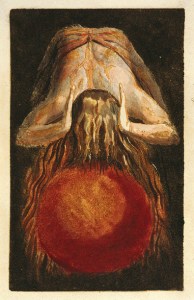
urizen_a_p11-17_100

Plate 17, The Book of Urizen William Blake Archive

From here we zoomed in still further, with Peter Otto’s (Melbourne) paper on plate 17 of Blake’s The Book of Urizen (1794). Otto gave a detailed and original reading of the plate which encompassed The Terror and images of decapitation by guillotine, the story of Adam and Eve, Perseus and the Gorgon, and the Narcissus myth to show how the plate connects primal history with events unfolding in the present through an art of visual and textual quotation. He argued that the plate illustrated a turning point in society, represented as a decapitation, and that Blake was constructing an imagined reality through quotation which in turn tries to shape or frame what reality is.

From royal executions to royal collections, Kate Heard (Royal Collection) showed us how George III and George IV both engaged with the reproductive print market, albeit in very different ways, as prints enabled middle-class consumers to gain access to items in the Royal Collection. We saw how Royal Collection items circulated as prints, so much so that satirical caricaturists could imitate them, and she argued that the print market played a crucial role in the public sense of the King. We also saw what a fantastic resource the Collection is for scholars.

Taking us through to the Victorian period, Bethan Stevens (Sussex) spoke about her work on the albums of proofs put together by the dominant mid-century London wood-engraving firm, the Dalziel family. The firm of Dalziel produced the illustrations to a vast range of literary and non-literary texts, including such classics as the Alice books and Tennyson’s Idylls of the King. Stephens showed how, in the albums, the exclusion of words affects the status, form and narrative of illustration, and provokes a new attention to illustrations as images which enables all kinds of subversive and intriguing readings.

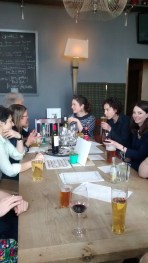
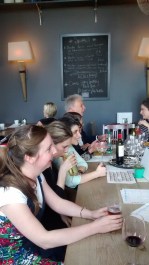
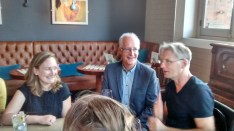
Three Bibliographical Society Studentships were awarded: Anne Musset (Warwick/Paris-Diderot), Tessa Kilgariff (National Portrait Gallery/Bristol), and Naomi Billingsley (Manchester). We ended the day, as usual, with a period of open discussion about the broader themes of the event and the future of the network (upcoming ventures include the panel at BARS 2015 in Cardiff and the digitised Shakespeare Gallery, currently under construction). After that we adjourned to the pub, to round off a successful and fun day with a friendly drink.

Details of the BARS panel will be appearing on the blog and website soon: we hope to see you there!
IMG_20150606_180246993IMG_20150606_180306094_HDRIMG_20150606_180236143