Event Report: ‘The Literary Galleries: Entrepreneurship and Public Art’, RIN 3, Friday 27 February 2015, Tate Britain

The third ‘Romantic Illustration Network’ symposium took place on Friday 27th February at the Tate Britain. Podcasts of the talks will be available on the website next week.

This symposium brought together the authors of the key scholarship on the literary galleries of the Romantic period: Fred Burwick (The Boydell Shakespeare Gallery, 1996), Rosie Dias (Exhibiting Englishness, 2013), Ian Haywood (Romanticism and Caricature, 2013), Luisa Calé (‘Blake and the Literary Galleries’, 2008; Fuseli’s Milton Gallery 2006) and Martin Myrone (Gothic Nightmares, 2006; John Martin: Apocalypse, 2011) in a venue that is itself a form of literary gallery (Tate Britain) to present new research and to debate the relationship of painting to illustration, text, and print.  To what extent did the literary galleries change the role of illustration in the Romantic period?

RIN 3 attendees at the tea break, enjoying tea and pastries.

RIN 3 attendees at the tea break, enjoying tea and pastries.

Martin Myrone, Lead Curator in Pre-1800 British Art, welcomed everyone to the Tate, before we heard from our first speakers: Rosie Dias and Ian Haywood. Dias showed us how the location of Josiah Boydell’s shop on Cheapside and Shakespeare Gallery in Pall Mall fitted in to the cultural geography of 18th century London. She drew upon Luisa Calé’s work to demonstrate that at the Shakespeare gallery the textual and the visual – the catalogue of Shakespeare extracts and the paintings themselves – were presented as autonomous realms that could be separated or united at will, and that attendees could choose by their physical actions to be either readers or spectators.

Ian Haywood gave a paper on Macklin’s shop the Poets’ Gallery and his exhibition and publication Gallery of British Poets. He presented a subversive close reading of the text and images published in 1794 in the fourth issue, at the height of the Terror in Paris. Luisa Calé gave a fascinating analysis of Maria Cosway’s ‘The Hours’ (the lead image on the RIN blog).

After lunch all together in the Tate café, Fred Burwick gave a paper on tableaux vivants, which argued that the stage was a kind of literary gallery in the early nineteenth-century, as artists and dramatists recreated famous paintings on stage, and in some instances turned narrative paintings into plays.
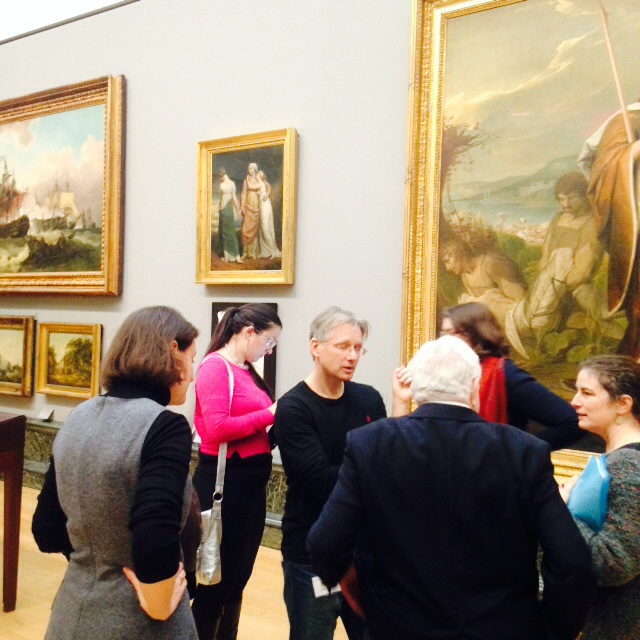
RIN 3 attendees in the Tate's galleries, in front of Barry's 'Lear'.

RIN 3 attendees in the Tate’s galleries, in front of Barry’s ‘Lear’.

We were then treated to guided tours of the Print Room and the Galleries by Assistant Curators Désirée de Chair and Clare Barlow. We looked at prints by Blake and Fuseli, as well as illustrated pages from Bell’s British Poets and a print of Barry’s ‘Lear and Cordelia’. In the galleries, we heard about Fuseli’s ‘Lady Macbeth seizing the daggers’, as well as looking closely at Barry’s enormous finished oil painting of Lear and the dead Cordelia.

After the presentation of the Bibliographical Society Studentship to Naomi Billingsley (Manchester) for her project on Blake and religious art, Martin Myrone spoke about gaps, misapprehensions, and questions of scale and authority in relation to the study of relationships between text and images, and between disciplines (such as literature, art history, book history, visual culture studies, theatre studies, etc). We rounded off the day with a discussion about the relationship between images, literature, and theatre, before heading to the White Swan for a companionable drink. The next symposium is on Saturday June 6th at the House of Illustration, and we are sure it will be as enjoyable and productive as this one! Keep an eye on the blog and the events page for details of the programme and registration.
CFP: ‘Romanticism and the Arts’ SAMLA, Durham, North Carolina, USA (13-15 Nov. 2015)

Call for Papers
‘Romanticism and the Arts’
an affiliated session of the Keats-Shelley Association of America South Atlantic Modern Language Association Conference
Durham, North Carolina, USA (13-15 Nov. 2015)
Deadline: 15 May 2015

This panel seeks papers related to second-generation Romantic-era British writers and/or their literary circles, so proposals addressing the works of John Keats, Percy and Mary Shelley, Lord Byron, Leigh Hunt, and William Hazlitt will receive priority. Proposals that engage with the conference theme (“In Concert: Literature and the Other Arts”) are especially welcome. Subjects to be considered might include (but are not limited to) Romantic literature in relation to music, concerts, songs, painting, engravings, caricatures, drawings, panoramas, book arts, calligraphy, dance, theatre, opera, architecture, sculpture, china, pottery, ceramics, textiles, and, in later contexts, electronic art, film, and photography.

Please send a 250-word abstract, bio or CV (one page only), and audio-visual requests to Ben P. Robertson, Troy University, (bprobertson@troy.edu) by 15 May 2015.

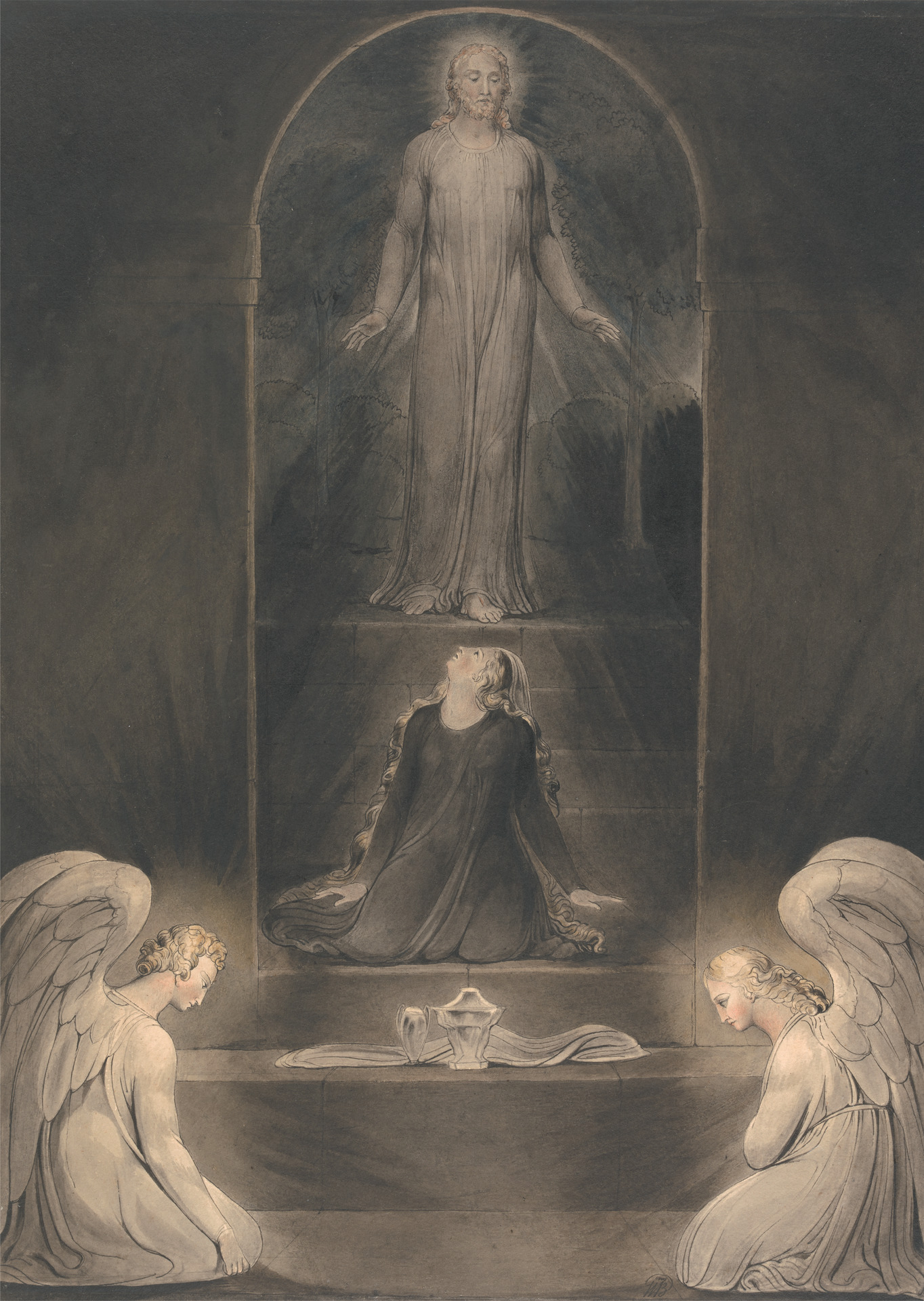
Image of the Month: William Blake, ‘Mary Magdalen at the Sepulchre’ (c.1805).

William Blake, 'Mary Magdalen at the Sepulchre' (c.1805). Watercolor with pen and ink on paper. 17 1/4 x 12 1/4 inches (43.8 x 31.1 cm). Yale Center for British Art, Paul Mellon Collection.  http://collections.britishart.yale.edu/vufind/Record/1670856

William Blake, ‘Mary Magdalen at the Sepulchre’ (c.1805). Watercolor with pen and ink on paper. 17 1/4 x 12 1/4 inches (43.8 x 31.1 cm). Yale Center for British Art, Paul Mellon Collection.
http://collections.britishart.yale.edu/vufind/Record/1670856

February’s ‘Image of the Month’ comes from Naomi Billingsley, PhD Candidate in Religions and Theology, University of Manchester, and recipient of a Bibliographical Society Studentship to assist with attendance at the third RIN symposium, ‘Literary Galleries’.


This is one of approximately eighty watercolour illustrations to the Bible produced by William Blake for his loyal patron Thomas Butts (a civil servant) between 1800 and about 1805 (several designs were added after this date but the majority were completed in this five-year period).[1] It is not clear how these designs originally functioned as illustrations: they may have extra-illustrated a large Bible or they might have been kept in their own portfolio or volume as a Bible in pictures.[2]

The design is from c.1805 and depicts Mary Magdalene at the tomb (or sepulchre) of Jesus; it is probably an illustration to John 20, because in the Gospels of Matthew, Mark and Luke, there are others with Mary when she goes to the tomb, and it is John that mentions Mary seeing ‘two angels in white sitting, the one at the head, and the other at the feet, where the body of Jesus had lain’, which Blake has included in the design (v. 12). However, Blake has compressed several moments in the narrative together in a single frame: in John’s account Mary stays ‘without’ the tomb and stoops to look inside (v. 11); she then turns around and sees Jesus but mistakes him for a gardener (v. 14). Although Blake has placed Mary on the threshold of the tomb, she is at the bottom of a flight of steps leading down to it, and so she is not stooping; Jesus stands at the top of the steps above her.

Blake has probably chosen this arrangement for compositional reasons: the design’s symmetry is characteristic of Blake’s ‘gothic’ style in this period. Indeed, this watercolour is one of six similarly symmetrical and near-monochrome designs of the death and resurrection of Christ which seem to form a sub-group within the series of biblical watercolours (The Crucifixion and the following designs – not including #499 or #503 – viewable via the Blake Archive).

Blake’s use of composition may also make a theological point. Jesus and Mary are directly aligned in the central vertical portion of the design; their arm gestures are almost identical and there is eye contact between them (see the Blake Archive’s image enlargement). This may be an expression of Blake’s idea that every person is an embodiment of Jesus – as articulated, for example, in his statement to Henry Crabb Robinson that Jesus ‘Is the only God… And so am I and so are you’[3] and his aphorism ‘The Eternal Body of Man is The Imagination. that is God himself | ישע Jesus | The Divine Body | we are his Members’.[4] So we might read Mary Magdalene here as a member of Jesus’ Divine Body, making the design not only ‘mere’ illustration but also a vehicle for Blake’s own ideas.

Any readers in the New Haven (Connecticut, USA) area will be able to see this work in the exhibition ‘The Critique of Reason: Romantic Art, 1760-1860’ between 6 March and 26 July at the Yale University Art Gallery this year.

[1] Cf. Martin Butlin, The Paintings and Drawings of William Blake (New Haven: Yale University Press, 1981): nos. 433-526.

[2] David Bindman, Blake as an Artist (Oxford: Phaidon, 1977): 144.

[3] William Blake to Henry Crabb Robinson, December 1825, in G. E. Bentley, Jr. Blake Records (New Haven: Yale University Press, 2nd Ed. 2004): 421.

[4] William Blake, ‘The Laocoön’, in David V. Erdman (ed.), The Complete Poetry and Prose of William Blake (New York: Doubleday, 1988): 273 and available via the Blake Archive.


CFP: The Romantic Eye (Yale, 17-18 April 2015)

Please see below for a Call for Papers for an exciting-sounding symposium on the Romantic Eye at Yale this April.  The organisers are particularly keen to secure contributions from early career scholars (including people working on their doctorates).  Flights and accommodation will be provided for those invited to speak, so if you’re working on a topic in this area, this could be a really great opportunity.

(Taken from the BARS blog)

— — — — —

The Romantic Eye, 1760–1860 and Beyond
April 17, 2015-April 18, 2015
Yale University
Yale-Conference-300x222

This symposium examines Romanticism as a shape-shifting cultural phenomenon that resists easy categorization. Focusing on the period from 1760 to 1860, the symposium embraces the amorphousness that has been ascribed to Romanticism historically by eschewing any limiting definition of it, seeking instead to explore the broad range of art and visual culture characterized as “Romantic” during this hundred-year span. We are interested in what the Romantic “eye” pursued and perceived, and how it set itself the task of recording those perceptions. In addition to interrogations of the relationship between the visual arts and Romanticism, we welcome papers on writers, composers, scientists, and philosophers whose projects engaged the visual. Papers also are sought for a special panel that will address the legacies of Romanticism in contemporary art.

This symposium coincides with a major collaborative exhibition organized by the Yale Center for British Art and the Yale University Art Gallery, The Critique of Reason: Romantic Art, 1760–1860, which opens March 6, 2015. The exhibition comprises more than three hundred paintings, sculptures, medals, watercolors, drawings, prints, and photographs by such iconic artists as William Blake, John Constable, Honoré Daumier, David d’Angers, Eugène Delacroix, Henry Fuseli, Théodore Géricault, Francisco de Goya, John Martin, and J. M. W. Turner. Talks that respond explicitly to works in the collections of the Yale Center for British Art or the Yale University Art Gallery are particularly encouraged, as are cross-disciplinary and comparative studies.

We are seeking presentations of thirty minutes in length. Graduate students and early career scholars are particularly encouraged to apply. Travel and accommodation costs will be covered by the organizers. Please e-mail abstracts of no more than three hundred words and a short CV or bio (no more than two pages) by February 2, 2015, to romanticism2015@gmail.com.

The symposium is cosponsored by the Department of the History of Art at Yale University, the Yale Center for British Art, the Yale University Art Gallery, and the Yale Student Colloquia Fund.

CFA: ‘Illustration and Gender’

Dear Colleagues,

As you wrap up the end of your semester and look forward to the spring, I hope you will consider submitting an article to the Summer 2015 special issue of Nineteenth-Century Gender Studies on the topic of “Illustration and Gender.” We welcome articles of 5,000-8,000 words reflecting interdisciplinary approaches and international perspectives on illustration and gender studies. NCGS endorses a broad definition of gender studies, and we welcome submissions that consider nineteenth-century illustration and gender and sexuality in conjunction with race, class, place and nationality. The submission deadline for complete articles is March 15, 2015 (earlier submission is encouraged). We hope to address a variety of possible topics including but not limited to:

Studies of female illustrators of the nineteenth century

Critical histories of illustrators marked by gender and sexuality

Depictions of gender, race, sexuality, and/or class in illustrated literary works

Depictions of gender, race, sexuality, and/or class in illustrated advertisements

Illustration and gender in periodical publications

Illustration and gender in the novel

Illustration and gender in poetry

Illustration and gender in the fin-de-siècle

The influence of scientific theories and discoveries (phrenology, evolution, ethnography) on illustration and gender

Avenues opened up by the digital humanities for visualizing gender in nineteenth-century culture.

Please adhere to MLA style, using endnotes rather than footnotes, and include a coversheet with your contact information and a short (100-150 word) bio with your article submission. Please contain all identifying information to the coversheet. Feel free contact us at the email addresses listed below with any questions or concerns. You can find more information online at the following link, CFP: Illustration and Gender or please feel free to distribute the CFP to colleagues or graduate students who may be working at the intersections of nineteenth-century illustration and gender studies.

We look forward to reading your submissions!

Dr. Nicole Lobdell, Georgia Institute of Technology, nicole.lobdell@lmc.gatech.edu

Kate Holterhoff, Carnegie Mellon University, kholterh@andrew.cmu.edu

Event Report: ‘The Artist and the Writer’, IES, 29th November 2014. Supported by the British Association of Victorian Studies and the University of Roehampton.

‘The Artist and the Writer’, IES, 29th November 2014.

Supported by the British Association of Victorian Studies (www.bavs.ac.uk) and the University of Roehampton.

‘The Artist and the Writer’ at IES told a chronological narrative of the relationship between artists and writers c. 1750 – 1850, revealing the contrasts and connections in book illustration from the eighteenth century to the Victorian period. The day opened with Lynn Shepherd’s paper on ‘Illustrating Pamela’. Shepherd showed how the illustrations to Pamela by Hayman and Gravelot create a narrative with a significantly different perspective from that provided by Pamela’s narration.  In the 28 illustrations – chosen on literary rather than visual grounds by Richardson himself – the ‘warm scenes’ are totally omitted.  Mr B’s assaults therefore exist only in Pamela’s words and not in the third person visual narration of the illustrations.  Lynn Shepherd read the images in terms of the pyramidal structures of contemporary conversation pieces, and also traced the gradual disappearance of barriers placing Pamela outside the class territory occupied by Mr B. The following discussion focused on the question of the kinds of visual literacy that readers might have brought to the task of reading the illustrations.  Shepherd argued that those who had sat for portraits would have understood the visual languages of these images.

Mary L. Shannon (Roehampton) introduces novelist and scholar Lynn Shepherd

Mary L. Shannon (Roehampton) introduces novelist and scholar Lynn Shepherd

Sandro Jung’s paper on ‘Thomas Stothard, Romantic Literature and the Illustrative Vignette’ took an ephemeral publication – The Royal Engagement Pocket Atlas  – as a means to overturn some of the key assumptions of illustration studies, namely that illustrators focused on old canon works newly freed from copyright. Stothard’s more than 800 head vignettes for Baker’s annual diary featured illustrations to recent and fashionable authors, prompting purchasers to discuss their current reading.  Baker followed Bell’s example in commissioning illustrations, but Baker made the decision to include recent poets not illustrated by Bell. Stothard, for instance, illustrated Crabbe, Byron and Scott, as well as Hayley’s Triumphs of Temper and Rogers’ Pleasures of Memory.  Stothard’s recognizable visual style thus provided a branding device not just for Baker’s publication but also for the concept of literature.  Jung argued that the Baker series offers a snapshot of consumer historical conditions.

Tim Fulford presented the early nineteenth-century as a period of virtual travel, when travellers prepared themselves by visiting exhibitions and looking at engravings, and picture books changed what the Romantic poets published.  Turning away from an earlier anti-picturesque aesthetic, and an earlier hostility about literary annuals, after 1818 Wordsworth and Southey repeatedly produced virtual topography, which functioned as guides for tourists.  The new urban bourgeoisie craved reminders of the countryside they had left, and technical developments made illustrations increasingly affordable.  Industrialization lowered the cost of paper, while from the 1820s the move to steel rather than copper engraving made larger print runs possible.  The Lake District gained its name through the sale of books of engraved views which were more popular than verse.  The Lake poets were therefore keen to foster links with artists and by the 1820s were working on jointly authored picture books in which poems were written to accompany pictures.  In the following discussion William St Clair argued that we needed to follow the logic of two industries and two media, tracing the links between them.

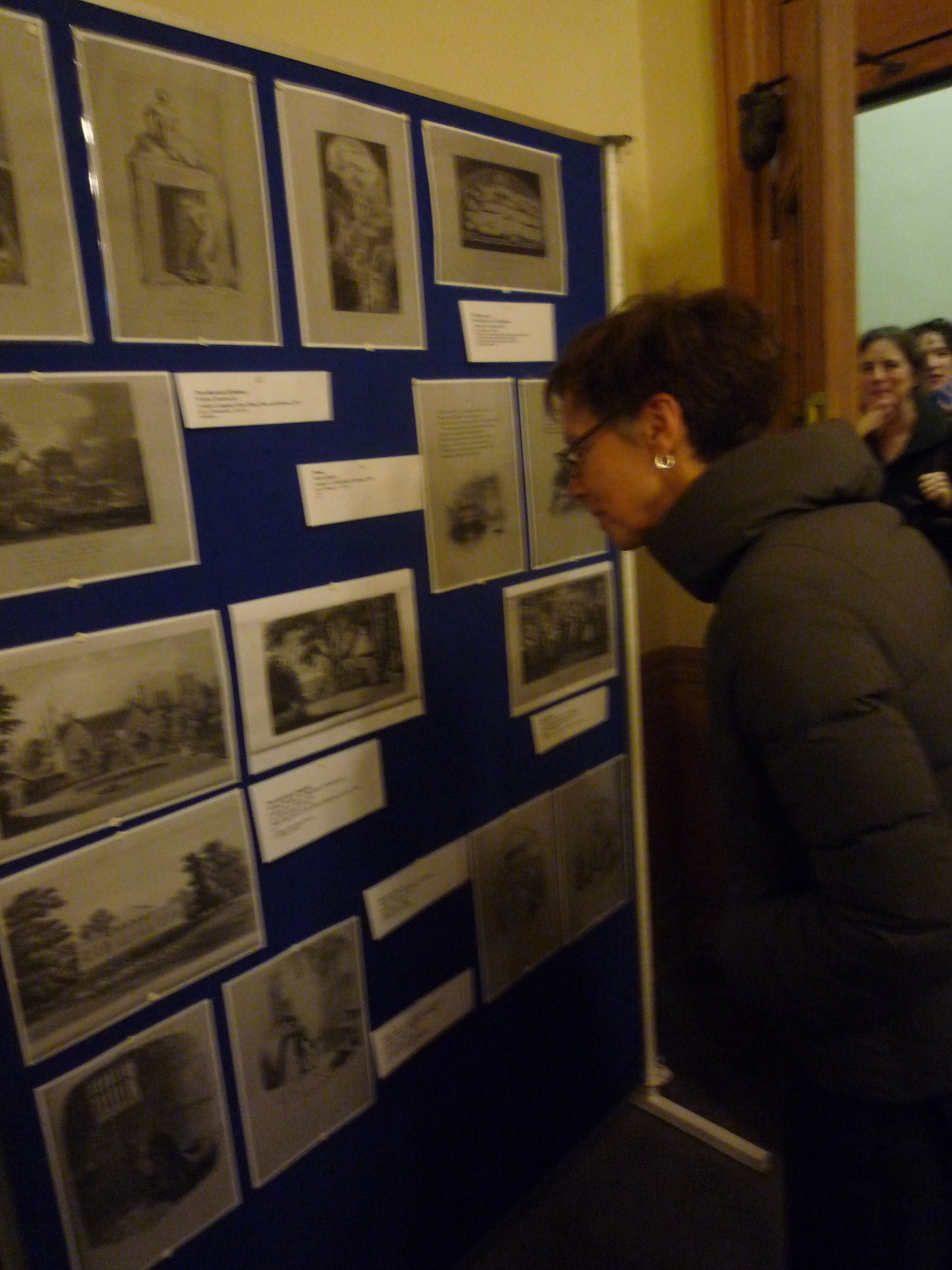
Exhibition of images from Senate  House Special Collections

Exhibition of images from Senate
House Special Collections

After a lunch sponsored by the British Association for Victorian Studies, and a visit to see some beautiful illustrated books in the Senate House library Special Collections (chosen to complement the day’s talks), Sophie Thomas traced the pre-history of the figure of the Bard in painting and illustration, from Thomas Jones’ the Bard (1774) via West, Sandby, Fuseli, Turner and Martin to the Bard in Blake’s illustrations to Gray and his painting of Gray’s Bard for his 1809 exhibition. Thomas’s paper on ‘Bardic Exhibitionism’ showed how Gray’s Bard appeared in Bentley’s illustrated Gray and reappeared in a lower illustrative mode in editions by Bell and Cooke, carrying complex meanings.

In the final session on Dickens, Mary L. Shannon’s ‘What did Dickens learn from Romantic Illustration?’ argued that Dickens drew on the more recognizable figure of Cruikshank to establish his own public identity, creating a visual image which drew on the conventions of visual Byronism.  Sadly, Ruth Richardson was unable to speak due to a bereavement, so more time was then devoted to open discussion. This ranged across author portraits, later images of Dickens and Victorian authors, continuities between the Romantic and Victorian periods, and links between theatre and visual culture. Anthony Mandal reminded us of the influence of Scott on Dickens, and Julia Thomas raised the significance of Luke Fildes’ watercolour tribute to Dickens, ‘The Empty Chair’ (1870).  The day concluded with a sociable drink nearby, at which it was agreed that the lively atmosphere, high-quality papers, and the trip to Special Collections had all made the event enjoyable, varied, and successful.

Susan Matthews, University of Roehampton

‘Lost Visions’ Workshop Report: Cardiff, 4th November 2014

‘Lost Visions: Retrieving the Visual Element of Printed Books from the Nineteenth Century’

lost visions logoWorkshop Report

Cardiff, 4th November 2014

http://lostvisions.weebly.com/about.html

‘Lost Visions’ is an AHRC-funded project led by Professor Julia Thomas in the School of English, Communication & Philosophy, Cardiff University. It attempts to tackle the challenges of big-data by working with more than a million illustrations from books in the British Library’s collection. Although many historical texts have been digitally stored, the illustrations in these texts are frequently without the information needed to help people understand them. The Cardiff team will devise methods that will enable the collection of illustrations to become fully searchable via an online database.

At the workshop in Cardiff, we were introduced to the scope and the challenges of the project, as well as the early version of the online database itself. Julia Thomas explained the vast dataset given to them by the British Library, with over 65,000 mixed-genre volumes c. 1528 – 1946, with the majority from the eigtheenth and nineteenth centuries. This gives a total of about 1 million illustrations in the database. Ian Harvey then gave us an introductory demonstration of the database in its current form, and Nicola Lloyd explained the many research applications that the database has already had for academics at Cardiff, but also beyond.

Ian Harvey then spoke in more details about the implemetationa challenegs faced so far in the project, not least the vast amount of images and the missing or inaccurate metadata that came with them. He demonstrated how dates, page numbers, and even names of illustrators need adding and/or correcting. They plan to use crowd-sourcing to encourage users (whether academics, teachers, or the general public) to tag images and help make the database more easily and accurately searchable.

After coffee, we all had chance to try out the search functions and the tagging. The closing roundtable discussion was full of praise for the project. It was noted how important it was to focus on visual culture when so many digital projects were text-based. It also became clear the ‘Lost Visions’ will enable us to rethink the author/artist hierarchy, especially in the context of the eigtheenth and nineteenth centuries.

The full database will be launched in March 2015, and once it has been launched RIN members are encouraged to try searching and tagging for themselves.

REGISTRATION open and PROGRAMME confirmed: ‘The Artist and the Writer’, Saturday 29th Nov. 10-5, IES, Senate House, London

We are delighted to announce that REGISTRATION is OPEN and the PROGRAMME CONFIRMED for:

‘The Artist and the Writer’ (a Romantic Illustration Network event)

29 November 2014, 10am – 5pm

Institute of English Studies, University of London, Senate House, Malet Street, London WC1E 7HU

Supported by the British Association for Victorian Studies (BAVS): http://www.bavs.ac.uk/ and the University of Roehampton.

REGISTRATION is FREE, but places are LIMITED. Register at: http://www.ies.sas.ac.uk/ies-conferences/ArtistWriter

Full programme below, and at https://romanticillustrationnetwork.wordpress.com/events/, where all abstracts will be posted in advance of the event.

We look forward to seeing you in November!

10.00 Registration

10.15 Lynn Shepherd (Richardson scholar and novelist): ‘Reading Pamela, picturing Pamela: Samuel Richardson illustrates his novel’

11.00 tea and coffee

11.15 Sandro Jung (Ghent): ‘Thomas Stothard, Romantic Literature, and the Illustrative Vignette’

12.00 Tim Fulford (De Montfort): ‘William Westall and the Lake Poets’

12.45 sandwich lunch

2.00 Sophie Thomas (Ryerson, Canada): ‘Bardic Exhibitionism: Illustration and the ‘Open’ Text in Blake and Gray’

2.45 tea and coffee

3.15 Mary L. Shannon (Roehampton): ‘What Did Dickens Learn From Romantic Illustration?’

3.45 Ruth Richardson (King’s College London; Cambridge): ‘Dickens, Cruikshank, and Oliver Twist’

4.30 Open discussion

5.00pm Close. Please join us for a drink at a pub nearby.

‘The Artist and the Writer’, Saturday 29th November, IES, Senate House, London

The Artist and the Writer: second symposium of the Romantic Illustration Network

Saturday 29 November 2014, 10 – 5pm

Institute of English Studies, Senate House, London WC1E 7HU

Lynn Shepherd (Richardson scholar and novelist), Tim Fulford (De Montfort), Sandro Jung (Ghent); Sophie Thomas (Ryerson, Canada); Nicky Watson (Open University); Mary L. Shannon (Roehampton). Supported by the British Association for Victorian Studies (BAVS): http://www.bavs.ac.uk/

Registration required: details, and full programme, to be advertised soon.

T:  0207 862 8675
W: ies.sas.ac.uk for map and directions.
 

Funding secured for next Symposium from British Association of Victorian Studies

We are delighted to announce that the next symposium of the Romantic Illustration Network, on Saturday 29th November 2014 at the Institute of English Studies, Senate House, University of London, will be supported by the British Association for Victorian Studies (BAVS): http://www.bavsuk.org.

It was clear from our first symposium in June (see an earlier post for the event report) that much important work on book illustration has been done within Victorian studies, and part of RIN’s role will be to establish fruitful dialogue between researchers working across the eighteenth and nineteenth-centuries.

Further details for November’s event will be announced soon via this blog.

BAVS Logo