Image of the Month: Caricature of Darwin and the crew of the Beagle

painting-depicting-charles-darwin

Lot 10, ‘English Literature, History, Childrens’ Books and Illustrations’ Sale, 15 December 2015, Sotheby’s London. Earle, Augustus (attrib.) CARICATURE GROUP PORTRAIT ON BOARD HMS BEAGLE Watercolour, entitled “Quarter Deck of a Man of War on Diskivery [sic] or interesting Scenes on an Interesting Voyage”, depicting Darwin together with ten other figures, all crew members of HMS Beagle, including Robert FitzRoy and three other officers, shipboard with fossils, botanical and mineralogical specimens, some with captions, several figures with nautical and surveying instruments, each figure with a speech bubble with words written above in black ink, single sheet (340 x 205 mm), watercolour and ink on paper (Whatman Mill watermark, undated), [Bahía Blanca, Argentina, on or around 24 September, 1832]; some creasing and light staining, mounted. http://www.sothebys.com/en/auctions/ecatalogue/2014/english-literature-history-childrens-books-illustrations-l15408/lot.10.html

Last month, Sotheby’s in London sold for £52,500 the only known painting of the naturalist Charles Darwin aboard the HMS Beagle.

The watercolour, painted by Augustus Earle (1793–1838) was offered in the English Literature, History, Children’s Books and Illustrations sale in London. Darwin (giving a long-winded description of an insect), Captain Robert Fitzroy, and various officers and sailors are all depicted: it captures the bustle of Darwin’s historic expedition, while the speech bubbles hint at in-jokes and standing jokes from the voyage. An officer, thought to be 1st Lt John Clements Wickham, complains: “There is no such thing as walking the deck for all these cursed specimens!”

zoomable digital image of the caricature is available on Sotheby’s website, along with an article on the caricature on Sotheby’s rare books blog Bibliofile.


A Christmas Workshop: RIN/House of Illustration Partnership

Anna Glendenning is a PhD candidate from Roehampton’s Centre for Research in Romanticism, who works on caricature. She reports here on the Romantic Illustration Network’s collaboration with the House of Illustration on a workshop for Y8 pupils, supported by the University of Roehampton.

On Thursday 3rd December, the House of Illustration in King’s Cross London was home to an exciting day of collaboration between local schoolchildren, RIN member Dr. Mary L. Shannon from the University of Roehampton, and professional illustrator Merlin Evans.

A group of thirty girls aged 12-13 (from Elizabeth Garrett Anderson School in Islington) braved a suitably chilly winter’s morning to visit the House of Illustration, where they immersed themselves in a special workshop on Dickens’s A Christmas Carol .  I also got to help out: it was hugely enjoyable to be part of such an inspiring day of interdisciplinary fun. For the full photostory, see http://www.roehampton.ac.uk/Courses/English-and-Creative-Writing/News/There-s-no-Bah-Humbug-this-Christmas-for-pupils-at-illustration-workshop/.

Dickens’ text has long been a favourite in English classrooms, but it was the aim of this collaboration to give the girls a unique opportunity to explore the crucial role of illustrations – both conceptually and creatively – with two experts.

The HOI’s learning programme, with Head of Education Emily Jost at its helm, is dedicated to bringing illustrations into the limelight. Its core aim is to enhance knowledge of and confidence in visual communication for all. The Romantic Illustration Network (RIN) shares this enthusiasm. RIN’s project to restore the importance of visual culture in the Romantic period involves a commitment to sharing and to promoting access to the research it undertakes.

Mary Shannon, who specializes in Victorian print culture and is a Dickens expert, led a lively session. By contrasting different illustrations of Scrooge with Dickens’s narrative, trying out their own sketches, and learning from Shannon about Victorian Christmas traditions, the girls contributed lots of compelling thoughts and critiques, expanding their understanding of the relationship between illustrations and Dickens’s text.

After taking a look at the House of Illustration’s current exhibition, the girls returned to the studio for a special session with Merlin Evans. Evans brought in tools from her trade and shared some different techniques of collage-making and line work to help the girls to get to grips with the material qualities of producing images. The girls rummaged through photocopies of Victorian illustrations and had the chance to try out the new drawing methods Evans had demonstrated. The results were exquisite. The girls were able to compare their work with the earlier sketches they had made – a great way to show how their understanding of Scrooge’s character had developed over the course of the workshop, and, hopefully, to boost their illustration skills and confidence into the future.

Future collaborative workshops involving RIN’s Professor Ian Haywood (Roehampton) and Dr Susan Matthews (Roehampton) are in the pipeline, so watch this space in the New Year!

Anna Glendenning

Autumn issue of ‘Blake: An Illustrated Quarterly’ now online

“And I only am escaped alone to tell thee”: the autumn issue of Blake: An Illustrated Quarterly is now online.

http://blake.lib.rochester.edu/blakeojs/index.php/blake

Blake Illustrated Quarterly

It is dedicated to two articles on Blake’s Illustrations of the Book of Job. Mei-Ying Sung describes in detail for the first time the set of pre-publication Job proofs at the Beinecke Library at Yale, and Sibylle Erle talks about Alfred Tennyson’s copy of Job: how and when he acquired it and how he used it.

For past issues, see http://bq.blakearchive.org/

Registration open: Artist and Empire: New Dynamics, Tate, 24-6 Nov. 2015

International conference
Artist and Empire: New Dynamics: 1790 to the present day

Tate Britain, Clore Auditorium
24 – 26 November 2015

We are pleased to announce that Tate is holding a major conference in collaboration with Birkbeck, University of London and Culture at King’s College London, to mark the opening of the exhibition Artist and Empire. Scholars, curators and artists from around Britain and the world will consider art created under the conditions of the British Empire, its aftermath, and its future in museum and gallery displays. Scholarship has expanded over the last two decades across a span of disciplines and locations. This conference takes the historic opportunity of the exhibition, featuring diverse artists from the sixteenth century to the present day, to bring together people to meet and share the latest research being developed around this subject. The papers, roundtables and audience discussions will consider the cosmopolitan character of objects and images, and the way geographical, cultural and chronological dislocations have in many instances obscured, changed or suppressed their history, significance and aesthetics. We will also explore how approaches to contemporary art, archives, curation and collecting can help develop new ways to look at them now.

24 November – Exhibition preview and Keynote Lecture
25 November, Day One – Artist & Empire: The Long Nineteenth Century
26 November, Day Two – Artist & Empire: Curating in a Transnational Context

For further information please contact the conference administrator, Jessica Knights, at jessica.knights@tate.org.uk

Artist and Empire: New Dynamics is convened by Tate, Birkbeck and Culture at King’s College London. The conference has been generously supported by Culture at King’s College London, The Paul Mellon Centre for Studies in British Art, Birkbeck School of Arts, The British Association of Victorian Studies, The Association of Art Historians, Creative Victoria and the Australia Council for the Arts. ’Parallel Perspectives: Curating in London’s transnational contexts’ is a Culture at King’s College London project in collaboration with the British Library, Tate and V&A Museum.

Full program details will be announced shortly. Book now to secure your place: http://www.tate.org.uk/whats-on/tate-britain/conference/artist-and-empire-new-dynamics

Sincerely,
Birkbeck Centre for Nineteenth-Century Studies

Pre-Raphaelite Fellowship: A Joint Fellowship from the University of Delaware Library and the Delaware Art Museum

Pre-Raphaelite Fellowship: A Joint Fellowship from the University of Delaware Library and the Delaware Art Museum

Deadline: November 1, 2015

The University of Delaware Library, in Newark, Delaware, and the Delaware Art Museum are pleased to offer a joint Fellowship in Pre-Raphaelite studies. This short-term, one-month Fellowship, awarded annually, is intended for scholars conducting significant research in the lives and works of the Pre-Raphaelites and their friends, associates, and followers.  Research of a wider scope, which considers the Pre-Raphaelite movement and related topics in relation to Victorian art and literature, and cultural or social history, will also be considered. Projects which provide new information or interpretation—dealing with unrecognized figures, women writers and artists, print culture, iconography, illustration, catalogues of artists’ works, or studies of specific objects—are particularly encouraged, as are those which take into account transatlantic relations between Britain and the United States.

Receiving the Fellowship:
The recipient will be expected to be in residence and to make use of the resources of both the Delaware Art Museum and the University of Delaware Library. The recipient may also take advantage of these institutions’ proximity to other collections, such as the Winterthur Museum and Library, the Philadelphia Museum of Art, the Princeton University Library, and the Bryn Mawr College Library. Each recipient is expected to participate in an informal colloquium on the subject of his or her research during the course of Fellowship residence.

Up to $3,000 is available for the one-month Fellowship. Housing may be provided. Personal transportation is recommended (but not mandatory) in order to fully utilize the resources of both institutions.

The Fellowship is intended for those who hold a Ph.D. or can demonstrate equivalent professional or academic experience. Applications from independent scholars and museum professionals are welcome. By arrangement with the Yale Center for British Art, New Haven, CT, scholars may apply to each institution for awards in the same year; every effort will be made to offer consecutive dates.

To Apply:
Send a completed application form, together with a description of your research proposal (maximum 1 page) and a curriculum vitae or resume (maximum 2 pages) to the address given below. Letters of support from two scholars or other professionals familiar with you and your work are also required. These materials may also be sent via email to: fellowships@delart.org.
Pre-Raphaelite Fellowship Committee Delaware Art Museum 2301 Kentmere Parkway Wilmington, DE 19806
Application Form: http://www.delart.org/about/opportunities/#preraphfellowship Important Dates:
The deadline to apply for the 2016 Fellowship is November 1, 2015. Notification of the successful applicant will be announced by December 1, 2015. The chosen candidate will then be asked to provide a date for assuming the Fellowship by January 1, 2016.
If you have any questions or would like to request more information, please contact:
Margaretta S. Frederick Pre-Raphaelite Fellowship Committee Direct line: 302.351.8518 E-mail: fellowships@delart.org

Romantic London: new digital project

Romantic London is a research project by Dr Matthew Sangster (Birmingham) exploring life and culture in London around the turn of the nineteenth century using Richard Horwood’s pioneering ‘PLAN of the Cities of LONDON and WESTMINSTER the Borough of SOUTHWARK, and PARTS adjoining Shewing every HOUSE’ (published between 1792 and 1799). It considers the ways in which the writers and works later grouped under the umbrella of Romanticism interacted with London’s communities and institutions while also examining a wide range of alternative approaches to representing and organising urban existence.

The site is based around a digital version of Horwood’s Plan laid over and georeferenced to modern maps of the city; this allows for detailed examinations and comparisons. As well as considering the Plan and its creator, the site is using Horwood’s work as a means of thinking about the ways in which writers, publishers and artists sought to communicate insights into London’s general character and particularities. By using Horwood’s Plan as a base map and adding other kinds of information to it using annotated markers, the site reflects upon the social, geographical and aesthetic assumptions made in late eighteenth- and early nineteenth-century attempts to make sense and art of the burgeoning metropolis.

Texts brought into conversation with Horwood’s Plan on the site at present include:
•Entries from the dual-language New Guide for Foreigners prepared around 1790 and sold by the printseller S.W. Fores from his shop opposite the Paris Diligence office.
•Descriptions and images from Modern London, an 1804 publication put together by the radical publisher Richard Phillips, which included two sets of plates of the city, one showing major landmarks, the other showing itinerant traders hawking their wares in more out-of-the-way locations.
•The lavish aquatints from Rudolf Ackermann’s Microcosm of London (1808-10), engraved from collaborations between the artist and architectural draftsman Auguste Charles Pugin and the uproarious caricaturist Thomas Rowlandson.
•The text of the 1788 edition of Harris’s List of Covent-Garden Ladies, a disreputable register of London prostitutes.

The site at present is a work in progress; there are a great number of additions still to be made. You can follow the changes and developments on the site’s blog.

CFP: NeMLA 2016 panel: “Word and Image on Page, Stage, and Screen in the Long Nineteenth Century.”

NeMLA 2016 panel

“Word and Image on Page, Stage, and Screen in the Long Nineteenth Century.”

Chairs Robert Hasenfratz and Kate Holterhoff are asking for abstracts: they welcome projects engaging any aspect of the word-image nexus in illustrated novels, stage productions, or film in Anglo-European or North American culture during the long nineteenth century.

‘The relationship between text and image has an important and suggestive place in the humanities. While in decades past literary scholars have been apt to treat any visual elements accompanying literary texts as supplemental, a growing number of visual and media studies theorists have expressed interest in the important and under-theorized role of paratexts in the form of advertisements, book illustrations, and film and stage adaptations. We have a particular interest in the visual culture of the long nineteenth century. For example, the craze for tableaux vivants, re-creations of famous paintings on stage with living actors, infected both the popular stage, early film, and book illustration in the mid-1890s. The visual culture leading to this moment had itself been conditioned by pre-cinematic arts like magic lantern shows and stereoscopic viewers. We are interested in the complex ways that this visual culture not only supplemented but determined the representational conditions of literary texts, films, and stage productions.’

Abstracts should be submitted by September 30, 2015 through the following link: https://www.cfplist.com/nemla/Home/S/15947

Topographies: London Group of Historical Geographers Autumn Seminar Series

LONDON GROUP OF HISTORICAL GEOGRAPHERS
Seminar Programme, Autumn 2015
TOPOGRAPHIES
Talks in this series may well be of interest to RIN members. Seminars are held on Tuesdays at 5.15pm in the Wolfson Conference Suite (NB01), Institute of Historical Research, North Block, Senate House, University of London.

For further details please visit the LGHG homepage or the seminar listing on the IRH website.

6 October 2015
Stephen Daniels (University of Nottingham)
“’Map-work”: John Britton and the topographical imagination in nineteenth-century Britain.
20 October 2015
Veronica della Dora (Royal Holloway, University of London)
“And he walked from country to country”: Vasilij Grigorovich Barskij’s pious topographies, 1723–1747.
3 November 2015
William Bainbridge (Paul Mellon Centre for Studies in British Art)
“Mountains run mad”: shared topographies and conflicting memories in the Dolomites.
17 November 2015
Jordan Goodman (UCL)
Making places, knowing lives: Joseph Banks learns Australia, 1770–1810.
1 December 2015Felicity Myrone (British Library)Re-evaluating topography: the case of Captain Thomas Davies’ An east view of the great cataract of Niagara (1762).

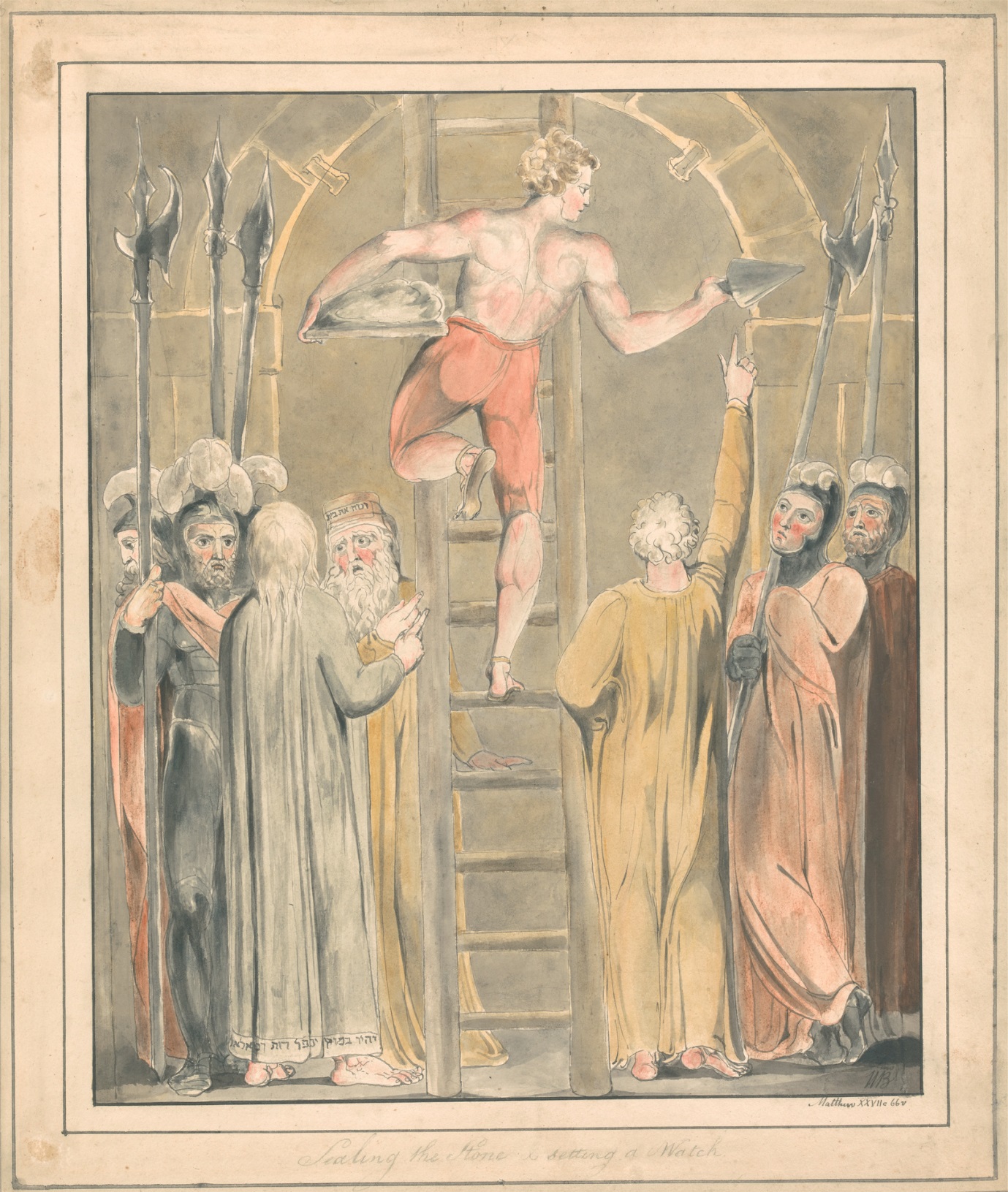
Image of the Month: William Blake, Sealing the Stone and Setting a Watch (c.1800-1803).

Blake Sealing the Stone

William Blake, Sealing the Stone and Setting a Watch (c.1800-1803). Watercolor, with pen, in gray ink, black ink and graphite on moderately thick, slightly textured, wove paper. Yale Center for British Art, Yale Art Gallery Collection, Everett V. Meeks, B.A. 1901 Fund.

In an ‘Image of the Month’ in February, I wrote about Blake’s watercolour Mary Magdalen at the Sepulchre (c.1805). In this post, I’m jumping back a bit to another of Blake’s watercolour illustrations to the Bible, Sealing the Stone and Setting a Watch (c.1800-03), which depicts a moment slightly earlier in the biblical narrative, and was probably also produced several years earlier (the exact dates of these works are not known, but they have been assigned dates based on stylistic features).

The text illustrated is Matthew 27:66 which describes the sealing of Jesus’ tomb on the day after his death and burial. The chief priests and Pharisees had heard Jesus say that he would rise again on the third day, and they feared that the disciples would try to take away the body to fabricate a resurrection. They therefore asked Pilate to secure the tomb, so he sent a watch and instructed them make the tomb as sure as they could (27:62-65).

In Blake’s illustration, the task is being undertaken very diligently. At the centre of the design is a young man balancing on a ladder, holding a palette of cement and a knife. He is turning to his right, directed by a priest standing below who appears to be pointing out a gap in the cement for the young man to seal. There are two more priests to the left of the ladder, and five soldiers are standing guard.

This is a relatively unusual subject, which is perhaps unsurprising; illustrators of the New Testament have tended to focus on the acts of Jesus and his disciples, not on those of Jesus enemies. We cannot be certain whether the subject was chosen by Blake or by his patron, Thomas Butts; either way, its inclusion in the series of biblical illustrations emphasises that the tomb was firmly shut. Thus, when Blake added The Angels Hovering over the body of Christ in the Sepulchre (c.1805, V&A) to the series, he was giving the viewer privileged access to a scene inside the firmly-sealed tomb, and then in The Angel Rolling Away the Stone from the Sepulchre (c.1805, V&A) and The Resurrection (c.1805, Fogg Art Museum), Blake depicts Christ bursting that seal.

As a stand-alone design the subject may not have obvious appeal, but in a series of illustrations to the narrative of Jesus’ death and resurrection, Sealing the Stone and Setting a Watch plays a key role.

Naomi Billingsley (Manchester)

CFP: “Tracing Types: Comparative Analyses of Literary and Visual Sketches (1830-1860)”, Ghent University Belgium, 3-4 June 2016.

“Tracing Types: Comparative Analyses of Literary and Visual Sketches (1830-1860)”, Ghent University Belgium, 3-4 June 2016.

Deadline for abstracts: October 1, 2015

In the wake of the pioneering work of Nathalie Preiss and Martina Lauster, a new wave of scholarship has emerged in recent years, which examines nineteenth-century sketches (sometimes referred to as ‘panoramic literature’) from a transnational perspective.

Two recent examples of this interest are the special issue of Interférences littéraires, “Croqués par eux-mêmes. La société à l’épreuve du panoramique” (2012), directed by Nathalie Preiss and Valérie Stiénon, and the recent NYU conference “Dissecting Society: Periodical Literature and Social Observation (1830-1850)” (March 2015), organized by Christiane Schwab and Ana Peñas Ruiz.

The present call for papers seeks to continue this comparative reflection by placing the spotlight on the comparative analysis of texts and images of specific types and by tracing how these representations vary across sketches from different places, media and editorial contexts.

We welcome presentations that address the following types of questions:

– How do the representations and definitions of a type (or group of related types) vary from one national context to another?
– How do different collections, periodicals or editorial contexts inflect a type in different ways?
– How do visual representations of a type differ from one another or from literary representations of the same figure?
– How does the type transform as it is taken up in other genres, registers or types of discourse?
– Does the type exist in a system? Does it belong to a collection or series of types and if so, how does it relate to or interact with other types in the system? How do different collections position the type within their systems?
In short, we invite each participant to choose a type (or group of related types) and to trace how it shifts or remains the same across different contexts and in relation to different co-texts. Presentations that explore less known types are particularly welcome.

The long term goal of this project is to publish an edited volume exploring these issues. It is our hope that the combined insights of the seminar will allow us to draw a series of general reflections about how portrayals of types shift across contexts, borders and media.

We would like to invite expressions of interest in the form of a short abstract (of around 300 words in English or French) describing your idea. Please submit your idea to Leonoor Kuijk at l.kuijk@ugent.be by October 1, 2015.

http://www.tracingtypes.ugent.be/

Organizers: Leonoor Kuijk, Elizabeth Amann and Marianne Van Remoortel (Ghent University), Valérie Stiénon (Université Paris 13)