Event Report: ‘The Art of Quotation and the Miniaturised Gallery’, RIN 4, Saturday 6 June 2015

The fourth Romantic Illustration Network symposium took place at the House of Illustration on Saturday the 6th of June. Once again the event was well-attended with a friendly mix of regulars and new faces, local and international.house-of-illustration-logo-kids-in-the-halls-column-arts-agency

We had two inter-related themes for the symposium:

1.Miniaturization: Drawing on Peter Otto’s work on virtual culture in the Romantic period, is the illustration a form of virtual gallery? How does visual meaning change when an image is resized?
2.The Art of Quotation: How were literary quotations used to conceptualise visual images? How important are framing devices to the meaning of an image?

However, speakers were free to interpret the terms ‘quotation’ and ‘miniaturised gallery’ in any way they saw fit, and to raise any other questions they chose.

We kicked off with David Worrall (Roehampton/Nottingham Trent) who presented us with his concept of ‘locations of curation’. After crediting William St Clair in RIN 3 for inspiring his quest for a new theory of illustration, Worrall explored what he described as two currently disconnected narratives – Romanticism and eighteenth-century theatre – to consider the changing moments when images interact with other objects, such as the people who view them. He used the example of theatrical portraits to demonstrate how images moved from stage, to page, to prints, to household objects.

Susan Matthews’s (Roehampton) paper interrogated questions of scale, domesticity, and artistic encounter, the idea of ‘meeting’ an artist though their illustrations. She pointed out that the name ‘House of Illustration’ (as opposed to ‘Gallery of Illustration’) is significant: we often seem to want to give illustration a ‘home’. She focused on Fuseli’s illustrations to an edition of Cowper’s popular poem The Task (1785), and revealed the awkward tensions between Fuseli’s depictions of domestic scenes and Cowper’s lines, whilst also showing that Fuseli could produce powerful images on a small scale when he really wanted to. Matthews drew parallels between Fuseli’s techniques and the recent exhibition of Paula Rego’s work at House of Illustration.

urizen_a_p11-17_100

Plate 17, The Book of Urizen William Blake Archive

From here we zoomed in still further, with Peter Otto’s (Melbourne) paper on plate 17 of Blake’s The Book of Urizen (1794). Otto gave a detailed and original reading of the plate which encompassed The Terror and images of decapitation by guillotine, the story of Adam and Eve, Perseus and the Gorgon, and the Narcissus myth to show how the plate connects primal history with events unfolding in the present through an art of visual and textual quotation. He argued that the plate illustrated a turning point in society, represented as a decapitation, and that Blake was constructing an imagined reality through quotation which in turn tries to shape or frame what reality is.

From royal executions to royal collections, Kate Heard (Royal Collection) showed us how George III and George IV both engaged with the reproductive print market, albeit in very different ways, as prints enabled middle-class consumers to gain access to items in the Royal Collection. We saw how Royal Collection items circulated as prints, so much so that satirical caricaturists could imitate them, and she argued that the print market played a crucial role in the public sense of the King. We also saw what a fantastic resource the Collection is for scholars.

Taking us through to the Victorian period, Bethan Stevens (Sussex) spoke about her work on the albums of proofs put together by the dominant mid-century London wood-engraving firm, the Dalziel family. The firm of Dalziel produced the illustrations to a vast range of literary and non-literary texts, including such classics as the Alice books and Tennyson’s Idylls of the King. Stephens showed how, in the albums, the exclusion of words affects the status, form and narrative of illustration, and provokes a new attention to illustrations as images which enables all kinds of subversive and intriguing readings.

Three Bibliographical Society Studentships were awarded: Anne Musset (Warwick/Paris-Diderot), Tessa Kilgariff (National Portrait Gallery/Bristol), and Naomi Billingsley (Manchester). We ended the day, as usual, with a period of open discussion about the broader themes of the event and the future of the network (upcoming ventures include the panel at BARS 2015 in Cardiff and the digitised Shakespeare Gallery, currently under construction). After that we adjourned to the pub, to round off a successful and fun day with a friendly drink.

Details of the BARS panel will be appearing on the blog and website soon: we hope to see you there!

IMG_20150606_180246993IMG_20150606_180306094_HDRIMG_20150606_180236143

REMINDER: RIN 4: The Art of Quotation and the Miniaturized Gallery. Saturday 6 June 2015, 10 – 5pm, The House of Illustration, London

The Art of Quotation and the Miniaturized Gallery.
Saturday 6 June 2015, 10 – 5pm 
The House of Illustration, London
Peter Otto (Melbourne), David Worrall (Roehampton/Nottingham Trent), Kate Heard (Royal Collection), Susan Matthews (Roehampton), Bethan Stevens (Sussex).
Supported by the University of Roehampton and the Bibliographical Society. Organised with the assistance of House of Illustration.

This session follows two themes:
1.Miniaturization: Drawing on Peter Otto’s work on virtual culture in the Romantic period, is the illustration a form of virtual gallery? How does visual meaning change when an image is resized?
2.The Art of Quotation: How were literary quotations used to conceptualise visual images? How important are framing devices to the meaning of an image?

…and other related questions.

Registration is free, and includes free entry to the main exhibition. You can download the full programme here.

To register, please email Mary.Shannon@roehampton.ac.uk, giving your name, job title, and institution (if applicable).

Birkbeck Arts Week Starts: Monday, 18 May

Birkbeck Arts Week Starts: Monday, 18 May

We start on Monday 18 May with sessions on Curiosity (with Marina Warner and others), Coffee and Commonwealth, illustrator and caricaturist Chris Riddell‘s reflecting on Gulliver’s Travels and Diderot on Monday, to discussions of Ruins, productions of S.T.Coleridge‘s Ancient Mariner and Blake‘s Illuminated manuscript Vala or the Four Zoas, Mike Leigh’s Mr Turner with members of the film team, and we end on Friday with sessions on the enlightenment art of Shadow Portraits and a Magic Lantern Show. And this is just a couple of examples.

Do visit the Birkbeck Arts Week’s webpage, choose your events, and book seats. It’s all free. And please spread the word.
http://www.bbk.ac.uk/arts/about-us/events/arts-week 

CFP: ‘The Arts and Feeling in Nineteenth-Century Literature and Culture’, Birkbeck College, University of London, 16-18 July 2015

CFP: The Arts and Feeling in Nineteenth-Century Literature and Culture

Birkbeck College, University of London, 16-18 July 2015

Keynote Speakers: Professor Caroline Arscott (Courtauld Institute of Art, London); Professor Tim Barringer (Yale University); Meaghan Clarke (University of Sussex); Professor Kate Flint (University of Southern California); Professor Michael Hatt (University of Warwick); Professor Jonah Siegel (Rutgers); Alison Smith (Tate Britain)

“She saw no, not saw, but felt through and through a picture; she bestowed upon it all the warmth and richness of a woman’s sympathy; not by any intellectual effort, but by this strength of heart, and this guiding light of sympathy…” (Nathaniel Hawthorne, The Marble Faun, 1860)

This conference will explore the ways in which nineteenth-century authors, artists, sculptors, musicians and composers imagined and represented emotion and how writers and critics conceptualised the emotional aspects of aesthetic response. How did Victorian artists represent feeling and how were these feelings aestheticised? What rhetorical strategies did Victorian writers use to figure aesthetic response? What expressive codes and conventions were familiar to the Victorians? Which nineteenth-century scientific developments affected artistic production and what impact did these have on affective reactions?

The conference will consider the historically specific ways in which feeling is discussed in aesthetic discourse. It will also, however, encourage reflection about the limits of an historicist approach for understanding the emotions at play in nineteenth-century aesthetic response and the possibility of alternative methodologies for understanding the relation between feeling and the arts.

Proposals of up to 400 words should be sent to Dr. Vicky Mills at artsandfeeling@gmail.com by 9 January 2015. Please also attach a brief biographical note. Proposals for panels of three papers are also welcome, and should be accompanied by a brief (one-page) panel justification.

Possible topics might include:

  • Languages of emotion (affect; feeling; sympathy; empathy; sentimentality)
  • Theories of feeling (psychologists; art critics; philosophers; authors)
  • The arousal of specific emotions (pain; joy; anger; grief; tenderness; anxiety; disgust) and the aestheticisation of the emotions
  • The physiology and psychology of aesthetic perception (Physiological aesthetics; empathy; the nervous system; head v. heart)
  • The arts and religious feeling (biblical painting; sacred music)
  • Artists, museum visitors and concert-goers in fiction
  • The gendering of aesthetic response
  • The codification of artistic expression
  • Museum Feelings (boredom; fatigue; the museum as a site of affect; the regulation of feeling)
  • Curating feeling
  • The ‘art of feeling’ (how to feel the right thing in response to music, art, sculpture)
  • Feeling and touch
  • The role of emotion in ekphrasis; translating feeling

The conference is organised by The Centre for Nineteenth-Century Studies at Birkbeck, University of London.

REGISTRATION OPEN: RIN 4: The Art of Quotation and the Miniaturized Gallery. Saturday 6 June 2015, 10 – 5pm, The House of Illustration, London

The Art of Quotation and the Miniaturized Gallery. Saturday 6 June 2015, 10 – 5pm, The House of Illustration, London: Peter Otto (Melbourne), David Worrall (Roehampton/Nottingham Trent), Kate Heard (Royal Collection), Susan Matthews (Roehampton), Bethan Stevens (Sussex). Supported by the University of Roehampton and the Bibliographical Society. Organised with the assistance of House of Illustration.

We are delighted to announce that registration for this free event is now OPEN.

You can download the full programme here.

To register, please email Mary.Shannon@roehampton.ac.uk, giving your name, job title, and institution (if applicable). Places will be awarded on a first-come, first-served basis, and there will be a waiting list.

We are also accepting applications for 3 Bibliographical Society Studentships of £60 each, to assist postgraduate students with attendance. 3 spaces are reserved for the successful candidates.

To apply, please send your CV, and a statement explaining how your research fits with the work of the Network and/or the Bibliographical Society (200 words max), to Mary.Shannon@roehampton.ac.uk by Monday 25th May. Successful candidates will be notified by Wednesday 27th May.

RIN 4: The Art of Quotation and the Miniaturized Gallery. Saturday 6 June 2015, 10 – 5pm, The House of Illustration, London

The Art of Quotation and the Miniaturized Gallery. Saturday 6 June 2015, 10 – 5pm, The House of Illustration, London: Peter Otto (Melbourne), David Worrall (Roehampton/Nottingham Trent), Kate Heard (Royal Collection), Susan Matthews (Roehampton), Bethan Stevens (Sussex). Supported by the University of Roehampton and the Bibliographical Society. Organised with the assistance of House of Illustration.

Registration for this event will soon be open: details will be posted on this blog.

We will also be advertising 3 Bibliographical Society Studentships of £60 each, to assist postgraduate students with attendance. 3 spaces are reserved for the successful candidates; details of how to apply will be advertised here soon.

UnivRoehamptonlogo Bib Soc support logo house-of-illustration-logo-kids-in-the-halls-column-arts-agency

Podcasts available: RIN 3, ‘The Literary Galleries’, February 2015, Tate

Podcasts of our third event ‘The Literary Galleries: Entrepreneurship and Public Art’, held at the Tate on February 27th 2015, are now available to listen to and to download on Vimeo here.

The programme for the symposium is downloadable from https://romanticillustrationnetwork.wordpress.com/events/, but the speakers were:

1) Rosie Dias (Warwick), ‘Viewers, Patrons, Readers, Consumers? John Boydell’s Shakespeare Gallery and its Public’

2) Ian Haywood (Roehampton), ‘Macklin’s Poets Gallery and the age of Terror’

3) Luisa Calè (Birkbeck), ‘The Hours’

4) Frederick Burwick (UCLA), ‘Painting and Performance: Tableaux Vivants on the London Stage’

5) Martin Myrone (Tate), ‘Blake and the Limits of Illustration’

Event Report: ‘The Literary Galleries: Entrepreneurship and Public Art’, RIN 3, Friday 27 February 2015, Tate Britain

The third ‘Romantic Illustration Network’ symposium took place on Friday 27th February at the Tate Britain. Podcasts of the talks will be available on the website next week.

This symposium brought together the authors of the key scholarship on the literary galleries of the Romantic period: Fred Burwick (The Boydell Shakespeare Gallery, 1996), Rosie Dias (Exhibiting Englishness, 2013), Ian Haywood (Romanticism and Caricature, 2013), Luisa Calé (‘Blake and the Literary Galleries’, 2008; Fuseli’s Milton Gallery 2006) and Martin Myrone (Gothic Nightmares, 2006; John Martin: Apocalypse, 2011) in a venue that is itself a form of literary gallery (Tate Britain) to present new research and to debate the relationship of painting to illustration, text, and print.  To what extent did the literary galleries change the role of illustration in the Romantic period?

RIN 3 attendees at the tea break, enjoying tea and pastries.

RIN 3 attendees at the tea break, enjoying tea and pastries.

Martin Myrone, Lead Curator in Pre-1800 British Art, welcomed everyone to the Tate, before we heard from our first speakers: Rosie Dias and Ian Haywood. Dias showed us how the location of Josiah Boydell’s shop on Cheapside and Shakespeare Gallery in Pall Mall fitted in to the cultural geography of 18th century London. She drew upon Luisa Calé’s work to demonstrate that at the Shakespeare gallery the textual and the visual – the catalogue of Shakespeare extracts and the paintings themselves – were presented as autonomous realms that could be separated or united at will, and that attendees could choose by their physical actions to be either readers or spectators.

Ian Haywood gave a paper on Macklin’s shop the Poets’ Gallery and his exhibition and publication Gallery of British Poets. He presented a subversive close reading of the text and images published in 1794 in the fourth issue, at the height of the Terror in Paris. Luisa Calé gave a fascinating analysis of Maria Cosway’s ‘The Hours’ (the lead image on the RIN blog).

After lunch all together in the Tate café, Fred Burwick gave a paper on tableaux vivants, which argued that the stage was a kind of literary gallery in the early nineteenth-century, as artists and dramatists recreated famous paintings on stage, and in some instances turned narrative paintings into plays.

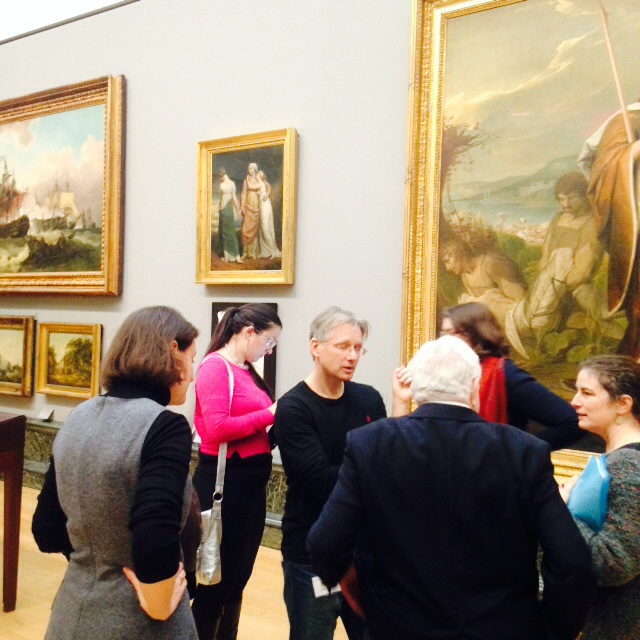
RIN 3 attendees in the Tate's galleries, in front of Barry's 'Lear'.

RIN 3 attendees in the Tate’s galleries, in front of Barry’s ‘Lear’.

We were then treated to guided tours of the Print Room and the Galleries by Assistant Curators Désirée de Chair and Clare Barlow. We looked at prints by Blake and Fuseli, as well as illustrated pages from Bell’s British Poets and a print of Barry’s ‘Lear and Cordelia’. In the galleries, we heard about Fuseli’s ‘Lady Macbeth seizing the daggers’, as well as looking closely at Barry’s enormous finished oil painting of Lear and the dead Cordelia.

After the presentation of the Bibliographical Society Studentship to Naomi Billingsley (Manchester) for her project on Blake and religious art, Martin Myrone spoke about gaps, misapprehensions, and questions of scale and authority in relation to the study of relationships between text and images, and between disciplines (such as literature, art history, book history, visual culture studies, theatre studies, etc). We rounded off the day with a discussion about the relationship between images, literature, and theatre, before heading to the White Swan for a companionable drink. The next symposium is on Saturday June 6th at the House of Illustration, and we are sure it will be as enjoyable and productive as this one! Keep an eye on the blog and the events page for details of the programme and registration.

Lecture: Rosie Dias (Warwick), ‘From Counting House to Country House: Building the Image of the East India Company’

The Birkbeck Eighteenth-Century Research Group is delighted to announce a lecture in the new year by Rosie Dias, Associate Professor in History of Art at the University of Warwick.

‘From Counting House to Country House: Building the Image of the East India Company’

6pm, Thursday 15th January
Room 407, 30 Russell Square

Rosie Dias’s research focuses on eighteenth and early nineteenth-century British art and visual culture. Her monograph, Exhibiting Englishness: John Boydell’s Shakespeare Gallery and the Formation of a National Aesthetic, was published by Yale University Press in 2013.

All very welcome! For further information, please contact Kate Retford: k.retford@bbk.ac.uk

best wishes,
Ann Lewis, Kate Retford, Luisa Cale and Emily Senior