Hone and Cruikshank: BBC Radio 4 Drama by Ian Hislop ‘Trial by Laughter’ now on iplayer

The Gamecock of Guildhall

BBC Radio 4 drama ‘Trial by Laughter’ is now available on iplayer for just over 20 days.

Written by Ian Hislop (the editor of Private Eye and a team captain on ‘Have I got News for You’) and his long-term collaborator Nick Newman (a satirical cartoonist for The Sunday Times and Private Eye), ‘Trial by Laughter’ is a  comedy drama based on the real transcripts of the trial of William Hone in 1817.

William Hone is the forgotten hero of free speech in Britain. He was a bookseller, publisher, printshop-owner and satirist – George Cruikshank was his friend and collaborator . In 1817, he stood trial for ‘impious blasphemy and seditious libel’. His crime was to be funny. Worse than that he was funny by parodying religious texts. And worst of all, he was funny about the despotic government and the libidinous monarchy.

Original music by Conrad Nelson
Director/Producer Gary Brown

For clips, the cast list, and background information on the trial, see http://www.bbc.co.uk/programmes/b071h2x6.

Click here to read Nick Newman’s article on Cruikshank and Hone for the BBC website.

For information on the William Hone collection at Adelphi University, USA, see http://libraries.adelphi.edu/archives-and-special-collections/special-collectionsfinding-aids/hone-collection/.
Researching visual, print and material culture in the UK?

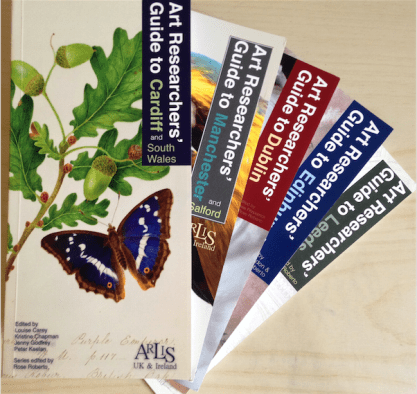
ArtResearchersGuidesLibrarians and archivists around Edinburgh, Dublin, Manchester, Leeds, Cardiff and South Wales, and Liverpool (coming in October 2016) have put together guidebooks that take researchers to treasures such as letters between Cruickshank and his publishers,  centuries-old sketches featuring Kirskstall Abby, and photos of the Cottingley Fairies.  There are botanical illustrations so realistic you feel compelled to stroke petals and illuminated maps, manuscripts and charters with the paintings of Queen Elizabeth I, whose elaborate signature officially classifies as a work of art itself.  Many of these gems are not online.

“These are handy, well designed little booklets,” says art historian, Mark Westgarth, “loosely drawing on the format of the ubiquitous city tourist guides.  They are portable, user friendly and fit in a coat pocket.”

“All these cities have fantastic collections on architecture, design and history broadly defined, but researchers don’t know how to get their hands on everything they might need — this guide helps solve that problem,” says Rose Roberto, book historian at the University of Reading and series editor.

Introductions to each guide have been written by leading scholars such as Christine Casey and Ben Read.  Through a visual narrative, all guides point the way to libraries and repositories with unique and under used resources.  Indexed by over 80 subjects, all guides include citywide maps, navigation icons, and a time-saving subject index to collections and colour images of each place.

“What makes these guides useful is the map and index.  If you’re doing research on fashion history, for example, the visual index shows which places have the right material, and whether it’s a book, archives, or audiovisual format,” says Racher Myers, former design librarian at Leeds University.

Published by the Art Libraries Society of the UK and Ireland (ARLIS), these  pocket sized guides range in price from £4.50-£8.00 each.  The books are available as a set or individually from the ARLIS website, http://arlis.org.uk/periodicals-libraries-sources/publications as well around the different cities featured in the Art Researchers’ Guide series.

New Open Access Journal: British Art Studies

Published jointly by the Paul Mellon Centre for Studies in British Art and the Yale Centre for Studies in British Art, British Art Studies is a new online, open access, peer-reviewed journal for new research and scholarship of the highest quality on all aspects of British art, architecture and visual culture in their most diverse and international contexts.

British Art Studies is one of the few completely open access journals in the field of art history, providing a forum for the growing debate about digital scholarship, publication and copyright. The Editorial of the first issue is an interesting summary of the aims and digital strategies of the journal.

Issue 1 (Autumn 2015) is avaliable now.


New Plays Added: The Romantic Illustration Network Shakespeare Gallery

New plays have been added to the RIN Shakespeare Gallery!

https://romanticillustrationnetwork.wordpress.com/shakespeare-gallery/

To zoom in on the images and see all the details clearly:

  • click on the thumbnails to see them in a larger size
  • click on ‘view full size’ (bottom right)
  • click on the full size image to zoom in, and you can also scroll left/right and up/down

Birkbeck 19th C Forum: Tuesday 26 January, ‘Julia Margaret Cameron: New Discoveries’ with Marta Weiss and Colin Ford

Birkbeck Forum for Nineteenth-Century Studies
Spring 2016 Programme

The first event of the spring term for the Birkbeck Forum for Nineteenth-Century Studies will feature Marta Weiss (Victoria & Albert Museum) presenting on ‘Julia Margaret Cameron: New Discoveries’ with Colin Ford (Former head of the National Museum of Photography, Film and Television) responding. This event is presented in collaboration with the History and Theory of Photography Research Centre at Birkbeck, and will take place Tuesday 26 January 2016 from 6.00pm to 8.00pm in the Keynes Library, 43 Gordon Square, London, WC1H 0PD.

This seminar will explore the new material Martha Weiss discovered while researching the current must-see exhibition at the Victoria and Albert Museum, marking the bicentenary of the birth of Julia Margaret Cameron, 150 years after she first exhibited her work there. Colin Ford has worked extensively on this important photographer, most notably in the comprehensive catalogue Julia Margaret Cameron: Complete Photos (Getty, 2002).

The session is free and all are welcome, but since the venue has limited space it will be first come, first seated.

For further information on the exhibition, see: http://www.vam.ac.uk/content/exhibitions/julia-margaret-cameron/about-the-exhibition/

Download Julia Margaret Cameron: Complete Photos (Getty, 2002) here: http://www.getty.edu/publications/virtuallibrary/0892366818.html

For further information on the History and Theory of Photography Research Centre, see: http://www.bbk.ac.uk/arts/research/photography

For further information on the Birkbeck Centre for Nineteenth-Century Studies, see: http://www.cncs.bbk.ac.uk/

Audio Recordings of Keynote Lectures from ‘The Arts and Feeling in Nineteenth-Century Literature and Culture’

From the Birkbeck 19th C Forum website:

‘We are pleased to announce that audio recordings of Keynote Lectures are now available for ‘The Arts and Feeling in Nineteenth-Century Literature and Culture’, a major international conference which took place at Birkbeck, University of London, 16-18 July 2015.

The conference explored the ways in which nineteenth-century authors, artists, sculptors and musicians imagined and represented emotion and how writers and critics conceptualised the emotional aspects of aesthetic response. It aimed to map the state of the field in this growing area of interest for nineteenth-century scholars by locating recent interdisciplinary work on sentimentality and art and writing and the senses within wider debates about the relationship between psychology and aesthetics in the long-nineteenth century.

Speakers investigated the physiology and psychology of aesthetic perception and the mind/body interactions at play in the experience of a wide range of arts. Key questions included: How did Victorian artists represent feeling and how were these feelings aestheticised? What rhetorical strategies did Victorian writers use to figure aesthetic response? What expressive codes and conventions were familiar to the Victorians? Which nineteenth-century scientific developments affected artistic production and what impact did these have on affective reactions?’

To access the recordings and abstracts, click here.

Image of the Month: Caricature of Darwin and the crew of the Beagle

painting-depicting-charles-darwin

Lot 10, ‘English Literature, History, Childrens’ Books and Illustrations’ Sale, 15 December 2015, Sotheby’s London. Earle, Augustus (attrib.) CARICATURE GROUP PORTRAIT ON BOARD HMS BEAGLE Watercolour, entitled “Quarter Deck of a Man of War on Diskivery [sic] or interesting Scenes on an Interesting Voyage”, depicting Darwin together with ten other figures, all crew members of HMS Beagle, including Robert FitzRoy and three other officers, shipboard with fossils, botanical and mineralogical specimens, some with captions, several figures with nautical and surveying instruments, each figure with a speech bubble with words written above in black ink, single sheet (340 x 205 mm), watercolour and ink on paper (Whatman Mill watermark, undated), [Bahía Blanca, Argentina, on or around 24 September, 1832]; some creasing and light staining, mounted. http://www.sothebys.com/en/auctions/ecatalogue/2014/english-literature-history-childrens-books-illustrations-l15408/lot.10.html

Last month, Sotheby’s in London sold for £52,500 the only known painting of the naturalist Charles Darwin aboard the HMS Beagle.

The watercolour, painted by Augustus Earle (1793–1838) was offered in the English Literature, History, Children’s Books and Illustrations sale in London. Darwin (giving a long-winded description of an insect), Captain Robert Fitzroy, and various officers and sailors are all depicted: it captures the bustle of Darwin’s historic expedition, while the speech bubbles hint at in-jokes and standing jokes from the voyage. An officer, thought to be 1st Lt John Clements Wickham, complains: “There is no such thing as walking the deck for all these cursed specimens!”

zoomable digital image of the caricature is available on Sotheby’s website, along with an article on the caricature on Sotheby’s rare books blog Bibliofile.


News: Earliest image of Chartist rally uncovered in Library of Congress

Doyle%20Bull%20Ring%20newspageThe oldest known drawing of a Chartist rally has been uncovered by RIN member Ian Haywood, after lying untouched in a sketchbook in the US Library of Congress for more than 175 years.

The pen-and-ink sketch from 1839 by Englishman Richard Doyle shows dozens of supporters being strong-armed by the Metropolitan Police who broke up the event. Officers were sent to the Bull Ring in Birmingham by the Government to bring an otherwise peaceful event in favour of political reform and social justice under control.

Doyle did not publish the image as he was only a teenager at the time, although he later went on to become an illustrator for Charles Dickens. There were no ‘respectable’ outlets for visual representations of current affairs in the late 1830s – neither the mainstream press nor the Chartist newspaper The Northern Star were able to publish illustrations at this time, and the famous satirical magazine Punch, for which Doyle later worked, was not launched until 1841.

This is why Ian Haywood’s discovery of the drawing is so important to modern understanding of Chartism. The drawing gives an insight into how observers at the time perceived the movement and the state’s response to it, several years earlier than previous records.

This image depicts in caricature form police brutality against peaceful, unarmed protestors in July 1839: the police and the authorities are depicted as giants wading into to the demonstration, kicking, scattering and grabbing Chartists by the handful. It is one of dozens of images in the sketchbook depicting open-air political meetings which suggests Doyle had a strong interest in contemporary events.

Ian Haywood said: “If Doyle’s image had been published it would have been the first visual representation of a Chartist demonstration and a significant blow for Prime Minister Lord Melbourne’s attempts to break up the movement. Doyle was a precocious talent and this could have made his name several years before he joined the staff of Punch and worked for Dickens.”

“From a historical perspective, this image is immensely valuable as it fills a gap in our knowledge of how ordinary people perceived the ‘threat’ of Chartism and also the vindictiveness of the state. It also confirms the dramatic significance of this event, the first major Chartist riot, which hardened resolve on both sides.”

Illumination: How the Visual Captures the Imagination (Senate House Library, London 28 Sept – 19 Dec 2015)

Illumination: How the Visual Captures the Imagination
Senate House Library, London

28 Sept – 19 Dec 2015

http://senatehouselibrary.ac.uk/visiting-the-library/exhibitions/illumination/

How do ideas move from the mental to the physical? From centuries old vases and painted canvasses to books and the virtual, creative ideas manifest themselves visually and allow us to understand such diverse worlds as cartography and astronomy to music and philosophy. Artists have drawn inspiration from themes which have transcended time such as the study of the human body and the natural world, to give them physical presence. The earliest printed books contained illuminations and later illustrations in which image and word converged to generate new visual forms for the reader. Technology also impacted on the ability to interpret objects moving from the naked eye to the scientific instruments designed to enhance optics. This exhibition will explore connections between these developments and how the gestation of the creative idea contributes to our understanding of visual culture. The exhibition draws together for the first time materials from Senate House Library with those of all of the Institute Libraries of the School of Advanced Study.

Over the three months, the Illumination Series will host over twenty events: lectures, symposia, workshop and performances which explore aspects of the visual through different disciplinary perspectives to bring new insights into the materials on display in the exhibition and the Library’s wider collections. Admission to the exhibition and events are free. However, due to space limitations, tickets are required for admission for the events. Click on the Eventbrite link for each event for ticket availability. For further information on the exhibition and the Series, contact the Curator and Research Librarian, Colin J.P. Homiski (details on the website).

Autumn issue of ‘Blake: An Illustrated Quarterly’ now online

“And I only am escaped alone to tell thee”: the autumn issue of Blake: An Illustrated Quarterly is now online.

http://blake.lib.rochester.edu/blakeojs/index.php/blake

Blake Illustrated Quarterly

It is dedicated to two articles on Blake’s Illustrations of the Book of Job. Mei-Ying Sung describes in detail for the first time the set of pre-publication Job proofs at the Beinecke Library at Yale, and Sibylle Erle talks about Alfred Tennyson’s copy of Job: how and when he acquired it and how he used it.

For past issues, see http://bq.blakearchive.org/