Third RIN Symposium ‘The Literary Galleries’: REGISTRATION OPEN

Romantic Illustration Network Symposium
The Literary Galleries: Entrepreneurship and Public Art’
Supported by the University of Roehampton, the Bibliographical Society, and Tate Britain

We are  pleased to announce that the third RIN symposium is now OPEN for REGISTRATION.

Friday 27th February 2015, 10am – 5pm
Board Room and Duffield Room, Tate Britain,
Millbank, London SW1P 4RG

This symposium brings together the authors of the key scholarship on the literary galleries of the Romantic period: Fred Burwick (The Boydell Shakespeare Gallery, 1996), Rosie Dias (Exhibiting Englishness, 2013), Ian Haywood (Romantic Caricature, 2013), Luisa Cale (‘Blake and the Literary Galleries’, 2008; Fuseli’s Milton Gallery 2006) and Martin Myrone (Gothic Nightmares, 2006; John Martin: Apocalypse, 2011) in a venue that is itself a form of literary gallery (Tate Britain) to present new research and to debate the relationship of painting to illustration, text, and print.  To what extent did the literary galleries change the role of illustration in the Romantic period?

Registration:

Places are FREE but limited to 15 in total, excluding speakers and organisers. This is due to restricted access to the Print Room. To secure your place, please email Mary.Shannon@roehampton.ac.uk, providing your name, status/job title, and institution (for name badges). Places will be awarded on a first-come, first-served basis and you will receive email notification. However, there will also be a waiting list. If you are unable to take up your place, please NOTIFY US BY EMAIL IN GOOD TIME so that someone else on the list may be offered your place.

We are able to offer 2 postgraduate ‘Bibliographical Society Studentships’ of £60 each to assist with the cost of attending at the symposium. Postgraduate students who live outside London are eligible. To apply, please send a CV and a statement (200 words) to Mary.Shannon@roehampton.ac.uk by Friday 6th February explaining your current research and its relevance to the interests of the Romantic Illustration Network as well as to the aims of the Bibliographical Society. Successful applicants will be notified by Tuesday 10th February.

Subject to permissions, we are hoping to record proceedings for the benefit of those unable to attend.

Programme:
10.00 Registration: meet at Staff Entrance (see map) to transfer to Board Room
10.15
Rosie Dias (Warwick), ‘Viewers, Patrons, Readers, Consumers? John Boydell’s Shakespeare Gallery and its Public’
Ian Haywood (Roehampton), ‘Macklin’s Poets Gallery and the age of Terror’
11.45 tea and coffee
12.15 Luisa Calè (Birkbeck), ‘The Hours’
1-2 Lunch (attendees to make own arrangements)
2.00 Frederick Burwick (UCLA), ‘Painting and Performance: Tableaux Vivants on the London Stage’
3pm Tours of Print Room and Galleries, led by Tate facilitators
4.00 Martin Myrone (Tate), ‘Blake and the Limits of Illustration’
4.45 Open Discussion
5pm Close. Please join us for a drink nearby.

For a full programme and a map of the venue, visit https://romanticillustrationnetwork.wordpress.com/events/

CFP: Print Culture and the Arts

‘Print Culture and the Arts’
SHARP @ SAMLA
Durham, North Carolina
13-15 November 2015

Papers are invited for the SHARP affiliate session at the 2015 South
Atlantic Modern Language Association (SAMLA) Convention. Potential
topics include print culture, history of the book, authorship,
publishing history, ephemera, illustration, publishers’ archives,
circulation, and reception. Papers addressing this year’s theme, “In
Concert: Literature and the Other Arts” are especially welcome. What
connections can be made between print culture/book history and the
areas of visual art, theatre, and music? How has the relationship
between print culture and the arts evolved from the manuscript age to
the digital world of the 21st century?

The 87th annual SAMLA Convention will be held November 13-15, 2015, at
the Sheraton Imperial Hotel & Convention Center, located in Durham,
North Carolina. Proposers need not be members of SHARP to submit, but
panelists must be members of both SHARP and SAMLA in order to present.
By June 1, 2015, please email a 350-word abstract and short biography
(including contact information) to SHARP liaison Dr. Melissa Makala,
at me.makala@gmail.com.

Please also visit SHARP at SAMLA’s Facebook page for more updates:
https://www.facebook.com/SHARPatSAMLA

Image of the Month: Mutual undermining by “Boz” and Cruikshank?

Mutual undermining by “Boz” and Cruikshank?

Helen-Frances Pilkington (Birkbeck)

Mary L. Shannon’s paper, at the recent The Artist and the Writer RIN symposium, discussed how Dickens, in the guise of “Boz”, had used Cruikshank’s established visual persona to bolster his own. This led me to think about another “Boz” – Cruikshank relationship from August 1838 in Bentley’s Miscellany, where they had engaged in some mutual under-mining. The sketch in question was the ‘Full Report of the Second Meeting of the Mudfog Association for the Advancement of Everything’ which was ‘illustrated by George Cruikshank’.

Within this article is a discussion on the local beadle. “Boz” was given the chance to state his case first. Mr Sowster, the reader is informed, was a ‘fat man, with a more enlarged development of that peculiar conformation of countenance which is vulgarly termed a double chin.’ After some ‘unconstitutional proceedings’ in which Mr Sowster was employed as a bouncer for the Mudfog meeting, “Boz” announced that he had ‘procured a local artist to make a faithful sketch of the tyrant Sowster’. This likeness was ‘from the life, and complete in every respect. Even if I had been totally ignorant of the man’s real character, and had it been placed before me without remark, I should have shuddered involuntarily. There is an intense malignity of expression in the features, and a baleful ferocity of purpose in the ruffian’s eye, which appals and sickens. His whole air is rampant with cruelty, nor is the stomach less characteristic of his demoniac propensities.’ Such a description evokes terror, potentially comic, especially when considering the satirical trope of beadles.

As noted by Sally Ledger, one of the prototypes for Mr Bumble, the beadle in Oliver Twist (1837-1838), was Robert Seymour’s 1830 engraving ‘Heaven and Earth’ in which a beadle, in a cocked hat, flowing robes and staff, descends from the clouds to deny relief to starving paupers (Figure 1: bottom centre).

Figure 1: Robert Seymour, ‘Heaven & Earth’, 1830 © British Museum

Ledger noted that ‘this image of the Beadle as a pompously attired, self-important petty official that established a satirical genealogy upon which Dickens and Cruikshank would together build a few years later in Sketches by Boz and Oliver Twist‘. Given the “Boz”-ian text, the date and the article title proclaiming the Cruikshank illustrations, the expectation for the first readers would have been a continuation of this trope. However, the ‘faithful’ sketch by the ‘local artist’ in Bentley’s Miscellany turned out to be quite different (Figure 2):

Figure 2: George Cruikshank, 'The Tyrant Sowster', Bentley's Miscellany (1838) © Victoria and Albert Museum

Figure 2: George Cruikshank, ‘The Tyrant Sowster’, Bentley’s Miscellany (1838) © Victoria and Albert Museum

In Figure 2, Cruikshank has depicted Sowster as a benignly comic figure, all double-chin and belly with little arms and legs attached, rather than the ferocious tyrant per “Boz’s” description or the pompous petty official of the satirical stereotype. So who is right? Is the ‘local artist’ incapable of accurate sketching or has “Boz” been carried away by his rhetoric?

Helen-Frances Pilkington (Birkbeck)

Helen-Frances is a PhD student at Birkbeck focusing on hot air balloons and railways in the early nineteenth century

Sources:

Dickens, Charles; ‘The Second Report of the Mudfog Association for the Advancement of Everything’; Bentley’s Miscellany; 4; (August 1838); 209-227.

Ledger, Sally; ‘From Queen Caroline to Lady Deadlock: Dickens and the Popular Radical Imagination’; Victorian Literature and Culture; 32; (2004); 575-600.

Ashmolean Blake Exhibition: Lectures and Conferences

Members of the Illustration Network might be interested in the upcoming events associated with the Blake exhibition at the Ashmolean.

LECTURES

Towards a New Era in Printmaking: Innovation in the 18th Century With Dr Ad Stijnman FRHistS, private researcher, Ashmolean Lecture Theatre, Friday 16 January, 2-3pm £5/£4 concessions. Printmaking changed dramatically after 1700 with the introduction of new plate-making and plate-printing processes, coloured inks and state of the art print presses. Dr Stijnman looks at this era in which artists, printers, engravers and publishers produced work that astonished audiences. BOOK NOW AT http://www.ashmolean.org/exhibitions/whatsontickets/

Reading in the Spirit of Blake With Saree Makdisi, Professor of English and Comparative Studies at UCLA Ashmolean Lecture Theatre, Friday 23 January, 4.30-5.30pm £5/£4 concessions. This lecture explores the relationship between William Blake’s words and the images in his illustrated books and hopes to show you how to read ‘in the spirit of Blake’. Part of the ‘Inspired by Blake’ Festival. BOOK NOW AT http://www.ashmolean.org/exhibitions/whatsontickets/

Italian Old Master Prints Through the Eyes of Blake and His Friends With Michael Bury, University of Edinburgh. Ashmolean Lecture Theatre, Thursday 19 February, 2-3pm £5/£4 concessions. In the late 18th century, Blake and his contemporaries developed a distinctive approach to the study of Italian Renaissance prints. They paid attention to printmakers whose work has been largely ignored or disparaged in preceding years. This talk examines these artworks and identifies why Blake admired them so much. BOOK NOW AT http://www.ashmolean.org/exhibitions/whatsontickets/

CONFERENCE

Apprentice & Master: Conference With the University of Oxford’s Faculty of English and the Birkbeck Centre for 19th-century Studies. Ashmolean Lecture Theatre, Saturday 24 January, 10am-8pm £30/£25 concessions. Leading academics in the study of Blake will explore a variety of perspectives on the exhibition. The conference includes lunch and is followed by a reception and private viewing of the exhibition. BOOK NOW AT http://www.oxforduniversitystores.co.uk/

CFA: ‘Illustration and Gender’

Dear Colleagues,

As you wrap up the end of your semester and look forward to the spring, I hope you will consider submitting an article to the Summer 2015 special issue of Nineteenth-Century Gender Studies on the topic of “Illustration and Gender.” We welcome articles of 5,000-8,000 words reflecting interdisciplinary approaches and international perspectives on illustration and gender studies. NCGS endorses a broad definition of gender studies, and we welcome submissions that consider nineteenth-century illustration and gender and sexuality in conjunction with race, class, place and nationality. The submission deadline for complete articles is March 15, 2015 (earlier submission is encouraged). We hope to address a variety of possible topics including but not limited to:

Studies of female illustrators of the nineteenth century

Critical histories of illustrators marked by gender and sexuality

Depictions of gender, race, sexuality, and/or class in illustrated literary works

Depictions of gender, race, sexuality, and/or class in illustrated advertisements

Illustration and gender in periodical publications

Illustration and gender in the novel

Illustration and gender in poetry

Illustration and gender in the fin-de-siècle

The influence of scientific theories and discoveries (phrenology, evolution, ethnography) on illustration and gender

Avenues opened up by the digital humanities for visualizing gender in nineteenth-century culture.

Please adhere to MLA style, using endnotes rather than footnotes, and include a coversheet with your contact information and a short (100-150 word) bio with your article submission. Please contain all identifying information to the coversheet. Feel free contact us at the email addresses listed below with any questions or concerns. You can find more information online at the following link, CFP: Illustration and Gender or please feel free to distribute the CFP to colleagues or graduate students who may be working at the intersections of nineteenth-century illustration and gender studies.

We look forward to reading your submissions!

Dr. Nicole Lobdell, Georgia Institute of Technology, nicole.lobdell@lmc.gatech.edu

Kate Holterhoff, Carnegie Mellon University, kholterh@andrew.cmu.edu

Lecture: Rosie Dias (Warwick), ‘From Counting House to Country House: Building the Image of the East India Company’

The Birkbeck Eighteenth-Century Research Group is delighted to announce a lecture in the new year by Rosie Dias, Associate Professor in History of Art at the University of Warwick.

‘From Counting House to Country House: Building the Image of the East India Company’

6pm, Thursday 15th January
Room 407, 30 Russell Square

Rosie Dias’s research focuses on eighteenth and early nineteenth-century British art and visual culture. Her monograph, Exhibiting Englishness: John Boydell’s Shakespeare Gallery and the Formation of a National Aesthetic, was published by Yale University Press in 2013.

All very welcome! For further information, please contact Kate Retford: k.retford@bbk.ac.uk

best wishes,
Ann Lewis, Kate Retford, Luisa Cale and Emily Senior

Update to the William Blake Archive

16 December, 2014

The William Blake Archive is pleased to announce a new wing of the Archive, which contains searchable HTML and PDF editions of thirty-nine past issues of Blake/An Illustrated Quarterly <http://www.blakearchive.org/blake/main.html> published from 2000 through 2009. These issues are accessible via the second entry on the home page, just below “Works in the Archive.” The PDF versions present the journal as originally published, but the HTML versions are re-implemented with many full-colour images from the Blake Archive, making it possible for users to link directly to the Archive for those works that have been published in the Archive.

This publication is the first installment of the Archive’s ongoing project of making freely available and fully searchable over four decades of past issues of Blake/An Illustrated Quarterly, thus making public some of the most important scholarly work done in Blake studies over the past half-century. Issues published within five years of the current issue will remain available only to those who subscribe to the journal <http://blake.lib.rochester.edu/blakeojs/index.php/blake>.

As always, the William Blake Archive is a free site, imposing no access restrictions and charging no subscription fees. The site is made possible by the University of North Carolina at Chapel Hill with the University of Rochester, the continuing support of the Library of Congress, and the cooperation of the international array of libraries and museums that have generously given us permission to reproduce works from their collections in the Archive.

Morris Eaves, Robert N. Essick, and Joseph Viscomi, editors
Joseph Fletcher, project manager, Michael Fox, technical editor
The William Blake Archive

New Romantic Circles Praxis Volume: Romantic Visualities

Dear colleagues,

Romantic Circles is very pleased to announce a new Romantic Circles Praxis
volume, Romantic Visualities, edited by Theresa M. Kelley and Jill H.
Casid:

http://www.rc.umd.edu/praxis/visualities

This volume is dedicated to both excavating the Romantic genealogies of
visuality and charting directions for the ways in which the study of
Romantic visual culture may redraw the geographic, temporal, and
disciplinary bounds of Romanticism, bringing diverse, and in some instances
new, objects and their ethical, political, and aesthetic stakes into view.
The essays investigate three broad inquiries: 1) technologies of vision and
objectivity’s slippages; 2) the indigenous or transplanted fruits of
visuality’s New World Genealogies and 3) the role of proto-photography,
panopticism, and slavery in the spectral formation of Romantic visuality.
Emphasizing the ways we interpret visuality in romantic culture, the volume
invites reconsideration of media, practices, and discourses that would seem
to belong to earlier and later periods—from the artifacts and modes of
viewing attached to curiosity and to technologies and ways of imaging and
imagining that have become aligned with photography and the digital. The
volume includes an editor’s  introduction by Theresa M. Kelley and Jill H.
Casid, with essays by Sophie Thomas, Marcus Wood, Matthew Francis Rarey,
Kay Dian Kriz,, and Lucy Kamiko Hawkinson Traverse.

Steve Jones
General Editor, Romantic Circles

Event Report: ‘The Artist and the Writer’, IES, 29th November 2014. Supported by the British Association of Victorian Studies and the University of Roehampton.

‘The Artist and the Writer’, IES, 29th November 2014.

Supported by the British Association of Victorian Studies (www.bavs.ac.uk) and the University of Roehampton.

‘The Artist and the Writer’ at IES told a chronological narrative of the relationship between artists and writers c. 1750 – 1850, revealing the contrasts and connections in book illustration from the eighteenth century to the Victorian period. The day opened with Lynn Shepherd’s paper on ‘Illustrating Pamela’. Shepherd showed how the illustrations to Pamela by Hayman and Gravelot create a narrative with a significantly different perspective from that provided by Pamela’s narration.  In the 28 illustrations – chosen on literary rather than visual grounds by Richardson himself – the ‘warm scenes’ are totally omitted.  Mr B’s assaults therefore exist only in Pamela’s words and not in the third person visual narration of the illustrations.  Lynn Shepherd read the images in terms of the pyramidal structures of contemporary conversation pieces, and also traced the gradual disappearance of barriers placing Pamela outside the class territory occupied by Mr B. The following discussion focused on the question of the kinds of visual literacy that readers might have brought to the task of reading the illustrations.  Shepherd argued that those who had sat for portraits would have understood the visual languages of these images.

Mary L. Shannon (Roehampton) introduces novelist and scholar Lynn Shepherd

Mary L. Shannon (Roehampton) introduces novelist and scholar Lynn Shepherd

Sandro Jung’s paper on ‘Thomas Stothard, Romantic Literature and the Illustrative Vignette’ took an ephemeral publication – The Royal Engagement Pocket Atlas  – as a means to overturn some of the key assumptions of illustration studies, namely that illustrators focused on old canon works newly freed from copyright. Stothard’s more than 800 head vignettes for Baker’s annual diary featured illustrations to recent and fashionable authors, prompting purchasers to discuss their current reading.  Baker followed Bell’s example in commissioning illustrations, but Baker made the decision to include recent poets not illustrated by Bell. Stothard, for instance, illustrated Crabbe, Byron and Scott, as well as Hayley’s Triumphs of Temper and Rogers’ Pleasures of Memory.  Stothard’s recognizable visual style thus provided a branding device not just for Baker’s publication but also for the concept of literature.  Jung argued that the Baker series offers a snapshot of consumer historical conditions.

Tim Fulford presented the early nineteenth-century as a period of virtual travel, when travellers prepared themselves by visiting exhibitions and looking at engravings, and picture books changed what the Romantic poets published.  Turning away from an earlier anti-picturesque aesthetic, and an earlier hostility about literary annuals, after 1818 Wordsworth and Southey repeatedly produced virtual topography, which functioned as guides for tourists.  The new urban bourgeoisie craved reminders of the countryside they had left, and technical developments made illustrations increasingly affordable.  Industrialization lowered the cost of paper, while from the 1820s the move to steel rather than copper engraving made larger print runs possible.  The Lake District gained its name through the sale of books of engraved views which were more popular than verse.  The Lake poets were therefore keen to foster links with artists and by the 1820s were working on jointly authored picture books in which poems were written to accompany pictures.  In the following discussion William St Clair argued that we needed to follow the logic of two industries and two media, tracing the links between them.

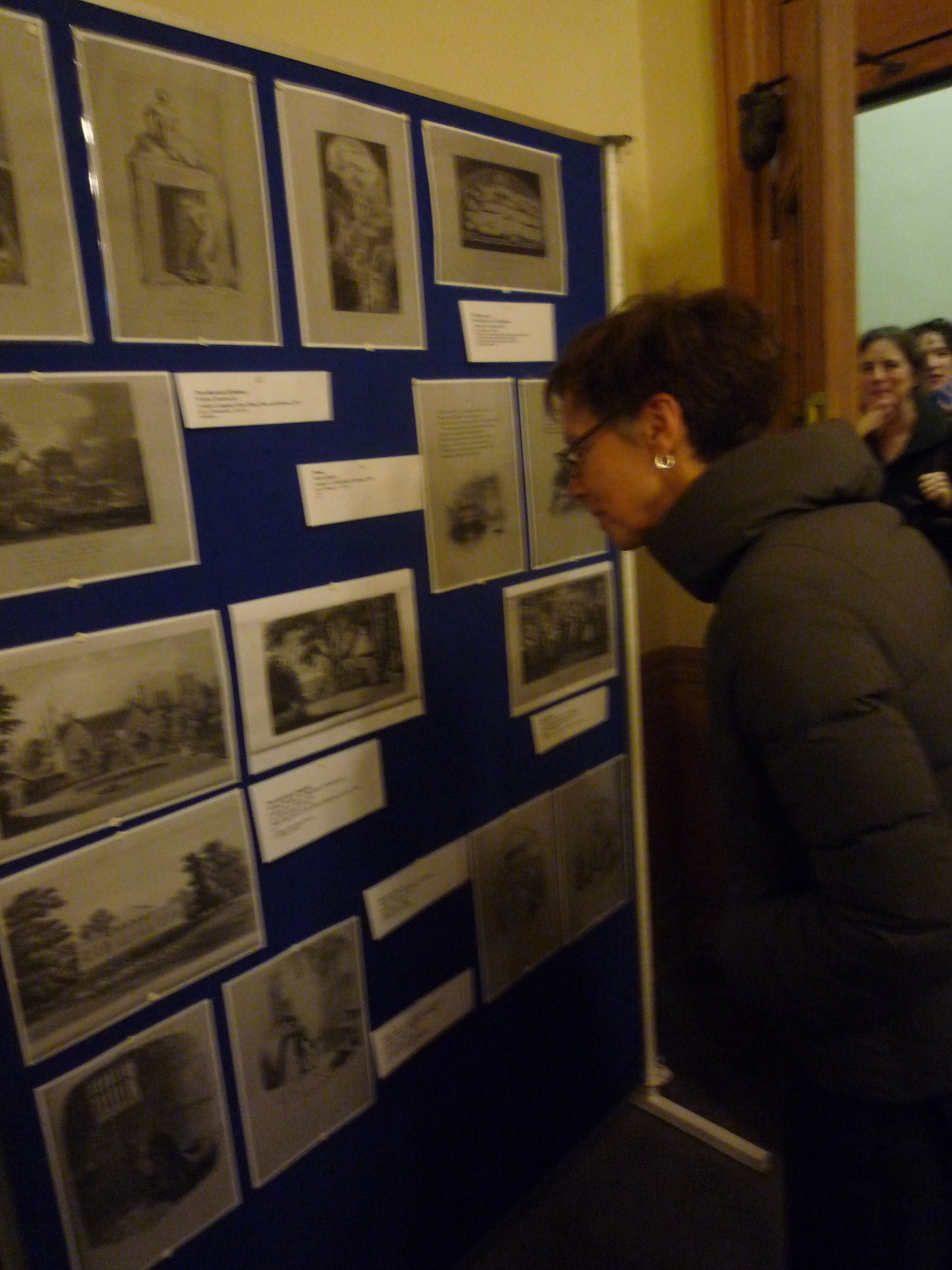
Exhibition of images from Senate  House Special Collections

Exhibition of images from Senate
House Special Collections

After a lunch sponsored by the British Association for Victorian Studies, and a visit to see some beautiful illustrated books in the Senate House library Special Collections (chosen to complement the day’s talks), Sophie Thomas traced the pre-history of the figure of the Bard in painting and illustration, from Thomas Jones’ the Bard (1774) via West, Sandby, Fuseli, Turner and Martin to the Bard in Blake’s illustrations to Gray and his painting of Gray’s Bard for his 1809 exhibition. Thomas’s paper on ‘Bardic Exhibitionism’ showed how Gray’s Bard appeared in Bentley’s illustrated Gray and reappeared in a lower illustrative mode in editions by Bell and Cooke, carrying complex meanings.

In the final session on Dickens, Mary L. Shannon’s ‘What did Dickens learn from Romantic Illustration?’ argued that Dickens drew on the more recognizable figure of Cruikshank to establish his own public identity, creating a visual image which drew on the conventions of visual Byronism.  Sadly, Ruth Richardson was unable to speak due to a bereavement, so more time was then devoted to open discussion. This ranged across author portraits, later images of Dickens and Victorian authors, continuities between the Romantic and Victorian periods, and links between theatre and visual culture. Anthony Mandal reminded us of the influence of Scott on Dickens, and Julia Thomas raised the significance of Luke Fildes’ watercolour tribute to Dickens, ‘The Empty Chair’ (1870).  The day concluded with a sociable drink nearby, at which it was agreed that the lively atmosphere, high-quality papers, and the trip to Special Collections had all made the event enjoyable, varied, and successful.

Susan Matthews, University of Roehampton

‘The Artist and the Writer’: room confirmation

If you are coming next Saturday 29th November to ‘The Artist and the Writer’, we can now confirm that it will be held in Room 349 of the Institute of English Studies, Senate House, Malet Street, London.

Signs will direct you there from Senate House reception on the day.

See the Events page of the RIN website for full details of the location and latest programme.

We look forward to seeing you there!