Symposium, The Courtauld Institute of Art: Frazzled and Dazzled

Scrambled Messages Symposium: Frazzled and Dazzled

Friday April 29th 2016

Organised by: Prof. Caroline Arscott, The Courtauld Institute of Art

Free admission

Advanced booking required via eventbrite

Frazzled and Dazzled brings together scholars from literature, art history, media studies and archaeology to focus on the flow of data and scrambling of information as historical sites take on new functions, imagery reaches new audiences and social and natural appearances are understood to be liable to blur and deceive.  Nineteenth-century instances are considered alongside key contemporary phenomena.  The day will offer broad-ranging discussions of photography, newspaper illustration, and other aspects of communications technology as well as the bafflements and reveals to be found in Victorian detective fiction and evolutionary theory.  This symposium is organised by the research project ‘Scrambled Messages: the Telegraphic Imaginary, 1858-1900’ funded by the AHRC and focusing on the cultural effects of telegraphic technology.

Please see http://courtauld.ac.uk/event/frazzled-and-dazzled for further details and booking.
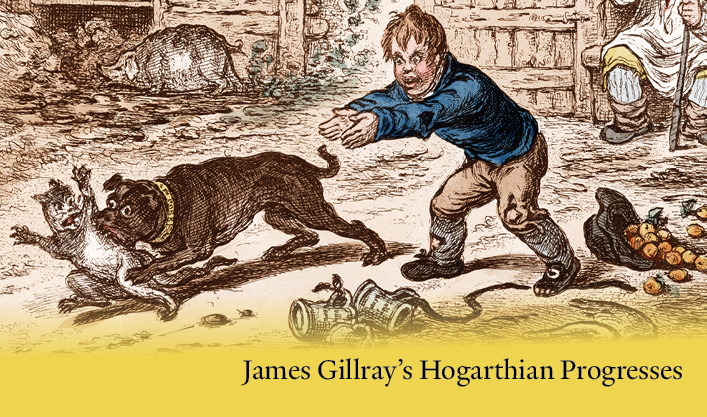
Lewis Walpole Library New Exhibition: “James Gillray’s Hogarthian Progresses”

“James Gillray’s Hogarthian Progresses”

Exhibition on view April 6 – September 16

The Lewis Walpole Library

154 Main Street, Farmington, CT 06032

Sequential narration in satiric prints is most famously associated with the “modern moral subjects” of William Hogarth (1697–1764): Harlot’s Progress (1732), A Rake’s Progress (1735), Marriage A-la-Mode (1745), and Industry and Idleness (1747) among others. HP_publicity-images_enews-lg-1Less well-known is the broad spectrum of legacy “progresses” produced by subsequent generations drawing both on Hogarth’s narrative strategies and his iconic motifs. James Gillray (1756–1815), celebrated for his innovative single-plate satires, was also among the most accomplished printmakers to adopt Hogarthian sequential narration even as he transformed it according to his unique vision. This exhibition presents a number of Gillray’s Hogarthian progresses alongside some selected prints by Hogarth himself.

Curated by Cynthia Roman, Curator of Prints, Drawings, and Paintings, The Lewis Walpole Library.

Exhibition open Wednesdays, 2-4:30 pm, and by appointment

Further information about the exhibition and associated programming

Keeping Sketchbooks: Talk and Book Launch, The House of Illustration, King’s Cross, London

Keeping Sketchbooks

14 Apr 2016, 7:00pm

2 Granary Square, King’s Cross London, N1C 4BH

Celebrate the importance of the sketchbook in this evening of illustrated talks as The House of Illustration launch Martin Ursell’s ‘Keeping Sketchbooks’

Sketchbooks are vital to the work of illustrators, artists, designers and even medical professionals. Come along for an evening of talks to celebrate the publication of Martin Ursell’s new book Keeping Sketchbooks.

Hear from three of the book’s nineteen contributors. John Vernon Lord will share his spectacularly detailed and brilliant sketchbooks of doodles and jottings complied over fifty years. Phil Carter of Carter Wong studio gives us a rare opportunity to view his stunning reportage sketchbooks. And hand surgeon Donald Summat provides insight into his immaculate working sketchbooks complied during operations and consultations.

The book will be available in the shop for signing, and Martin Ursell is offering a free copy of his limited edition Zootime, featuring a selection from thirty years of zoo drawings to anyone buying the book.

To book tickets, go to the House of Illustration’s website: http://www.houseofillustration.org.uk/whats-on/current-future-events/keeping-sketchbooks

Jane Austen and the Godmersham Park Library: Senate House, London, 7 March, 5.30-7.00 pm

The first in a new season of Open University Book History Research Group seminars, “Travelling Books and Readers in the Long Eighteenth Century,” will be held at Senate House, London (room G35) on Monday 7 March 5.30-7.00 pm. Prof. Peter Sabor (McGill University) and Dr. Gillian Dow (University of Southampton) will be giving a joint presentation entitled “Jane Austen Alone in the Library: The Books at Godmersham Park.” Their paper reports on a project to locate and identify books from the library that were read by Austen herself, as well as other members of the wider Austen family.

See the seminar series page for more details: http://www.open.ac.uk/arts/research/book-history/research-seminar-series/travelling-books-and-readers-long-eighteenth-century.

All are welcome.

Hone and Cruikshank: BBC Radio 4 Drama by Ian Hislop ‘Trial by Laughter’ now on iplayer

The Gamecock of Guildhall

BBC Radio 4 drama ‘Trial by Laughter’ is now available on iplayer for just over 20 days.

Written by Ian Hislop (the editor of Private Eye and a team captain on ‘Have I got News for You’) and his long-term collaborator Nick Newman (a satirical cartoonist for The Sunday Times and Private Eye), ‘Trial by Laughter’ is a  comedy drama based on the real transcripts of the trial of William Hone in 1817.

William Hone is the forgotten hero of free speech in Britain. He was a bookseller, publisher, printshop-owner and satirist – George Cruikshank was his friend and collaborator . In 1817, he stood trial for ‘impious blasphemy and seditious libel’. His crime was to be funny. Worse than that he was funny by parodying religious texts. And worst of all, he was funny about the despotic government and the libidinous monarchy.

Original music by Conrad Nelson
Director/Producer Gary Brown

For clips, the cast list, and background information on the trial, see http://www.bbc.co.uk/programmes/b071h2x6.

Click here to read Nick Newman’s article on Cruikshank and Hone for the BBC website.

For information on the William Hone collection at Adelphi University, USA, see http://libraries.adelphi.edu/archives-and-special-collections/special-collectionsfinding-aids/hone-collection/.

Researching visual, print and material culture in the UK?

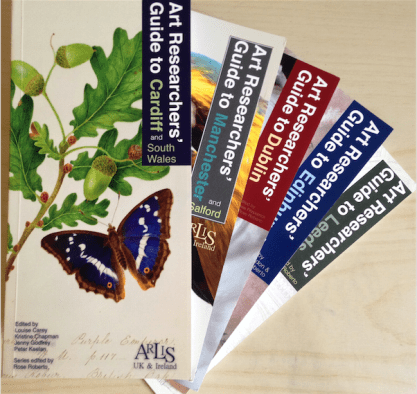
ArtResearchersGuidesLibrarians and archivists around Edinburgh, Dublin, Manchester, Leeds, Cardiff and South Wales, and Liverpool (coming in October 2016) have put together guidebooks that take researchers to treasures such as letters between Cruickshank and his publishers,  centuries-old sketches featuring Kirskstall Abby, and photos of the Cottingley Fairies.  There are botanical illustrations so realistic you feel compelled to stroke petals and illuminated maps, manuscripts and charters with the paintings of Queen Elizabeth I, whose elaborate signature officially classifies as a work of art itself.  Many of these gems are not online.

“These are handy, well designed little booklets,” says art historian, Mark Westgarth, “loosely drawing on the format of the ubiquitous city tourist guides.  They are portable, user friendly and fit in a coat pocket.”

“All these cities have fantastic collections on architecture, design and history broadly defined, but researchers don’t know how to get their hands on everything they might need — this guide helps solve that problem,” says Rose Roberto, book historian at the University of Reading and series editor.

Introductions to each guide have been written by leading scholars such as Christine Casey and Ben Read.  Through a visual narrative, all guides point the way to libraries and repositories with unique and under used resources.  Indexed by over 80 subjects, all guides include citywide maps, navigation icons, and a time-saving subject index to collections and colour images of each place.

“What makes these guides useful is the map and index.  If you’re doing research on fashion history, for example, the visual index shows which places have the right material, and whether it’s a book, archives, or audiovisual format,” says Racher Myers, former design librarian at Leeds University.

Published by the Art Libraries Society of the UK and Ireland (ARLIS), these  pocket sized guides range in price from £4.50-£8.00 each.  The books are available as a set or individually from the ARLIS website, http://arlis.org.uk/periodicals-libraries-sources/publications as well around the different cities featured in the Art Researchers’ Guide series.

New Open Access Journal: British Art Studies

Published jointly by the Paul Mellon Centre for Studies in British Art and the Yale Centre for Studies in British Art, British Art Studies is a new online, open access, peer-reviewed journal for new research and scholarship of the highest quality on all aspects of British art, architecture and visual culture in their most diverse and international contexts.

British Art Studies is one of the few completely open access journals in the field of art history, providing a forum for the growing debate about digital scholarship, publication and copyright. The Editorial of the first issue is an interesting summary of the aims and digital strategies of the journal.

Issue 1 (Autumn 2015) is avaliable now.


New Plays Added: The Romantic Illustration Network Shakespeare Gallery

New plays have been added to the RIN Shakespeare Gallery!

https://romanticillustrationnetwork.wordpress.com/shakespeare-gallery/

To zoom in on the images and see all the details clearly:

  • click on the thumbnails to see them in a larger size
  • click on ‘view full size’ (bottom right)
  • click on the full size image to zoom in, and you can also scroll left/right and up/down

Birkbeck 19th C Forum: Tuesday 26 January, ‘Julia Margaret Cameron: New Discoveries’ with Marta Weiss and Colin Ford

Birkbeck Forum for Nineteenth-Century Studies
Spring 2016 Programme

The first event of the spring term for the Birkbeck Forum for Nineteenth-Century Studies will feature Marta Weiss (Victoria & Albert Museum) presenting on ‘Julia Margaret Cameron: New Discoveries’ with Colin Ford (Former head of the National Museum of Photography, Film and Television) responding. This event is presented in collaboration with the History and Theory of Photography Research Centre at Birkbeck, and will take place Tuesday 26 January 2016 from 6.00pm to 8.00pm in the Keynes Library, 43 Gordon Square, London, WC1H 0PD.

This seminar will explore the new material Martha Weiss discovered while researching the current must-see exhibition at the Victoria and Albert Museum, marking the bicentenary of the birth of Julia Margaret Cameron, 150 years after she first exhibited her work there. Colin Ford has worked extensively on this important photographer, most notably in the comprehensive catalogue Julia Margaret Cameron: Complete Photos (Getty, 2002).

The session is free and all are welcome, but since the venue has limited space it will be first come, first seated.

For further information on the exhibition, see: http://www.vam.ac.uk/content/exhibitions/julia-margaret-cameron/about-the-exhibition/

Download Julia Margaret Cameron: Complete Photos (Getty, 2002) here: http://www.getty.edu/publications/virtuallibrary/0892366818.html

For further information on the History and Theory of Photography Research Centre, see: http://www.bbk.ac.uk/arts/research/photography

For further information on the Birkbeck Centre for Nineteenth-Century Studies, see: http://www.cncs.bbk.ac.uk/

Audio Recordings of Keynote Lectures from ‘The Arts and Feeling in Nineteenth-Century Literature and Culture’

From the Birkbeck 19th C Forum website:

‘We are pleased to announce that audio recordings of Keynote Lectures are now available for ‘The Arts and Feeling in Nineteenth-Century Literature and Culture’, a major international conference which took place at Birkbeck, University of London, 16-18 July 2015.

The conference explored the ways in which nineteenth-century authors, artists, sculptors and musicians imagined and represented emotion and how writers and critics conceptualised the emotional aspects of aesthetic response. It aimed to map the state of the field in this growing area of interest for nineteenth-century scholars by locating recent interdisciplinary work on sentimentality and art and writing and the senses within wider debates about the relationship between psychology and aesthetics in the long-nineteenth century.

Speakers investigated the physiology and psychology of aesthetic perception and the mind/body interactions at play in the experience of a wide range of arts. Key questions included: How did Victorian artists represent feeling and how were these feelings aestheticised? What rhetorical strategies did Victorian writers use to figure aesthetic response? What expressive codes and conventions were familiar to the Victorians? Which nineteenth-century scientific developments affected artistic production and what impact did these have on affective reactions?’

To access the recordings and abstracts, click here.