Author Archives: marylshannon
New Resource Added: Illustrated Satirical Pamphlets of the Queen Caroline Affair
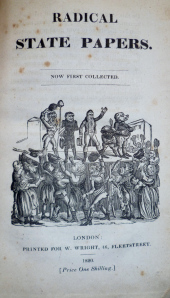
RIN member Mathew Crowther asks me to alert network members to the fact that he has created a small digital archive of material which is freely available via his wonderful blog, https://theprintshopwindow.wordpress.com.
It contains copies of the illustrated portions of some of the rarer satirical pamphlets in his collection which were published during the Queen Caroline affair of 1820-1. A number of these items are not even listed on COPAC, so it is very likely that this is the only online archive of such material.
Find it at:
Meet your fellow-RIN Members (1)
In the first of what will hopefully be come a series, RIN member Michael Demson tells us about his current research:
‘Hello, I’m Michael Demson, and I am an assistant professor of English at Sam Houston State University in Huntsville, Texas, where I teach undergraduate and graduate courses in Romanticism, World literature, and literary theory. Currently, I am working on a book-length study on transatlantic radicalism, agrarian politics, and Romantic literature, a project supported by an American Council of Learned Societies’ Fellowship for 2014-2015.
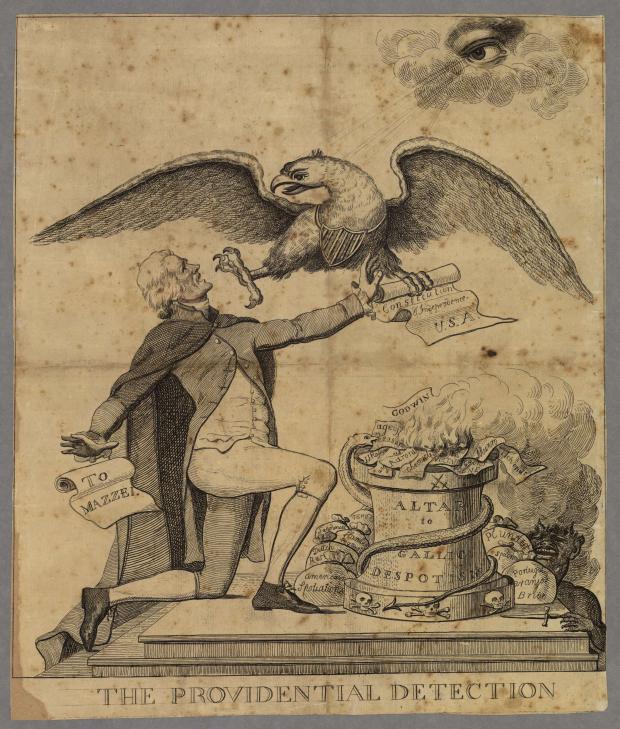
The first few chapters of this book will explore critiques of agricultural improvement in literary, philosophical, and political correspondences during the 1790s between such figures as Thomas Jefferson, Constantin-François Volney, and William Godwin (a transatlantic network of radicals that this anonymous 1798 cartoon sought to expose, figure 1.). The subsequent chapters explore later Romantic novels (Cooper, Hugo, Trollope) profoundly affected by the radical critique of improvement developed during the decade of revolutions.
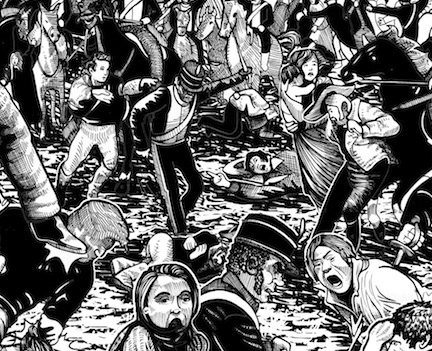
I’ve also published articles in Romanticism, European Romantic Review, Nathaniel Hawthorne Review, among others, and my graphic novel, Masks of Anarchy: The History of a Radical Poem, about the second life of Percy Shelley’s 1819 lyrical satire among garment workers in New York City at the turn of Twentieth Century, was published by Verso Books in 2013 (figure 2.). You can reach me at demson@shsu.edu.’
Funding secured for next Symposium from British Association of Victorian Studies
We are delighted to announce that the next symposium of the Romantic Illustration Network, on Saturday 29th November 2014 at the Institute of English Studies, Senate House, University of London, will be supported by the British Association for Victorian Studies (BAVS): http://www.bavsuk.org.
It was clear from our first symposium in June (see an earlier post for the event report) that much important work on book illustration has been done within Victorian studies, and part of RIN’s role will be to establish fruitful dialogue between researchers working across the eighteenth and nineteenth-centuries.
Further details for November’s event will be announced soon via this blog.
New Resources added: Bibliography entries
RIN member Paul Barnaby, of the Walter Scott Digital Archive, had made the following suggestions for the RIN bibliography, which I’ve now added:
Garside, Peter. ‘Illustrating the Waverley Novels: Scott, Scotland, and the London Print Trade, 1819-1836’, The Library, 11 (2010), 168-96.
Garside, Peter. ‘Print Illustrations and the Cultural Materialism of Scott’s Waverley Novels’, in British Literature and Print Culture, ed. Sandro Jung (Cambridge: D. S. Brewer, 2013), pp. 125-57.
(This essay collection also has a chapter by Sandro Jung on illustrations of Thomson’s The Seasons in the 1790s.)
Hill, Richard. ‘The Illustration of the Waverley Novels: Scott and Popular Illustrated Fiction’, Scottish Literary Review, 1.1 (2009), 69-88.
Hill, Richard. Picturing Scotland through the Waverley Novels: Walter Scott and the Origins of the Victorian Illustrated Novel. (Farnham: Ashgate, 2010)
Westover, Paul. ‘Illustration, Historicism, and Travel: The Legacy of Sir Walter Scott’, in Necromanticism: Traveling to Meet the Dead, 1750-1860 (Basingstoke; New York: Palgrave Macmillan, 2012), pp. 142-73.
If you have any suggestions for texts we should include on the Bibliography page, or would like us to add your book or article, please email me at Mary.Shannon@roehampton.ac.uk.
Seminar ‘Early popular visual culture: dissemination networks and image traditions, 1700-1914’.
An invitation from Dr. Jeroen Salman,
Faculty of Humanities, Utrecht University:
Seminar: ‘Early popular visual culture: dissemination networks and image traditions, 1700-1914’.
Location and date
Bijzondere Collecties UvA, Turfmarkt 129, 1012 GC, Amsterdam, Van Leerzaal
Friday 26 September, 9.30 until 16.30
Registration
Information and registration
Dafna Ruppin (d.ruppin@uu.nl)
Outline
This seminar is about image traditions in print and film culture as well as on the infrastructure, that is the production, distribution and reception, behind popular media such as penny prints, photographs and early movies (from the 18th until the 20th century). The leading questions are: In what way did images of narratives, fictional heroes, national identities and colonial cultures change over time, and how was this influenced by the context in which these images were produced? Who was responsible for the publication and production of these texts and images and what were their motives? What were the networks behind the production and distribution and how functioned the reception (reading, using, reviewing) of this material?
This seminar is a joint collaboration between two Utrecht projects: ‘Popularisation and Media Strategies (1700-1900)’ lead by Jeroen Salman and ‘The Nation and Its Other: The Emergence of Modern Popular Imagery and Representations’ lead by Frank Kessler. These projects are financed by NWO and part of the Cultural Dynamics research program.
The program of the seminar comprises keynote lectures by John Plunkett (Exeter) and Alexandra Franklin (Oxford) and lectures by the members of the two research groups: Frank Kessler, Sarah Dellmann, Dafna Ruppin, Jeroen Salman and Talitha Verheij.
Besides scholars in the field, we also invite research master students and PhD-students to participate (they will receive credits for it: 1 ECTS). The students have to prepare for this seminar by reading articles, formulating questions and handing in an abstract of a recent paper/thesis.
During lunch time the participants will be offered a guided tour through the exhibition ‘Sterke verhalen’ (‘Tall tales’).
New Resource Added: Walter Scott Illustrations
The following resources were suggested by Paul Barnaby, Project Officer for the Walter Scott Digital Archive, which draws upon the collections of Edinburgh University Library.
1) Walter Scott Image Collection (Paul Barnaby):
http://www.walterscott.lib.ed.ac.uk/imdata.html
This is an image library of just over 1000 illustrations to the works of Walter Scott and other Scott-related publications. It is part of a larger site, the Walter Scott Digital Archive.
2) Illustrating Scott: A Database of Printed Illustrations to the Waverley Novels, 1814-1901 (Peter Garside and Ruth McAdams):
http://illustratingscott.lib.ed.ac.uk/
Blake, The Flaxmans, and Romantic Sociability: 18-19 July 2014
RIN member Luisa Calè (Birkbeck) asks me to post the following:
I hope you are enjoying the summer. I am writing to invite you to attend
Blake, The Flaxmans, and Romantic Sociability
18-19 July 2014
Keynes Library, School of Arts, Birkbeck, 43 Gordon Square, London
Registration and Programme:
http://www.bbk.ac.uk/events-calendar/blake-the-flaxmans-and-romantic-sociability
Blake’s sociability encompasses the real, the satyrical, and the imaginary. His visionary company includes ‘Companions from Eternity’, corporeal friends, and spiritual enemies. From the salon to the moon, across the geographies of ‘a certain island near by a mighty continent’, a mighty cast of characters intermingle. Enter Steelyard the Lawgiver and Mrs Nannicantipot, Suction the Epicurean, Sipsop the Pythagorean, Quid the Cynic, Inflammable Gas the Wind Finder, Etruscan Column the Antiquarian, Aradobo the Dean of Morocco, Obtuse Angle, Tilly Lally the Siptippidist, Miss Gittipin, Gibble Gabble, and Scopprell. Their imaginary, emergent, and satyrical disciplines include ‘Fissic Follogy, Pistinology, Aridology, Arography, Transmography, Phizography, Hogamy HAtomy,& Hall that’. This wild jamboree is a record of the convivial friendship and patronage of John and Ann Flaxman, Harriet and her husband the Reverend Anthony Stephen Mathew, who provided the young artist with ‘The Bread of sweet Thought and the Wine of Delight’.
Starting from the world of An Island in the Moon, this conference illuminates Blake’s relationship with the ‘Sculptor of Eternity’ and his circle from the early days to the ‘Regions of Reminiscence’, from the 1780s to the 1820s, following the Flaxmans across the channel, into the cosmopolitan networks of the Grand Tour, in order to recover the material cultures, sites, and dynamic forms of their Romantic sociability.
Conference organizers: Helen Bruder and Luisa Calè
Contact: blakeflaxman@bbk.ac.uk
To book a place to attend the conference, you need to follow the link at the bottom of the website.
CFA: Picturing the Eighteenth-Century Novel Through Time: Illustration, Intermediality and Adaptation
Title: Picturing the Eighteenth-Century Novel Through Time: Illustration, Intermediality and Adaptation
Call for Articles
Christina Ionescu <cionescu@MTA.CA>
Deadline for abstracts: 1 August 2014
‘Have you noticed that no book ever gets well illustrated once it becomes a classic?’, asked in passing Aubrey Beardsley when faced with the challenge of illustrating Les Liaisons Dangereuses in the Art Nouveau era. Yet visually intriguing and conceptually intricate illustrations of eighteenth-century classics are abundantly present at key moments in the history of the book (Romanticism, the fin-de-siècle, the interwar period, amongst others). Defoe’s Robinson Crusoe, Swift’s Gulliver’s Travels, Voltaire’s Candide, Rousseau’s La Nouvelle Héloïse, Goethe’s Werther and Bernardin’s Paul et Virginie are just some examples of canonical texts that have inspired artists not only through time but also across national boundaries and different media. Such texts have produced visual corpora that are as vast as they are diverse. The timeless fascination with Paul et Virginie, for example, has resulted not only in illustrative series that steadily accompanied the text in its various incarnations as a book, but also in drawings, prints, sculptures, caricatures, tapestries, ceramics, clocks, etc., which circulated and were displayed independently of the text. Artistic transpositions and intermedial engagements with eighteenth-century bestsellers range from these visually static, yet geographically mobile forms of expression, to dynamic, performative adaptations such as films, operas and plays.
In spite of the increasing availability of digital images, critical approaches still tend to privilege the authorially sanctioned series (such as Gravelot’s engravings for Rousseau’s bestselling novel, commissioned and designed with the writer’s direct involvement), or ‘intervisual paradigms’ (patterns of iconographic representation considered independently of their text of origin). Moreover, theatrical or cinematic adaptations of eighteenth-century novels are seldom considered in relation to other forms of visual crossover, such as book illustration and decorative objects, though they all a priori rely on similar processes of visualising and adapting the text. The comparative analysis of different series of illustrations and of other forms of artistic representation of the same novel through time and space, however, allows us to explore the complexity of adaptation, to understand the visual representation inspired by text as an intermedial product and cultural phenomenon, and perhaps to grasp the fascination that the eighteenth century continues to exert upon us.
We invite submissions of papers that address any of the following questions through interdisciplinary and cross-cultural approaches:
• How does the illustration of an eighteenth-century novel through time respond to new techniques and to changing views of the function of illustration itself?
• How do successive generations of artists shape the reception of an eighteenth-century novel at different moments in time?
• How do illustrated translations of eighteenth-century classics reflect the geographical, linguistic and cultural displacement of the original text?
• How does the gradual shift from the poorly paid artisan to the internationally known artist affect the illustration of an eighteenth-century classic?
• How do publishers operating from lucrative centres of book production (Amsterdam, Brussels, The Hague, London, Paris, etc.) respond to the specific expectations of their subscribers or readerships in regard to illustration?
• How do artists, publishers and/or stage directors facilitate or negotiate verbal/visual crossover? What is their respective involvement in this process?
• How do individual artists re-view an eighteenth-century text when they illustrate it again for a different publisher or edition?
• How does the phenomenon of extra-illustration exemplify a unique rapport of visual closeness between the collector and text? How is the reading process impacted by the insertion within a single volume of parallel illustrations of the same scenes, which were executed at different moments in time?
• How do objects inspired by eighteenth-century novels become cultural artefacts and exist independently of the text? How are they integrated in home décor, private collections or museum space? And what impact do they have as things commissioned, inherited, or collected?
• How is visual representation transposed from one medium to another (for example, from book illustration to film adaptation)? What are the similarities and differences in the ways in which the text is visually adapted for each medium of expression?
Please send an abstract of 500 words to a.lewis@bbk.ac.uk and cionescu@mta.ca by 1 August 2014. The deadline for submission of completed articles will be June 2015 (approximately 8000 words). Articles may be in French or English. As is usual for peer-reviewed journals, all final decisions concerning the acceptance of articles for this special issue will be made by the JECS editorial board. We also intend to host a workshop around the collection at the BSECS annual conference in January 2016.
Romantic Circles Gallery of Romantic Visual Culture
Theresa Kelley and Richard C. Sha forward a link to their Romantic Circles Gallery of Romantic Visual Culture (see below). They say:
‘If anyone has interest in pulling together an exhibition of roughly ten images into an exhibit, please send us a proposal. The following link shows what we already have:
http://www.rc.umd.edu/gallery/exhibits
Here is the rationale for the gallery:
http://www.rc.umd.edu/gallery/about ‘
For further information, contact
Richard C. Sha [rcsha@american.edu] or Theresa Kelly [tkelley@wisc.edu]