Discovering the Legacy of the the Boydell Shakespeare Prints: A Collector’s Experience

by Jessica Ghyvoronsky

Jessica Ghyvoronsky is an artist, collector, and artist advocate based in Seattle, WA. She received both of her Bachelors degrees from the University of Washington in Interdisciplinary Visual Arts as well as Philosophy, and received her MFA in Visual Art from Azusa Pacific University. She has been active in the Seattle art world through her ventures Seattle Art Post and River Seattle, and has recently begun apprenticing in the realm of appraising fine art and antiques, working towards her Appraiser Certification through the Appraiser’s Association of America. She feels very lucky to own 18 of the original engravings, as they are rare and important artifacts that document the intersection of literature and visual arts of the 18th century in such a specific way. Her nearest goal is to collect the rest of the Seven Ages of Man – Stages 1-3, to complete that portion of the collection. Most of the prints are for sale on Etsy.

It was June 2024 when I was helping organize the attic of an antique shop I work with, sorting through a room full of boxes and antique items, when we came across a stack of large prints that were loosely draped behind a large pile of boxes. The sixteen prints were each in their own individual protective sleeve, and the stack was almost tri-folded. The prints were thankfully not creased, but certainly left in a state where we knew they’d require some love and effort to flatten them out again. They had been there for years, and were just seeing light again. I have always been drawn to antique etchings and engravings, but these were notably more beautiful than most of the works I’ve seen before, in the Romantic age style, all featuring scenes from some of Shakespeare’s most iconic plays. I was smitten, to say the least, and ended up procuring them and begun the process of carefully flattening the pages at home while researching the collection. I reached out to Shakespeare and Boydell experts all around the world, and owe most of my thanks to Dr. Rosemary Dias, who confirmed that I did indeed have the original large-format engravings that were first released by the Boydell Shakespeare Gallery and pointed me toward great references to learn more.

Laying out the prints all together for the first time.

Not a month into my research, my husband Mikhail and I were driving in Mount Vernon Washington and happened upon an Antique Fair that was ending that very day. Of course we had to stop by, and to my surprise while perusing a vendor’s inventory, I found two Boydell Shakespeare prints for sale, of the same large size format. The chances of this happening were extremely rare, one might even venture to name Fate as responsible. Since many of these engravings were originally bound into a folio and eventually became separated as individual works of art, most of these prints have been trimmed down in size from their original state to fit into frames more evenly. This is the case for these two prints I stumbled upon at the Antique Fair. The rest of the 16 prints that I previously found in the attic of the antique shop, however, remain intact in their original size, untrimmed. These large folio-sized prints are rare and many are exhibited in such museums as The British Museum, The Met Museum, The Folger Shakespeare Library, and The Smart Museum of Art at the University of Chicago.

This brings me to the following study of all I have learned thus far about the Boydell Shakespeare Gallery and of these prized engravings from 1796 that came into my possession. Some of the original paintings from the Boydell Shakespeare Gallery have been destroyed or simply disappeared, leaving their engraved copies as the only evidence we have that they ever existed. All of the photos included in this article are my own, of the prints that I now have in my collection.

Finding two more prints at the antique fair.

The Boydell Shakespeare Gallery

In November 1786, Josiah Boydell, a printer and publisher, organized a dinner in London with prominent artists and important representatives of London. They came up with the idea of making a special edition of Shakespeare’s plays with illustrations. Just a week later, Josiah and his uncle John Boydell decided to go even bigger: they planned to open a place called The Shakespeare Gallery. This gallery opened in London’s Pall Mall in 1789. It displayed brand-new, life-size paintings of scenes and characters from Shakespeare’s plays. The gallery became very popular, charging one shilling for entry and attracting hundreds of visitors every day. This was around the time when museums like the British Museum were starting to become popular. Boydell saw this trend and used it to create a unique museum experience focused entirely on Shakespeare.

The Engravings

Boydell changed the art world by making it more commercial, moving away from relying solely on wealthy patrons. The Shakespeare Gallery was a prime example of this shift, demonstrating that art could be turned into prints and sold to many people. Large prints of the paintings in the gallery were sold through subscriptions starting in 1791. Smaller versions were included in a new edition of Shakespeare’s plays. It took ten years to publish the complete set of nine large folios in 1802. In 1803, Boydell printed two large books containing all of the engravings. Engraving became more popular in the 18th century, growing alongside the book industry as literacy grew. Boydell’s new way of marketing, combining exhibitions with print sales, became a model for others to follow, and inspired galleries like Thomas Macklin’s Poet Gallery, Henry Fuseli’s Milton Gallery, Blake’s Dante Gallery, and the Dore Gallery. 

Josiah Boydell not only published the Shakespeare Gallery folios, he was also a painter. This picture shows a powerful moment from the play “King Henry IV, Part 2” where Prince Hal stands by his dying father’s bed and tries on the crown. 
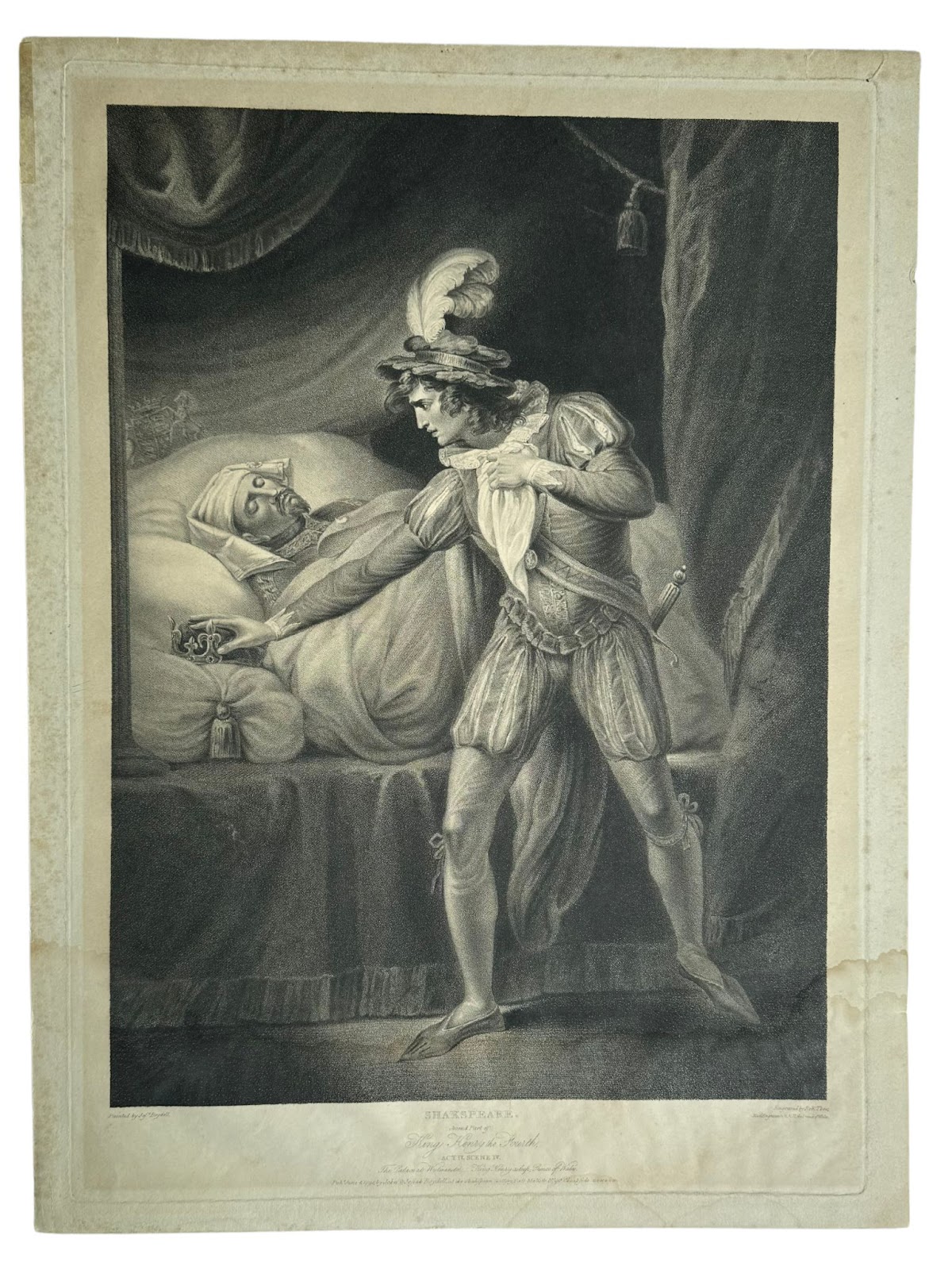
Josiah Boydell: Second Part of King Henry the Fourth. Act IV, scene iv. The Palace of Westminster. – King Henry asleep; Prince of Wales. Engraved by Robert Thew, published June 4, 1795.

History Painting

Boydell’s gallery brought a significant change to English painting. Previously, most artists earned their living by painting portraits for wealthy nobles. Boydell changed this by hiring top artists to create artworks based on Shakespeare, other writers, and English history. The Boydells aimed to promote British painting, focusing on History Painting. This type of art depicted important events and moral lessons, considered the most prestigious form of art at the time. Shakespeare, emerging as a national symbol, was an ideal subject for their endeavors. Boydell’s initiative created a demand for history paintings, providing artists with a new income source beyond portraits. Some artists worked on these projects for eight to ten years. Boydell paid generously for their works, offering painters around 500 pounds and engravers even more. This increased the popularity of history painting, placing it on par with portraits and landscape paintings.

Starting with 34 paintings in 1789, the collection grew to over 160 by 1802, profoundly shaping how Shakespeare was visually portrayed for generations. Boydell’s emphasis on history painting wasn’t accidental; it coincided with England’s recovery from a tumultuous period, including the Treaty of Versailles ending the American colonies’ war, which had divided Parliament and weakened the monarchy. As London’s Mayor, Boydell had a personal and political interest in promoting his country’s stability and the monarchy’s authority. He achieved this by glorifying England’s past through its greatest playwright. The Shakespeare Gallery not only celebrated England’s cultural and literary heritage but also revived national pride during a time of crisis. Visiting and supporting the Shakespeare Gallery became a way for people to show their patriotism. Boydell, though innovative for his time, faced bankruptcy due to his failure to meet the high standards of history painting and the loss of his European market during the French Revolution. The entire collection of 167 paintings was sold in a lottery and dispersed, with some artworks disappearing forever.
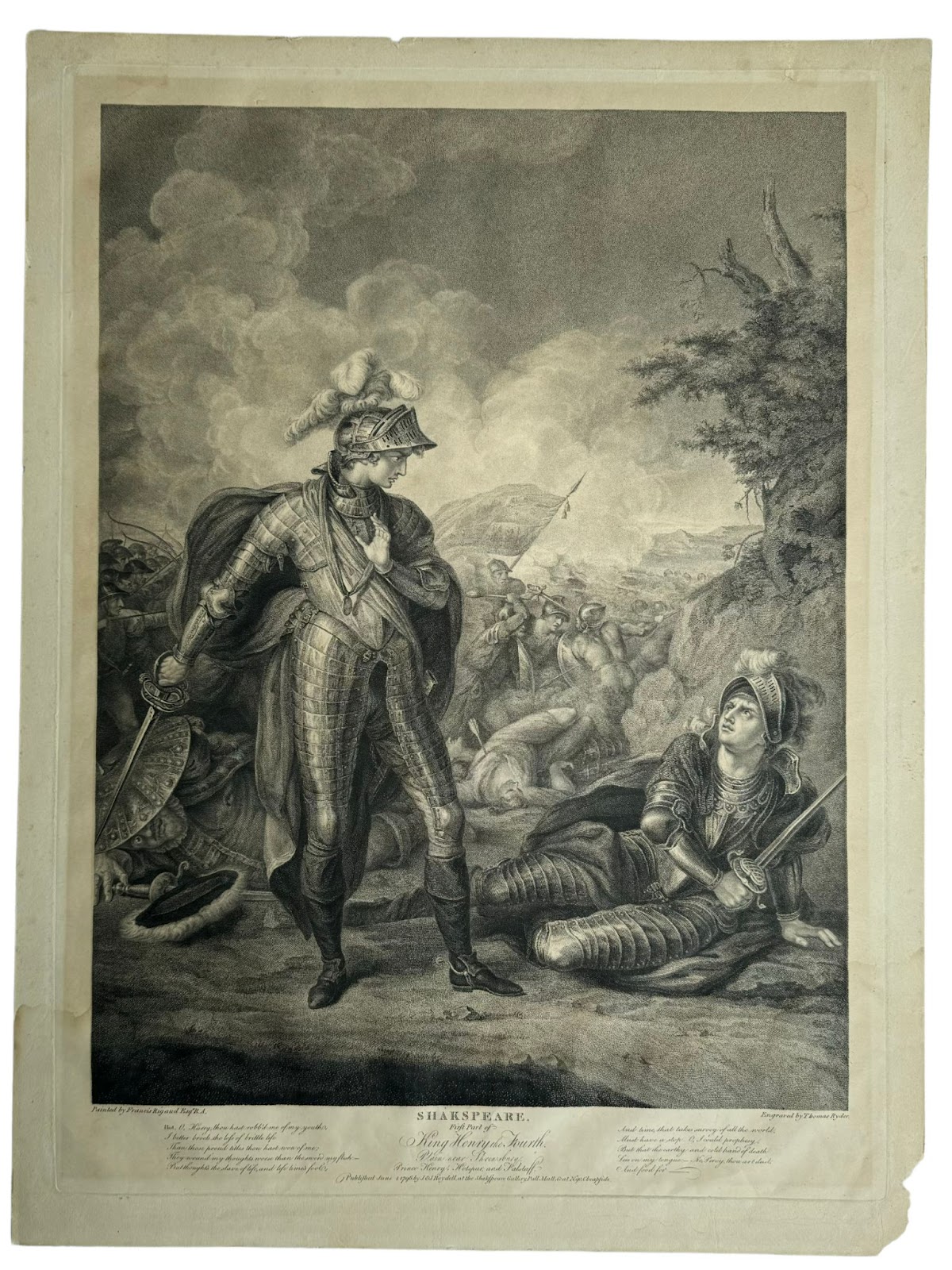
John Francis Rigaud: First Part of King Henry the Fourth. Act V, scene iv. Plain near Shrewsbury, Prince Henry, Hotspur, and Falstaff. Engraved by Thomas Ryder, published June 1, 1796.

Hot: O, Harry, thou hast robb’d me of my youth:

I better brook the loss of brittle life

Than those proud titles thou hast won of me;

They wound my thoughts worse than thy sword my flesh: –

But thought’s the slave of life, and life time’s fool;

And time, that takes survey of all the world,

Must have a stop. O, I could prophesy,

But that the earthy and cold hand of death

Lies on my tongue; – No, Percy, thou art dust,

And food for____”

In this battlefield scene, the artist shows a young soldier holding up a flag as a sign of victory, fearlessly leading his men into battle.

This piece shows a scene from William Shakespeare’s play where Prince Henry, Hotspur, and Falstaff are on a plain near Shrewsbury. In Shakespeare’s story, Prince Henry is determined to kill the rebellious knight Hotspur, who has fought against King Henry IV of England. The engraving depicts Hotspur being fatally wounded by Prince Henry during the battle of Shrewsbury, while Falstaff pretends to be injured or dead nearby. 
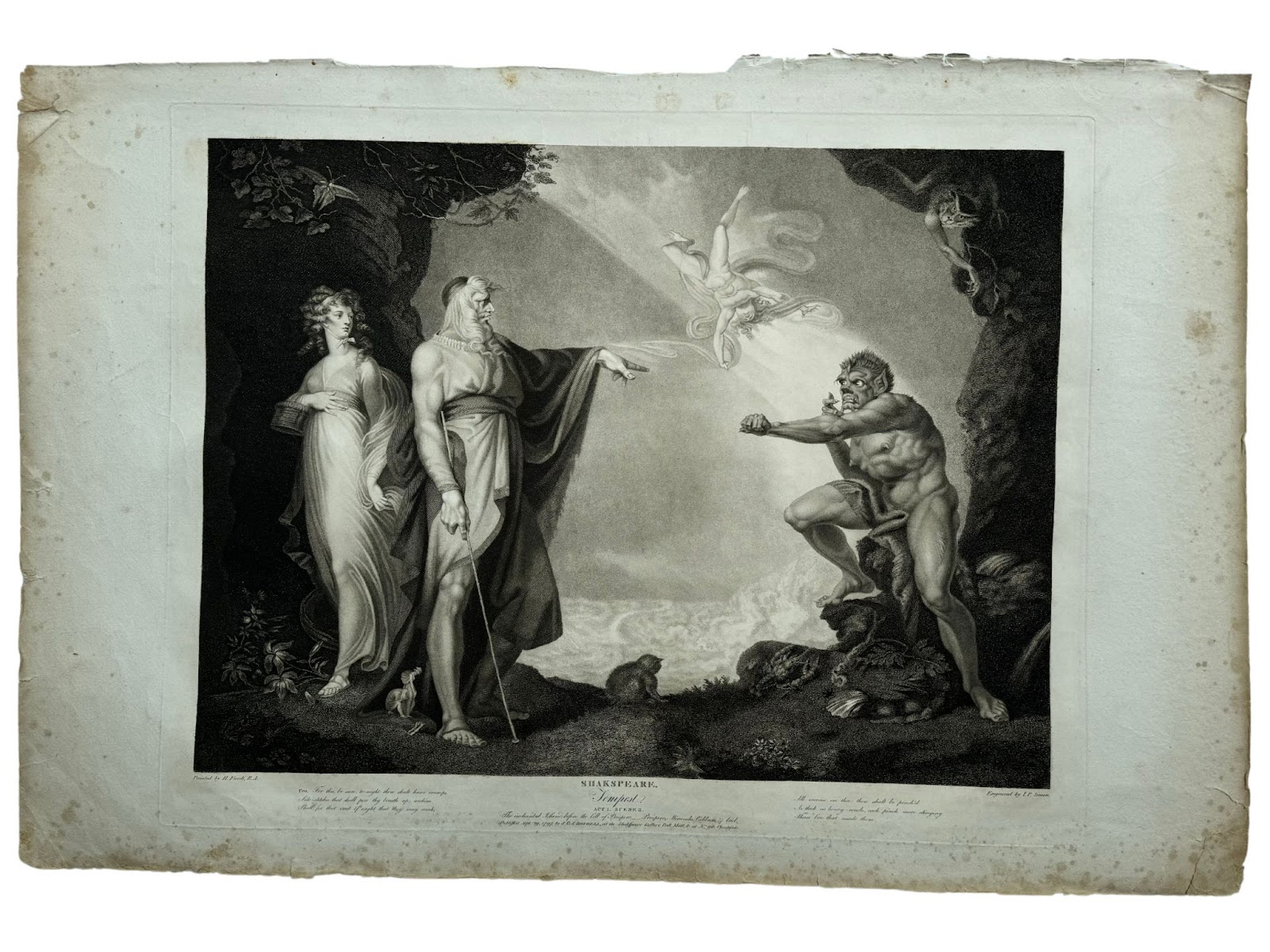
Johann Heinrich Fuseli: The Tempest. Act I, Scene ii. The inchanted Island: Before the Cell of Prospero. – Prospero, Miranda, Caliban, & Ariel. Engraved by Jean Pierre Simon, published Sept 29, 1797. Location of original painting: City of York Art Gallery: Head of Prospero only.

“Pro. For this, be sure, tonight thou shalt have cramps,

Side-stiches that shall pen thy breath up; urchins 

Shall, for that vast of night that they may work, 

All exercise on thee: thou shalt be pinch’d

As thick as honey-combs, each pinch more stinging

Than bees that made them.”;

Various nationalist themes can be found in the way some of the artists chose to depict their scenes, as in The Tempest, where Prospero’s power is subtly undermined, questioning his right to sovereignty. At first pass, one might view Caliban as subservient victim and Prospero as the authoritative disciplinarian, but there are key details that undermine the supposed power of Prospero. The viewer’s eye is directed to Caliban, not Prospero. Caliban is just more interesting to look at – lit from above, where we practically see his full form and face (versus the half profile view of Prospero and Miranda), strong muscular body, striking and terrifying face. Seeing as how the artist Henri Fuseli spent a significant amount of his studies in Rome, viewing the works of Michelangelo, one can see the similarities to the Creation scene in the Sistine Chapel. Only here, Caliban’s form plays the role of God, with an outstretched defiant fist and Prospero the role of Adam, pointing accusatorily. It could be said that this is Fuseli’s commentary on the political climate in England, revealing King George as tyrannical and not the true Sovereign.
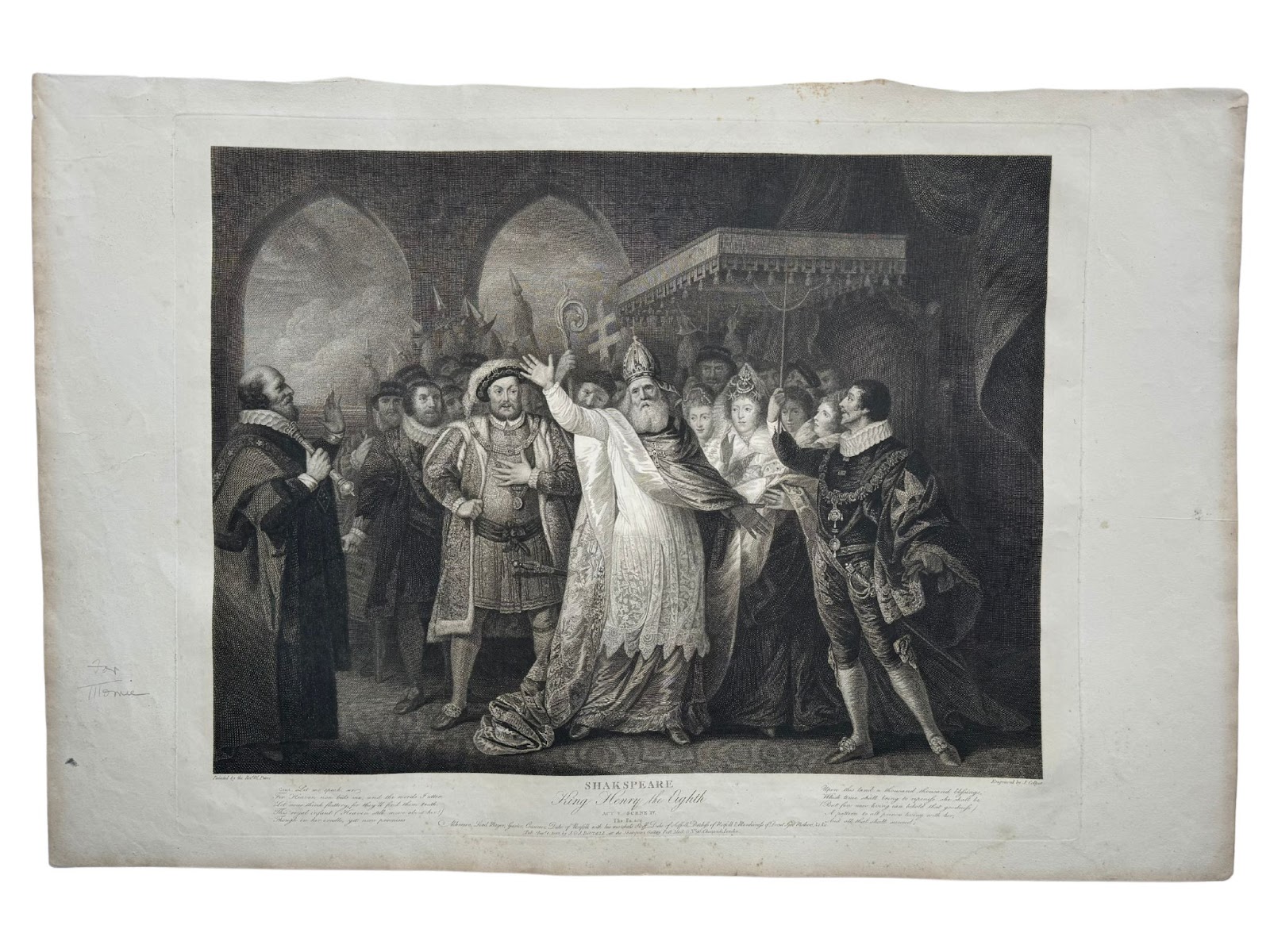
Rev Matthew Peters: King Henry the Eighth. Act V, scene iv. The Palace, Aldermen, Lord Mayor, Garter, Crammer, Duke of Norfolk & Marchioness of Dorset, God Mothers, & c. & c. Engraved by Joseph Collyer, published Dec 1, 1803.

“Cran. Let me speak, sir,

For Heaven now bids me; and the words I utter

Let none think flattery, for they’ll find them truth.

This royal infant (Heaven still move about her!)

Though in her cradle, yet now promises

Upon this land a thousand thousand blessings,

Which time shall bring to ripeness: she shall be 

(But few now living can behold that goodness)

A pattern to all princes living with her,

And all that shall succeed;”

In this scene by Reverend Matthew Peters from King Henry the Eighth, Archbishop Cranmer’s influence over the King is feared, as the king trusts his integrity and rescues him from the hands of the conspiratorial nobles. To further demonstrate his endorsement of the Archbishop, the King has him serve as godfather at Elizabeth’s christening. The painting represents the union of Church and Monarchy, with the Church exhibiting more prominence and glory over the Monarchy.

The Stage

It is not surprising that many of the paintings in the Shakespeare Gallery feature scenes that look like they could’ve been captured on the theater stage. It would have been impossible for the artists to have not been influenced by their visual experiences as theatergoers while recreating their scenes into painting.

In this scene, Robert Smirke portrays a play-within-a-play by Shakespeare, framed by velvet curtains, as a theater stage would. A lord pranks a drunk tailor named Sly by treating him as a nobleman who has been asleep for fifteen years. The servants, hiding their laughter, play along. Sly, thinking he is a nobleman, meets a page posing as his wife, who persuades him to watch a comedy instead of joining him in bed. Shakespeare’s play illustrations pose questions for historians: Do they reflect stage productions accurately or influence them? 

Black figures in British Art

In the original painting, Robert Smirke included the portrayal of a black servant, standing taller than the surrounding highborn gentlemen, holding a pitcher of what could possibly be water or coffee. Between the 16th and 17th centuries, Black servants (most were slaves at the time) were seen as symbols of wealth, status and refinement within British aristocratic homes. By the late 18th century, slavery in Britain became increasingly rare, resulting in legal and social opposition after 1772. In earlier 18th century portraits, Black servants, often boys or young men in exotic attire (often a mix of African, Indian and Arab influences as we see in this piece), were depicted in affluent domestic settings, alongside commodities like coffee, chocolate, or tea from the West Indies. Unlike the overexaggerated racist depictions common in America, European artists often portrayed Black figures with individuality and dignity. It is important to call out how these images still reflected underlying themes of objectification and racial hierarchy.
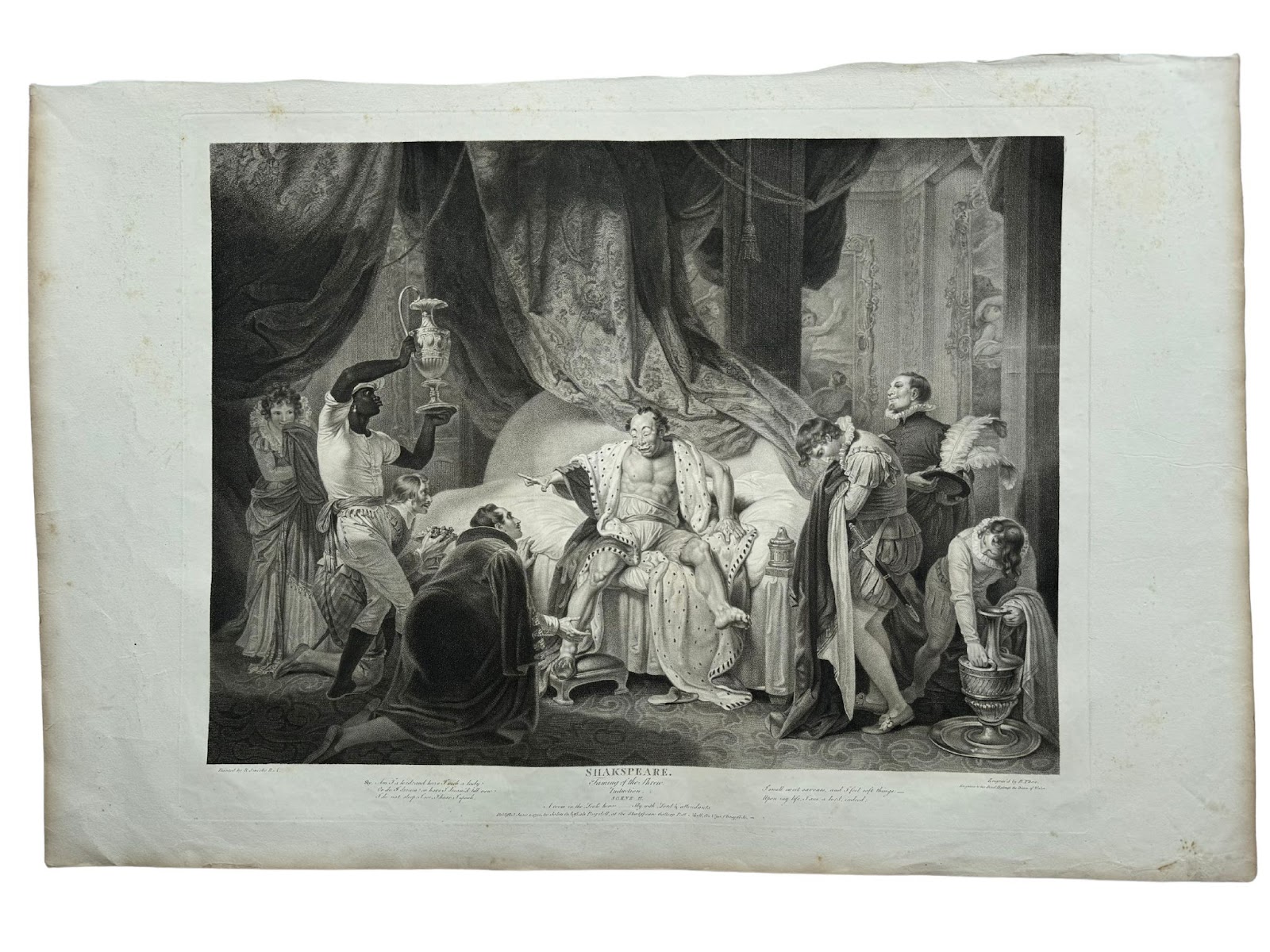
Robert Smirke: Taming of the Shrew. Introduction. Scene ii. A room in the Lord’s house. – Sly with Lord & attendants. Engraved by Robert Thew, published Jan 4, 1794.

“SLY. Am I a lord? And have I such a lady?

Or do I dream? Or have I dream’d till now?

I do not sleep: I see, I hear, I speak:

I smell sweet savours, and I feel soft things:-

Upon my Life, I am a lord indeed;”
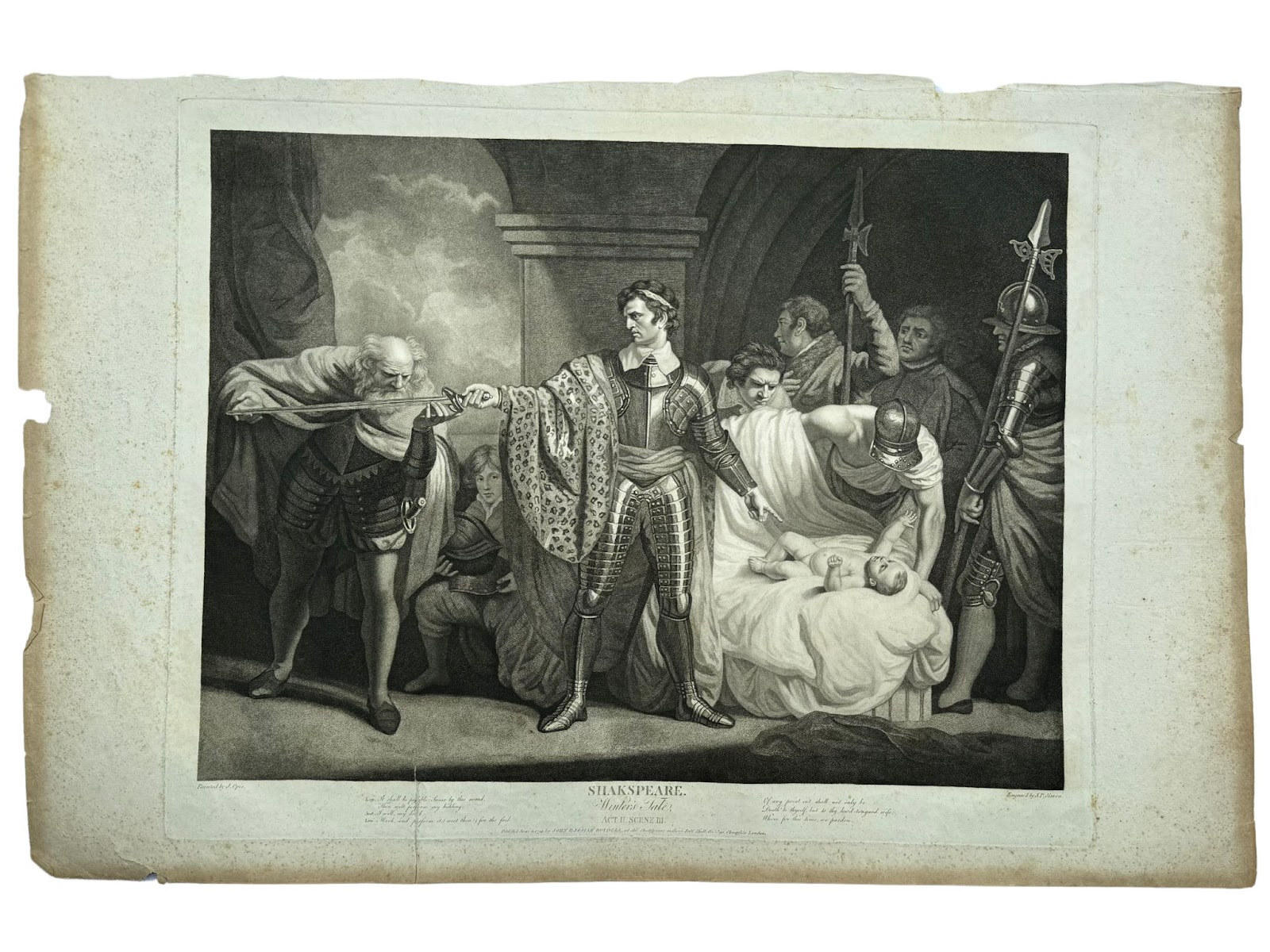
 John Opie: Winter’s Tale. Act II, scene iii. Engraved by Jean Pierre Simon, published June 4, 1793. Location of the original painting: Northbrook Sale, Stratton Park, November 27, 1929

“LEO. It shall be possible: Swear by this sword,

Thou wilt perform my bidding.

ANT. I will, my lord.

LEO. Mark, and perform it; (seest thou?) for the fail

Of any point in’t shall not only be 

Death to thyself, but to thy lewd-tongued wife;

Whom for this time, we pardon”

History painter John Opie, once hailed as “The Cornish Wonder” and even compared with Caravaggio, surprised viewers at the Shakespeare Gallery with his dramatic scenes and realistic approach, as if the scenes were taken straight from the stage. However, he pushed the dramatic action and emotion beyond the usual limits. In this scene, Leontes’ irrational rage is depicted as militant. Following the text, Opie shows Leontes holding a sword for Antigonus to wear on while pointing to a vulnerable infant. Opie’s choice of depicting his lighting highlights the metal armor and vulnerable baby. Leontes is shown front and center and gives off such stage quality that it looks like a study of stage action.

John Opie: Second Part of King Henry the Sixth. Act I, scene iv. Mother Jourdain, Hume, Southwell, Boldingbroke & Eleanor. Engraved by Charles Gautheir Playter and Robert Thew, published Dec 1, 1796

“SPIR. Adsum.

M. JOURD. Asmath.

By the eternal God, whose name and power

Thou tremblest at, answer that I shall ask;

For till thou speak thou shalt not pass from hence.

SPIR. Ask what thou wilt: – That I had said and done.”

Opie was said to be influenced by scenes of witchcraft by Salvator Rosa and Jacob de Gheyn. In addition to scenes like Talbot’s interview with the Countess of Auvergne and the Temple Garden scene, Eleanor, Duchess of Gloucester’s visit to Mother Jourdain is another mythical event. This visit is similar to Samuel’s visit to the Witch of Endor, as both are considered illegal and treasonous. Opie’s depiction of Mother Jourdan at her cauldron is more horrifying than Reynolds’. She holds a knife used to draw an infant’s blood, a key ingredient for her spell, and the dead baby lies at her feet among scattered human bones. The fiend points across the cauldron, revealing that “The Duke yet lives that Henry shall dispose”.

Stage Actors/Celebrities

Westall’s painting shows Lady Macbeth preparing to murder King Duncan. Despite Boydell’s instruction to avoid stage depictions and focus on historical imagination, artists often used famous actors as models. Sarah Siddons, portraying Lady Macbeth from 1785 to 1812, often evoked intense reactions. Her dramatic light and clenched fist aimed to provoke fear, reflecting the 18th-century actors’ study of antique sculptures. Siddons’ influential performance shaped discussions for decades, embodying power and passion, as seen in Westall’s painting where her clenched fist symbolizes intense passion.

Henry Fuseli (Johann Heinrich Fussli, 1741-1825) completed nine large paintings for the Shakespeare Gallery, but six are missing or destroyed and only known through the surviving engravings.
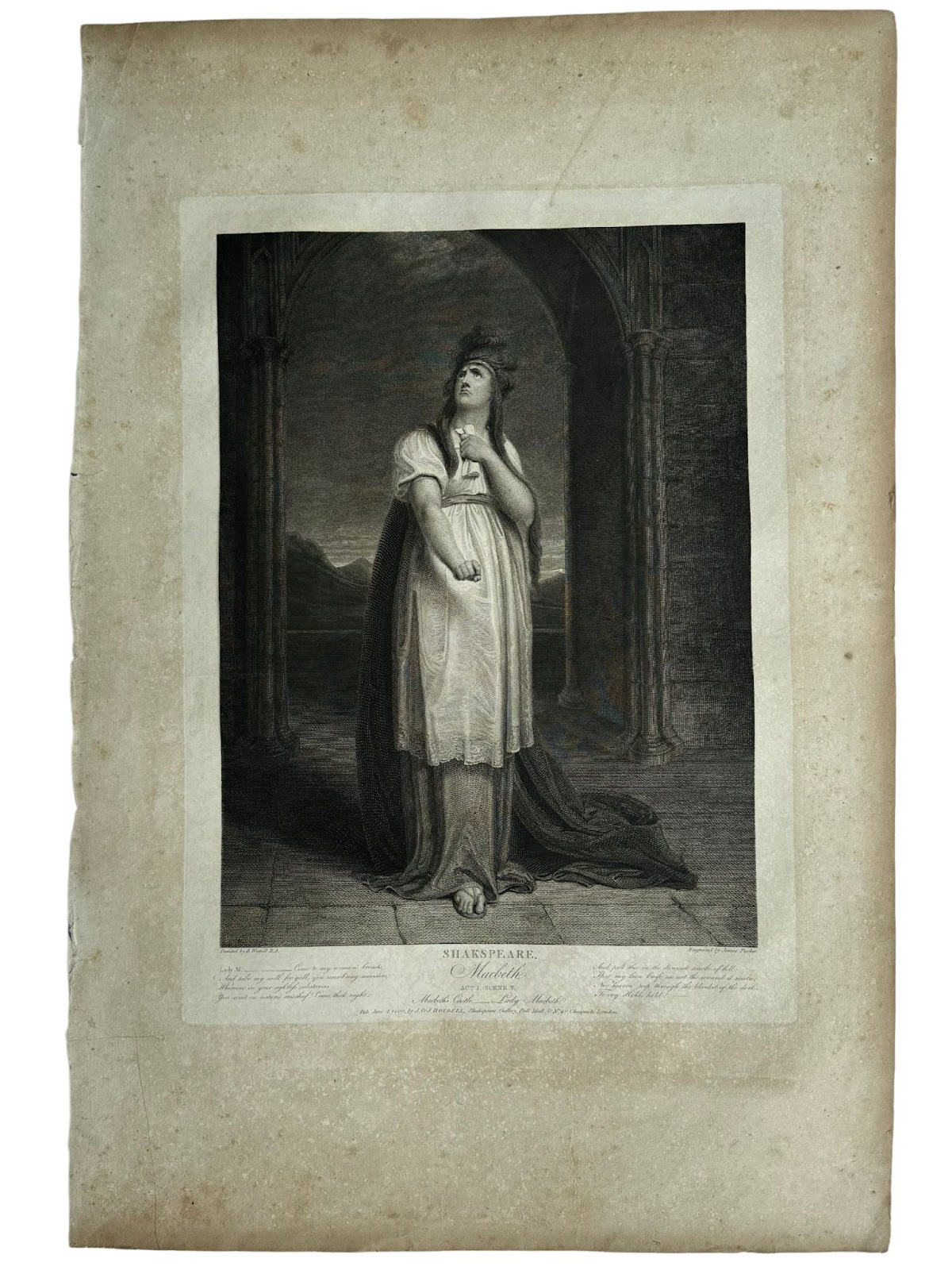
 Richard Westall: Macbeth. Act I, scene v. Macbeth’s Castle – Lady Macbeth. Engraved by James Parker, published June 4, 1800.

“LADY M. Come to my woman’s breasts,

And take my milk for gall, you murd’ring ministers,

Wherever in your sightless substances

You wait on nature’s mischief! Come, thick night;

And pall thee in the dunnest smoke of hell;

That my keen knife see not the wound it makes;

Nor heaven peep through the blanket of the dark,

To cry, Hold, hold!-”

 Johann Henrich Fuseli: Hamlet, Prince of Denmark. Act I, scene iv. The Platform before the Palace of Elsineur. – Hamlet, Horatio, Marcellus and the Ghost. Engraved by Robert Thew, published September 29, 1796.

“HAM. Still am I call’d. – unhand me gentlemen;

[Breaking from them.

By heaven, I’ll make a Ghost of him that lets me:-

I say, away: – Go on, – I’ll follow thee.

Hamlet struggles against Horatio’s hold, similar to Banquo’s pose from Macbeth. The Ghost, depicted in armor, is vividly real with moonlight radiating through its eyes and beard.

Falstaff

Sir John Falstaff is a comic character of Shakespeare’s plays. A fat, vain, and boastful knight, he spends most of his time drinking at the Boar’s Head Inn with petty criminals, living on stolen or borrowed money. The Shakespeare editor Nicholas Rowe wrote in 1709 that Queen Elizabeth liked Falstaff’s character so much in the Henry IV plays that she asked Shakespeare to write more plays with Falstaff in them. As a result, Falstaff appears in many of the paintings and engravings of the Boydell Shakespeare Gallery. This scene shows Sir John Falstaff at the Boar’s Head Tavern, run by Mistress Quickly, before heading north to recruit soldiers. Smirke’s Falstaff is a corrupt soldier, while Fuseli’s is self-indulgent and passive, waiting for pleasures to come to him. Doll Tearsheet, young and beautiful, is curled up on his lap. Falstaff argues with Doll and Pistol and makes rude comments about Prince Henry and Edward Poins, not knowing they are spying on him in the background, disguised as barmen. Fuseli’s theatrical style is seen in the costumes, composition, and décor inspired by London stage performances. He emphasizes Falstaff’s comic role by contrasting his large presence with Tearsheet’s delicate appearance, highlighting Falstaff’s bodily desires.
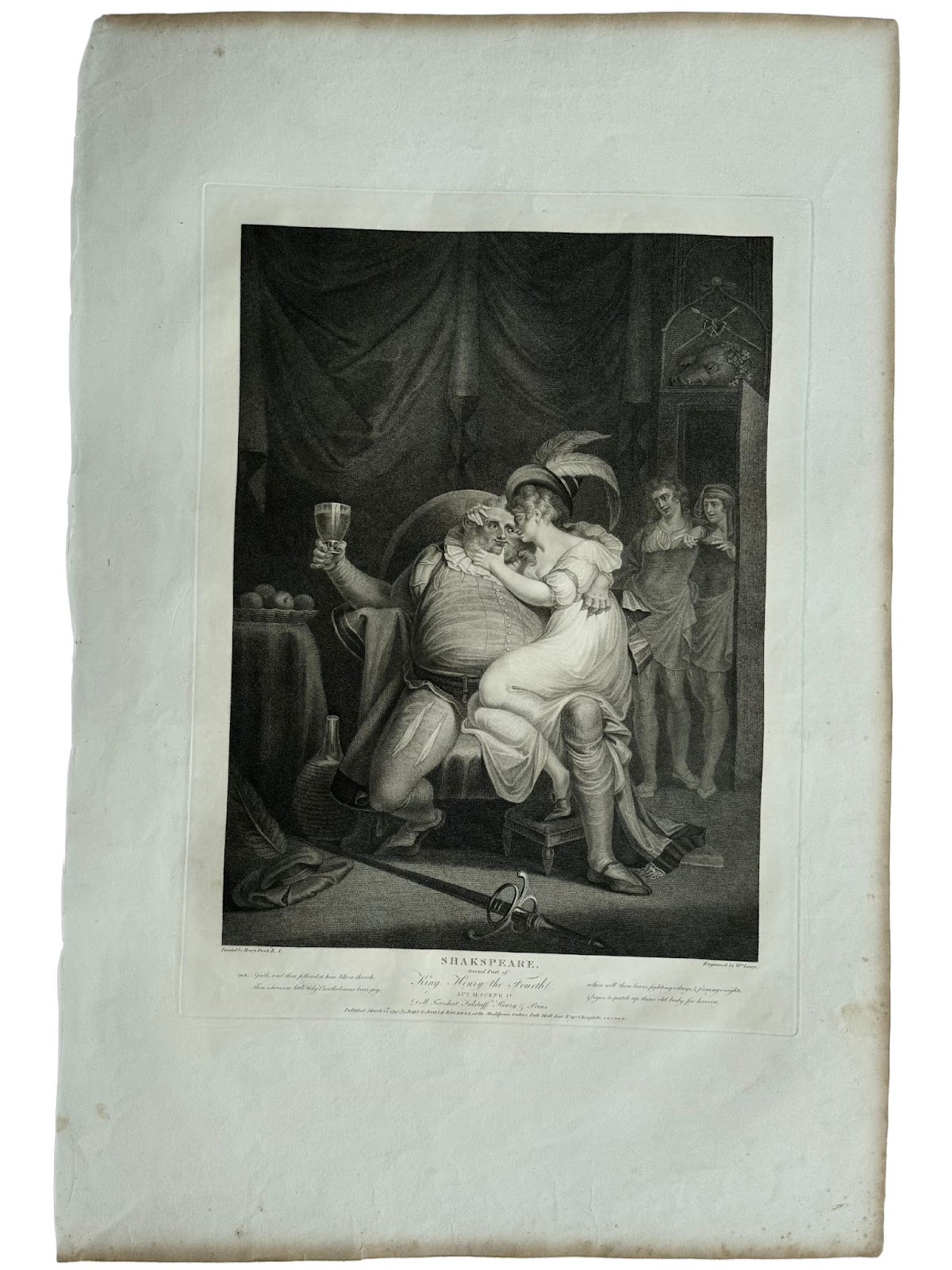
Johann Heinrich Fuseli: Second Part of King Henry the Fourth. Act II, scene iv. Doll Tearsheet, Falstaff, Henry, & Poins. Engraved by William Satchwell Leney, published March 25, 1795.

Dol. I’faith, and thou followd’st him like a church.

Thou whoreson little tidy Bartholomew boar-pig,

when will thou leave fighting o’days, & foining o’nights,

& Begin to patch up thine old body for heaven.”
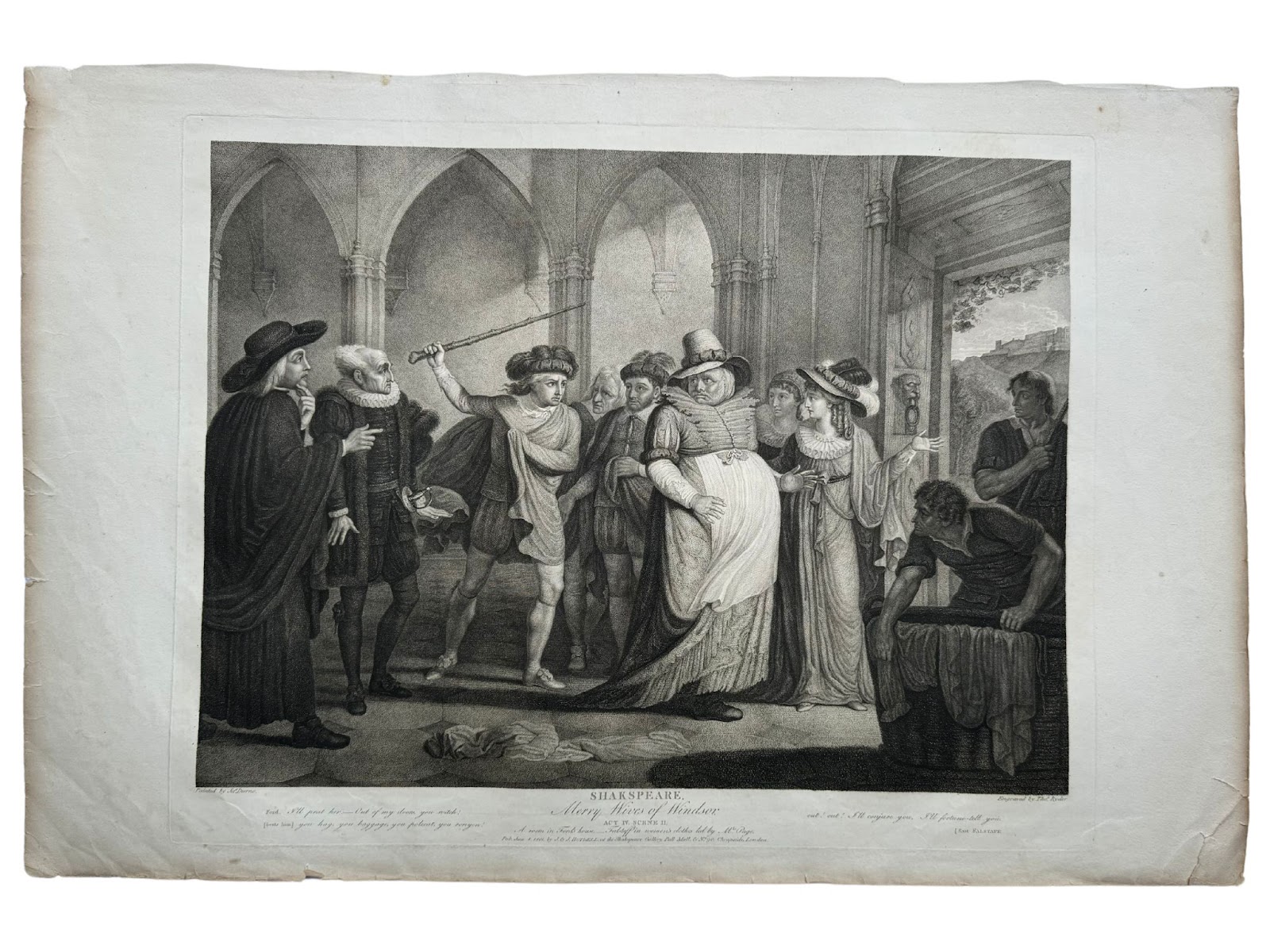
James Durno: Merry Wives of Windsor. Act IV, scene ii. A room in Ford’s House. – Falstaff in women’s clothes led by Mrs Page. Engraved by Thomas Ryder, published June 4, 1801. Location of the original painting: Soane Museum, London.

“FORD. I’ll prat her: – Out of my doors, you witch!

[beats him.] you hag, you baggage, you poecat, you ronyon!

Out! Out! I’ll conjure you, I’ll fortune-tell you.

[Exit Falstaff.]

Apart from Smirke’s depictions of “The Seven Ages”, The Merry Wives of Windsor had the most illustrations of any play in the Gallery, with five folio plates and two quarto plates. This is due to the character Falstaff’s popularity. Shakespeare wrote this comedy for Falstaff at Queen Elizabeth’s request to see Falstaff in love. In Durno’s painting, he depicts Falstaff in a busy scene, which shows ten characters, including Falstaff disguised as a woman.

James Durno: Second Part of King Henry the Fourth. Act III, scene ii. Justice Shallow’s Seat in Gloucestershire- Shallow, Silence, Falstaff, Bardolph, Boy, Mouldy, Shadow, Wart, Feeble, & Bull-calf. Engraved by Thomas Ryder, published Dec 1, 1798. Location of the original painting: Sotheby’s october 14, 1953.

“FAL. Come manage me your caliver;

So, very well, go to,

Very good, exceeding good. O give me always a little

Lean, old, chopp’d bald shot. Well said, i’faith,

Wart, thou’rt a good scab, hold, there’s a teter for thee.”

Critics complained that in this scene, Durno did not capture the comedy of the scene, only Falstaff’s belly. In Shakespeare’s play, Falstaff’s recruitment scene is filled with witty dialogue, but this doesn’t seem to be captured here in Durno’s depiction as all we see is Falstaff’s pointing finger, Shallow’s whispering, and Bardolph accepting a bribe.

Robert Smirke: First Part of King Henry the Fourth. Act II, scene iv. The Boar’s Head Tavern. – Prince Henry, Falstaff, Poins, & c. Engraved by Robert Thew, published June 4, 1796. Location of the original painting : Bob Jones University, Greenville, South Carolina.

FAL. Shalt I? content:_____This chair shall be my state,

this dagger my sceptre, and this cushion my crown.

Here we see Sir John Falstaff sitting at a table with one leg on a stool. He’s holding a dagger in one hand and his cap in the other. He orders his favorite drink, ‘Sack’, and brags about his bravery in the last battle. Peto, Gadshill, Bardolph, Poins, and the Prince of Wales listen to him. When Falstaff exaggerates too much, Prince Henry angrily calls out his lies. Then the Sheriff arrives to question Falstaff and his friends about a robbery. The Boar’s Head Tavern in Eastcheap, run by Mistress Quickly with help from the barman Vintner, Francis, and other servants, is one of Falstaff’s favorite spots.

Sir Joshua Reynolds: Second Part of King Henry the Sixth. Act III, scene iii. [Death of Cardinal Beaufort] Engraved by Caroline Watson, published August 1, 1792. Location of the original painting: Petworth, replica: Stratford-on-avon

“WAR. See, how the pangs of death do make him grin!

SAL. Disturb him not; let him pass peaceably.

K. HENRY. Peace to his soul, if God’s good pleasure be! –

Lord Cardinal, if thou think’st on heaven’s bliss,

Hold up thy hand, make signal of thy hope. – 

He dies, and makes no sign: – O God, forgive him!”

Rembrandt was known to inflict pain upon himself to sketch his face in a grimace, showing the importance of studying natural expressions of emotion. Viewers at the Shakespeare Gallery were disturbed by Reynold’s use of a grimace in his painting of Cardinal Beaufort on his deathbed, with a demon’s face hovering in the corner by his bedside, known to make the entire scene grotesque. In response to the criticism, Boydell had the demon removed in later engravings.

Caroline Watson engraved the painting, and she was known as the first professional female engraver in the UK and Engraver to Queen Charlotte. She started her career under the tutelage of her father, printmaker James Watson, and worked as a portrait artist for royalty and then moved onto creating aquatints for works by Italian-English artist and educator Maria Cosway.

Robert Smirke and The Seven Stages

“The Seven Ages of Man” is a monologue from Shakespeare’s play As You Like It, ACT II, scene vii. In this passage, the character Jaques reflects on the stages of human life, describing them as a series of acts in a play. The seven stages as he outlines are: 1. Infant 2. Schoolboy 3. Lover 4. Soldier 5. Justice 6. Pantaloon 7. Second Childishness. I own stages 4-7.

Smirke turns the seven stages into a series of pleasant, genre scenes with costumes from the seventeenth and eighteenth centuries. Smirke’s focus is on illustrating sentimental, moral scenes, not on theater or drama. 

The Fourth Age (Manhood): In the previous age, the young man was consumed by love. In this age, the mature man is driven by ambition, seeking reputation.

Robert Smirke: As You Like It. Act II, scene vii. The Seven Ages. Fourth Age. Engraved by John Ogborne, published June 4, 1801.

Jaq. __________ Then, a soldier;

Full of strange oaths, and bearded like a pard,

Jealous in honour, sudden and quick in quarrel,

Seeking the bubble reputation

Even in the cannon’s mouth.

Robert Smirke: As You Like It. Act II, scene vii. The Seven Ages. Fifth Age. Engraved by Jean Pierre Simon, published June 4, 1801.

“Jaq._____ And then, the justice;

In fair round belly, with good capon lin’d,

With eyes severe, and beard of formal cut,

Full of wise saws and modern instances,

And so he plays his part.”

The fifth age is middle age. Ambition has paid off, and now our man is a judge with a “fair round belly.” He sternly delivers justice to a sentenced couple. Shakespeare says, “And so he plays his part,” referring back to the famous lines, “All the world’s a stage, And all the men and women merely players.” In a way, the judge is as trapped as those he convicts. This scene shows a judge sentencing a young couple. On the left, a wealthy-looking man (probably the plaintiff) sits with a sleeping dog at his feet. On the right, the young man and woman (the offenders) listen to the verdict. The judge, a middle-aged man, is in the center of the engraving. People are watching the trial from both sides of the courtroom.

Robert Smirke: As You Like It. Act II, scene vii. The Seven Ages. Sixth Age. Engraved by William Satchwell Leney, published June 4, 1801.

Jaq. ________ The sixth age shifts

Into the lean and slipper’d pantaloon;

With spectacles on nose, and pouch on side;

His youthful hose well sav’d, a world too wide

For his shrunk shank; and his big manly voice,

Turning again to childish treble, pipes

And whistles in his sound:

In the sixth age, middle age turns into old age, with “Shrunk shank.” An unfortunate family asks for help at his door but is rudely sent away by him and his dog.

Robert Smirke: As You Like It. Act II, scene vii. The Seven Ages. Seventh Age. Engraved by Jean Pierre Simon, published June 4, 1801.

Jaq._____ Last scene of all,

That ends this strange eventful history,

Is second childishness, and mere oblivion;

Sans teeth, sans eyes, sans taste, sans everything.

‘The Seventh Age’ (Old Age) is the last and cruelest stage. It’s like a second childhood. At the feet of the frail old man, a young boy plays with a house of cards. In the background, a nurse is asleep. The paintings on the walls show the effects of time. Life ends brutally in “mere oblivion; Sans teeth, sans eyes, sans taste, sans everything.” In this scene, the artist shows a drowsy, weak old man wrapped in blankets as the main character, representing the seventh age. The old man sits by a dark, cold fireplace, unaware of the paintings, the sleeping woman, or the child playing on the floor. To his right is a chest of drawers with a bowl for porridge, a mug for hot milk, bottles, and other medicines for his pain. A pair of crutches leaning against the chest shows his lack of mobility.

Conclusion

By employing some of the most renowned British artists of the late 18th century and elevating British art during a politically tumultuous time, The Boydell Shakespeare Gallery influenced the visual representation of Shakespeare’s works for generations. The success and visibility of the engravings influenced subsequent artistic representations of Shakespearean scenes and were reproduced in various forms including books, prints and later theatrical productions. Although the gallery itself did not survive long-term financial challenges and eventually closed in the early 19th century, its impact on both art and the popularization of Shakespeare remains notable. 

References 

Marketing Shakespeare: the Boydell Gallery, 1789–1805, & Beyond – Folgerpedia https://folgerpedia.folger.edu/Marketing_Shakespeare:_the_Boydell_Gallery,_1789%E2%80%931805,_%26_Beyond?_ga=2.108326020.78832302.1720647577-570080926.1720647577

Burwick, Frederick and Pape, Walter. (1996). The Boydell Shakespeare Gallery. Peter Pomp.

Dias, Rosie. (2013). Exhibiting Englishness: John Boydell’s Shakespeare Gallery and the Formation of a National Aesthetic.  The Paul Mellon Centre for Studies in British Art

Printed Afterlives: Joshua Reynolds’ ‘Johnson Arguing’ portrait, 1769

by Miriam Al Jamil

Miriam Al Jamil is an independent researcher, with interests in eighteenth-century sculpture, material culture, and women’s history. She has published reviews and essays on online platforms and in academic journals including the Journal for Eighteenth-Century Studies, Studies in Religion and Enlightenment, and Early Modern Women. Her chapter on a Zoffany painting appeared in Antiquity and Enlightenment Culture: New Approaches and Perspectives (Brill, 2020). She is the Fine Arts review editor for BSECS Criticks, chair of the Burney Society UK, and is active in the Johnson Society and Women’s Studies Group, 1558-1837. 


One of the best-known portraits of Samuel Johnson by Joshua Reynolds entered the collection of the 3rd Duke of Dorset at Knole in Kent after its exhibition at the Royal Academy in 1770. Often styled ‘Johnson Arguing’, the portrait rapidly deteriorated, ‘the face cracked, the shadows damaged by bitumen’, due to Reynolds’ experiments with untested media. (1) As a result, the details of the painting are better appreciated from the 1769 mezzotint (figure 1) by James Watson (1740-1790). (2) Mark Hallett notes that ‘Johnson’s portrait offers an especially startling depiction of heightened, active introspection, conveyed most powerfully by his half-closed eyes and by the hands that claw the air as if grappling with, or playing on, an especially complex set of concepts.’ (3) The hands add tension to the portrait, capturing a moment when the whole body engages with a critical point in his thought process. However, the combination of an idealised, classicised Johnsonian face with strangely distorted and twisted hands has troubled commentators ever since it was first shown, the ‘hands raised and bent in a peculiar manner’. (4) Watson’s print is unusual among the variety of subsequent engraved copies featuring the face alone which form the subject of this essay.


Figure 1. James Watson, Samuel Johnson, 1769, mezzotint. National Portrait Gallery, NPG D36536.

The vocabulary of gesture and representation of the passions through facial expression was the subject of illustrated treatises which proliferated from the seventeenth century to inform and guide both artists and actors, lawyers and preachers, all of whom depended on public performance to some extent in their professions. (5) At a popular level, George Alexander Stevens published his ‘A Lecture on Heads’ in 1765, based on his demonstrations which used a range of busts as props to illustrate and satirise popular character stereotypes (see figure 2). 

Figure 2. Thomas Rowlandson after George Murgatroyd Woodward,
Frontispiece, from “A Lecture on Heads” by George Alexander Stevens, 1808, print. Metropolitan Museum of Art.
 

Stevens describes ‘The Learned Critic, or Word-grabber’: ‘This is a true classical conjugating countenance, and denotes dictionary dignity […] the ears of this critic are immensely large; they are called trap doors to catch syllables![…] his eyes are half closed; that’s called the Wiseman’s Wink; and shews (sic) he can see the world with half an eye.’ (6) Most interpretations of the half-closed eyes in Johnson’s portraits tend to point either to his disability directly or to his introspection rather than to shrewd engagement with the world. Stevens’ idea poses the possibility of an alternative and artful evaluation of Johnson’s half-closed eyes in the Knole portrait. Johnson might have enjoyed the epithet ‘Wiseman’s wink’.

The most influential contemporary analysis of gesture and appearance was one cited by James Boswell who listed all the known portraits of Johnson in a footnote to his Life of Johnson (1791). (7) These include one published in John Caspar Lavater’s Essays on Physiognomy (1789-98), ‘in which Johnson’s countenance is analysed upon the principles of that fanciful writer’. (8) The Knole portrait provided the most fruitful source for Lavater’s examination of Johnson’s character based on facial expression and physical peculiarities. The engraver Thomas Holloway (1748-1827) furnished many of the 800 illustrations to Henry Hunter’s translation of Lavater of 1789. His three Johnson portraits are pared down and simplified in line, combined on the page to enable subtle interaction in an exploration of the portrait subject (figure 3).

 Figure 3. Lavater, Samuel Johnson: Three Portraits, c.1789. Wellcome Library no. 28706i.

Thomas Holcroft’s translated edition of Lavater’s essays uses another engraving of the Knole portrait which has been divested of its introspective ‘wrestling’ altogether (figure 4). The description adds a further interpretation of Johnson’s expression, ‘the most unpractised eye will easily discover, […] the acute, the comprehensive, the capacious mind, not easily deceived, and rather inclined to suspicion than credulity’. (9) An appended essay in this edition by essayist Helfrich Peter Sturz (1736-1779) asserts that ‘Dr. Johnson had the appearance of a Porter; not the glance of the eye, not any trait of the mouth, speak the man of penetration, or of Science.’ (10) He continues, ‘Can a countenance more tranquilly fine be imagined, one that more possesses the sensibility of understanding, planning, scrutinizing? In the eyebrows, only, and their horizontal position, how great is the expression of profound, exquisite, penetrating understanding!’. (11) For Sturz, the character is belied by his attire. His assessment incorporates his familiarity with anecdotes about Johnson’s habitually dishevelled dress although the print itself does not include any evidence to support his analogy. An imagined substitution for the classical robe of Reynolds’ original painting enables the print to become a convenient signifier of Johnson, the man remembered by his friends.

 
Figure 4. From Lavater, Essays in Physiognomy, translated from the German by Thomas Holcroft. London: Ward, Lock & Co., undated), 17th edition. Plate 1, Nos. 3 and 4, p.33.

The portrait at Knole drew both visitors and copyists. One of these was Ozias Humphry (1742-1810), a skilled miniaturist who received the patronage of the 3rd Duke. He wrote about meeting Johnson sometime between 1764 and 1772: ‘I was very much struck with Mr. Johnson’s appearance, and could hardly help thinking him a madman for some time, as he sat waving over his breakfast like a lunatic. He is a very large man, and was dressed in a dirty brown coat and waistcoat with breeches that were brown also (though they had been crimson), and an old black wig.’ (12) Like  Sturz, Humphry went on to describe how the peculiarities of the man had ill-prepared him for the brilliant intelligence that he then witnessed in action. He painted at least one portrait of Johnson. Boswell listed ‘a beautiful miniature in enamel’ but some of his later work has been lost. (13)

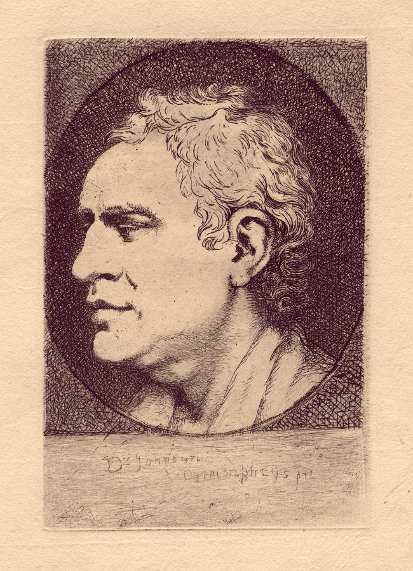
A 1918 biography of Humphry includes a copy of an etching of Johnson’s head taken from the Knole portrait, reputedly based on a drawing by Humphry. The etching is described, ‘From the rare etching after Humphry by Mrs. D. Turner, Original Unknown’. (14) Before 22nd July 2021, the National Portrait Gallery website attributed the print to Mrs. D. Turner, based on this information. This attribution has now been removed, following my query, in favour of Samuel James Bouverie Haydon (1815-1891). (15) However, the NPG continues to list an etching by Mrs. D. Turner c.1825, based on a crayon copy by Humphry but it is not illustrated or part of the gallery’s collection. (16) She did indeed make an etching of Johnson, but it was not the one cited in Humphry’s biography or originally by the NPG.

Mary Dawson Turner was born Mary Palgrave in Norfolk, in 1774. She married the banker, botanist, antiquarian and collector Dawson Turner in 1796, with whom she lived in Great Yarmouth and had eleven children, eight of whom survived into adulthood. (17) Dawson Turner’s extensive collections have received scholarly attention over the years. In the Preface to his Manuscript Library sale of 1859, he is described as ‘an accomplished scholar, a man of very varied attainments, and of accurate observation […], deriving his solace and delight alike from pursuits connected with the fine arts and archaeology’. (18) He arranged tuition in drawing and engraving for Mary and their six daughters whose subsequent industry and dedication to the production of illustrations for his books and projects both amazed and unsettled visitors to their home. Their contributions to his work and reputation have only recently been acknowledged and examined in a collection of essays published in 2007. (19)

The collector’s family life appears close; he loved, respected and was proud of his wife and children. However, I suggest that the intensive application to their studies required of the children and the daily labour of etching from 6.30 in the morning undertaken by Mary and her daughters betokens something more obsessive in an ostensibly benign patriarchal home. Alluding to a visit to London by her daughter Ellen, Mary expressed concern over her rigorous studies, ‘I certainly think that her less comparatively sedentary habits and strenuous application of mind will probably be [more] friendly to her general health than those she addicted herself to at home’. In the same letter, Mary describes one of her own etching subjects as ‘drudgery’ from which she needed ‘some precious rest to the eyes and pleasure to the mind’. (20) This feverish labour is the context in which Mary etched her print of Dr. Johnson.

Dawson Turner’s ‘grangerised’ volumes of James Boswell’s Life of Samuel Johnson (1791) are all now lost. These consisted of two sets of four volumes which were each made into six large imperial folio volumes, with around 1,700 portrait prints, views of locations mentioned in the text, news cuttings and autographs. It is likely that Mary’s etching of Johnson was destined for one of these volumes. Mary mentions her efforts to complete it in a letter of 1825. The cares of her household and large family and her own fragile health clearly interfered with the relentless etching programme which demanded her attention. She writes, ‘I have been so variously engaged today with perpetual calls for directions to whitewashers, whitesmith masons & etc. that I have not done Dr, Johnson’s head’. (21) An unpublished volume, of which only forty-nine copies were made, One Hundred Etchings by Mrs. Dawson Turner, includes Mary’s etching, ‘Johnson, Samuel LL.D, from a drawing by Ozias Humphry R.A. 1773’. (22) It is a disciplined and technically exact copy which was reproduced in other Dawson Turner print albums.

Figure 5. Mary Dawson Turner, Samuel Johnson, after Ozias Humphry, 1773
The Mother’s Exemplar, being a collection of Etchings, many of them from Original Drawings by Mrs. Dawson Turner and her family
V&A Prints and Drawings, 93 H/19.

In her study of eighteenth and nineteenth century-extra-illustrated books, Lucy Peltz identifies many cases where fathers and daughters undertook such an activity together. In the Turner family, she suggests, it was ‘a domestication of the intellectual sociability of the masculine club’ which gave the daughters ‘access to a traditionally male arena’ and ‘strengthened sentimental bonds between relatives’. (23) Such a bond is evident particularly in correspondence from Harriet Turner to her father which centres on the art she has seen and the subjects she has produced as drawings and etchings. Her enthusiasm is undeniable, but she is passionate and needy, longing for his approval and affection, even after she has married and moved away. (24) The illustrations chosen for inclusion in Turner’s volumes depended largely on the creative production of the Turner women over many years, a more demanding commitment than the leisurely and companionable selection of relevant prints from other sources which is suggested by Peltz’s statement.

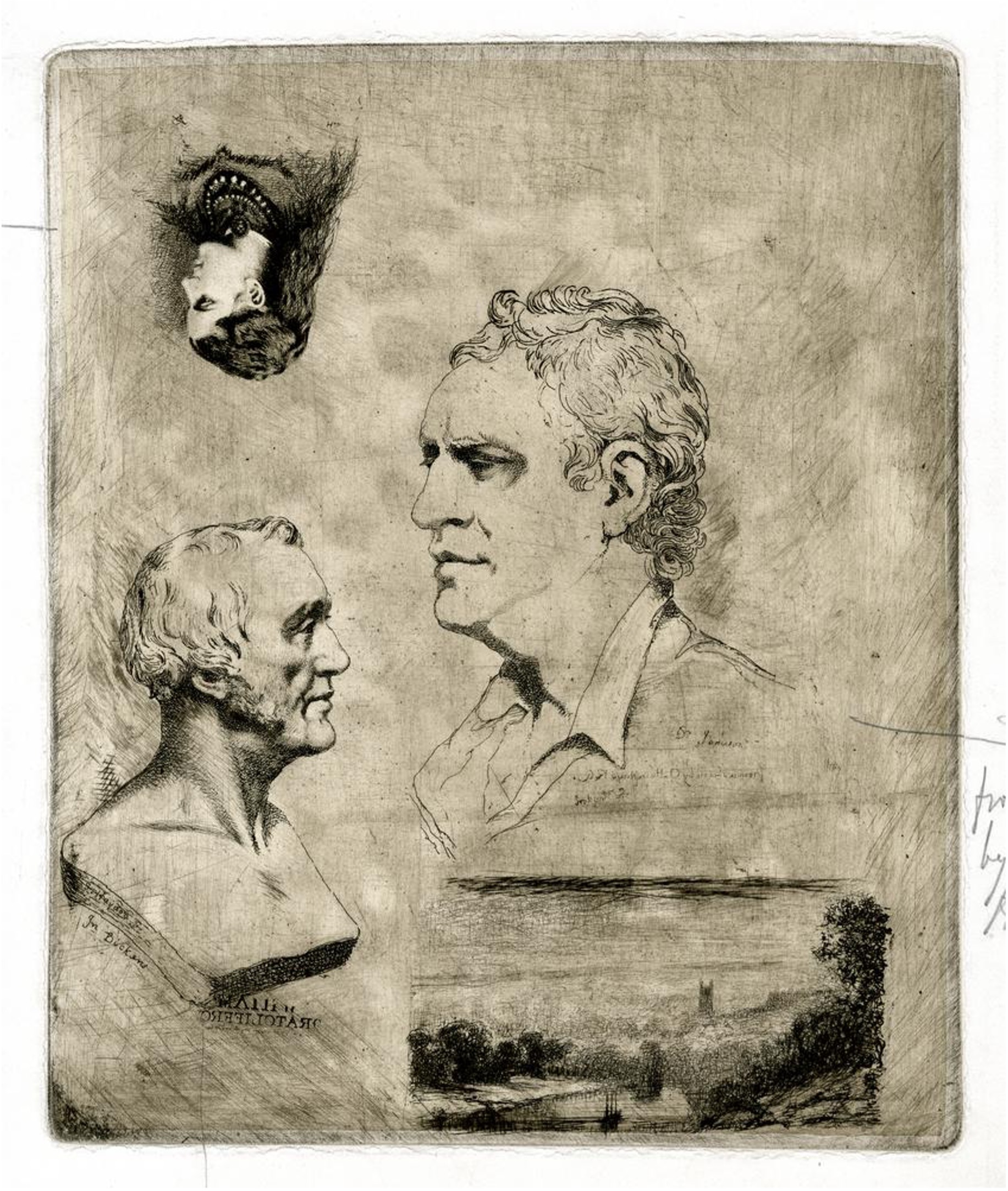
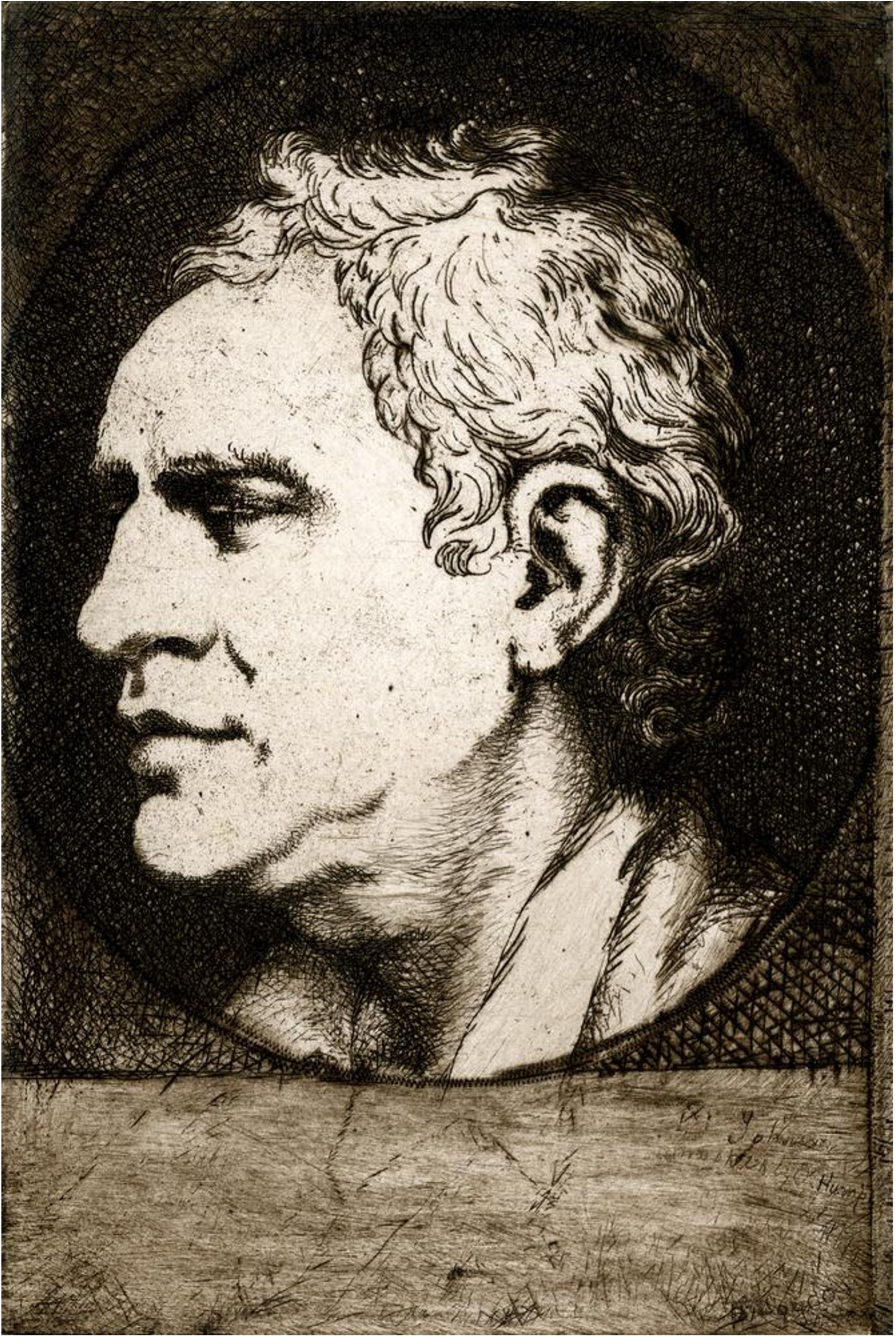
The inaccessibility of both Mary Turner’s print and of the lost Humphry drawing upon which it was based led to confusion over the attribution for another print, ostensibly after the same Humphry drawing. Samuel James Bouverie Haydon (1815-1891), print-maker and sculptor, made his etching of Johnson in 1860. Unlike Mary Turner, he did not alter the reverse image. The process of making his print is evident in plates held by the British Museum. He etched an early version on a large 32cm high plate, alongside trial etchings of a bust of John Dickens, a portrait of his daughter and a small landscape (figure 6). (25 ) He then trimmed the portrait down and added an oval frame which was probably close to the format of the original Humphry miniature portrait (figure 7). (26) He later burnished out and replaced the lettering on the earlier plate (figure 8). (27)


Figure 6. Samuel James Bouverie Haydon, etching on copper, c.1860, 320 x 265mm. British Museum, No. 1924,0512.18

Figure 7. Haydon, Portrait Head of Dr. Johnson, c.1860., 174 x 115mm. British Museum, No. 1832,0507.30.

Figure 8. Haydon, Portrait of Samuel Johnson, c.1860, 176 x 116mm, British Museum. No. 1913,0611.122. 

Another print of this final version is the one in the NPG collection (figure 9). (28) A comparison with Mary Turner’s print highlights Haydon’s dense and less formal cross-hatching of the background to deepen the contrast to the face, and his spare treatment of the hair with less expressive line and a consequent lack of movement and flow.


Figure 9. Haydon, Samuel Johnson, National Portrait Gallery, 283 x 203mm, NPG D3158.

The reason that Haydon undertook the etching is not known. He worked at his home in Exeter and in London. (29) He regularly exhibited at the Royal Academy from 1840 until 1876 and combined his traditional artistic practice with the pioneering medium of photography from 1845, when he worked as an assistant to William Fox Talbot. His academy exhibits reflect commissions for civic, ecclesiastical, military and aristocratic portrait busts, classical and sentimental subjects, and paintings of town and country locations. (30) The variety of his subjects point to an artist who adapted to the economic imperatives of the market, and though not universally celebrated, at least he made a living through his craft. The four trial etchings together on his plate summarise the diversity of the media he employed. In this context, Johnson’s head becomes inextricably linked with the cultural and commercial conditions of nineteenth-century London.

Unlike Haydon, Mary Turner and her daughters worked solely on Dawson Turner’s projects, never exhibited their art at public exhibitions and do not appear to have aspired to general artistic recognition. However, Jane Knowles in her essay on the Turner family identifies a hint of regret in one of Elizabeth Turner’s letters, ‘We can copy & that is all. And Mr. Varley’s kind efforts & example have only show’d to prove to us the strong line of demarcation which separates the artist from the draftsman’. (31) Knowles suggests that Dawson Turner regarded them as copyists, as merely ‘artistic’ rather than ‘artists’, who were never expected to develop an individual style. Maurice H. Grant, in his  A Dictionary of British Etchers (1952) is dismissive about Mary, ‘all competent little Plates without much finesse but firmly etched somewhat in the Netherlands tradition’. (32) Likewise, his entries for the Turner daughters are perfunctory, ‘They chiefly employed themselves in copying the sketches of J.S. Cotman, their instructor, but their several works are not now distinguishable’. (33) A recent dictionary of print-makers does not include etchers so fails to mention the Turners at all. (34) It is not surprising that Mary Turner’s etching of Johnson has been forced back into obscurity and inaccessibility and her name incorrectly attached to another artist’s work. Technical skill and a trained eye are no substitute for creative response.

Footnotes

(1) David Mannings, Sir Joshua Reynolds: A Complete Catalogue of his Paintings (New Haven: The Paul Mellon Centre for Studies in British Art, Yale University Press, 2000), no. 1012, p.280.

(2) See Mark Hallett, Reynolds: Portraiture in Action (New Haven: The Paul Mellon Centre for Studies in British Art, Yale University Press, 2014), p.242; James Watson, Samuel Johnson, 10 July 1769, National Portrait Gallery, NPG D36536; see entry for James Watson in Oxford Dictionary of National Biography: https://www.oxforddnb.com/view/10.1093/ref:odnb/9780198614128.001.0001/odnb-9780198614128-e-28840?rskey=u5GJ4E&result=4 [accessed 18 November, 2021].

(3) Hallett, p.244.

(4) Edward Hamilton, A Catalogue Raisonné of the Engraved Works of Sir Joshua Reynolds, P.R.A, from 1755 to 1820 (London: Colnaghi & Co., 1874), p.32.

(5) For a full discussion of available treatises, see Adam Kendon, Gesture: Visible Action as Utterance (Cambridge: Cambridge University Press, 2004), Chapter 3.

(6) George Alexander Stevens, The Celebrated Lecture on Heads, which has been exhibited upwards of One Hundred Successive Nights, To Crouded Audiences, and Met with the most Universal Applause (London: Richard Bond, 1765), Part III, p.15.

(7) James Boswell, Life of Johnson unabridged (Oxford World’s Classics, Oxford: Oxford University Press, 1998), Monday 20 December, 1784, p.1395, footnote 1.

(8) Johann Caspar Lavater, Essays on physiognomy; designed to promote the knowledge and the   love of mankind, Illustrated by more than eight hundred engravings accurately copied; and some duplicates added from originals. Executed by, or under the inspection of Thomas Holloway. Translated from the French by Henry Hunter (London: John Murray [etc.], 1789-98), 5 Vols.; https://wellcomecollection.org/works/yffvbzu5 [accessed 18 November, 2021].

(9) Essays on Physiognomy: translated from the German of John Caspar Lavater, by Thomas Holcroft. Also One Hundred Physiognomical Rules, taken from a posthumous work by J.C. Lavater; and a Memoir of the Author, seventeenth edition; Illustrated with upwards of four hundred profiles (London: Ward, Lock & Co., undated), p.33.

(10) Ibid., p.257.

(11) Ibid., p.258.

(12) Quoted from letter, private collection, in George C. Williamson, Life and Works of Ozias Humphry, RA (London: John Lane, 1918), p.87.

(13) Boswell, p.1395, footnote 1.

(14) Williamson, List of Illustrations, p.xiv, and facing p.88.

(15) National Portrait Gallery, NPG D3158.

(16) See National Portrait Gallery, https://www.npg.org.uk/collections/search/portraitExtended/mw03492/Samuel-Johnson#ref4  [accessed 12 October, 2021].

(17) Mary Dawson Turner (1774-1850), https://en.wikipedia.org/wiki/Mary_Dawson_Turner  [accessed 12 October, 2021]; see the Oxford Dictionary of National Biography entry for Turner, Dawson (1775-1858), https://www.oxforddnb.com/view/10.1093/ref:odnb/9780198614128.001.0001/odnb-9780198614128-e-27846 [accessed 12 October, 2021].

(18) Catalogue of the Important Manuscript Library of the late Dawson Turner, esq., formerly of Yarmouth […] to be sold by auction on Monday, June 6th, and following days’, Messrs. Puttick & Simpson, Auctioneers of Literary Property, 47 Leicester Sq., 1859, p.xvi.

(19) Nigel Goodman, ed., Dawson Turner: A Norfolk Antiquary and his Remarkable Family (Chichester: Phillimore, 2007).

(20) Trinity College Library, Cambridge, Dawson Turner Correspondence, Turner III, A33/42, Mary Turner to Dawson Turner, 5 April 1832.

(21) Dawson Turner Correspondence, Turner III, letter from Mary Turner, 19 April 1825.

(22) Turner, One Hundred Etchings by Mrs. Dawson Turner, Not published, [1830], British Library; other copies discussed by Warren R. Dawson, ‘A Bibliography of the Printed Works of Dawson Turner’, in Transactions of the Cambridge Bibliographical Society, (3:3, 1961), pp.232-256, 242.

(23) Lucy Peltz, Facing the Text: Extra-illustration, Print Culture, and Society in Britain, 1769-1840 (San Marino: The Huntington Library, 2017), p.313.

(24) See especially Dawson Turner Correspondence, Turner III, A8/1-35 Harriet Turner (Gunn) to Dawson Turner.

(25) Samuel James Bouverie Haydon, etching on copper, c.1860, 320 x 265mm, British Museum, No. 1924,0512.18 https://www.britishmuseum.org/collection/object/P_1924-0512-18 [accessed 29 October, 2021].

(26) Haydon, Portrait Head of Dr. Johnson, c.1860, 174 x 115mm, British Museum, No. 1832,0507.30 https://www.britishmuseum.org/collection/object/P_1932-0507-30 [accessed 29 October, 2021].

(27) Haydon, Portrait of Samuel Johnson, c.1860, 176 x 116mm, British Museum, No. 1913,0611.122 https://www.britishmuseum.org/collection/object/P_1913-0611-122 [accessed  29 October, 2021].

(28) Haydon, Samuel Johnson, National Portrait Gallery, 283 x 203mm, PG D3158. https://www.npg.org.uk/collections/search/portrait/mw37354/Samuel-Johnson?LinkID=mp02446&wPage=1&role=sit&rNo=39 [accessed 29 October, 2021]. My thanks to British Museum curator Hugo Chapman and National Portrait Gallery curator Paul Cox.

(29) For biographical details, see Mapping the Practice and Profession of Sculpture in Britain and Ireland, 1851-1951:https://sculpture.gla.ac.uk/view/person.php?id=msib7_1218129055 [accessed 7 November, 2021].

(30) See entries in The Royal Academy Summer Exhibition: A Chronicle, 1769-2018https://chronicle250.com/1840#catalogue [accessed 7 November, 2021].

(31) Elizabeth Turner, quoted in Jane Knowles, ‘A Tasteful Occupation? The Work of Maria, Elizabeth, Mary Anne, Harriet, Hannah, Sarah and Ellen Turner’, in Nigel Goodman, Dawson Turner, pp.123-140, p.136; reference is to John Varley, artist (1778-1842), acquaintance of the family.

(32) Col. Maurice Harold Grant, A Dictionary of British Etchers (London: Rockliff, 1952), p.207.

(33) Ibid., p. 208.

(34) See David Alexander, A Biographical Dictionary of British and Irish Engravers, 1714-1820 (New Haven: Yale University Press, 2021). Crome, Cotman and Varley, all associated with Dawson Turner, are included.

Michael Brown on the War Paintings of Charles Bell, Surgeon

Reposted from the Surgery & Emotion Blog

WARNING: CONTAINS GRAPHIC IMAGES OF WOUNDS AND INJURIES

Pity and Pride: Picturing the War Wounded in the Work of Charles Bell

November 2019


Dr Michael Brown of Roehampton University considers the emotional content of the famous war paintings of the surgeon Charles Bell.

I recently had an article accepted for publication by the Journal for Eighteenth-Century Studies which explores the relationship of the Scottish surgical siblings John Bell (1763-1820) and Charles Bell (1774-1842) to war, especially their imaginative and professional investment in military surgery and their complex emotional reactions to the experience of treating the wounded. Drawing on Yuval Noah Harari’s argument that the later eighteenth and early nineteenth centuries saw war configured as an increasingly transcendent emotional event, it considers the difficulties of translating both professional identities and emotional experiences across a widening civil-military divide.[1]

In this regard, what is particularly interesting about both John and Charles Bell is that neither man was a military surgeon.  While Charles wrote in 1807 that ‘of all things I should like to be kept and sent to the armies as a surgeon’ and while John agitated for a role in the training of military surgeons, neither had served in the army or navy and neither had any direct experience of battle.[2]   And yet, in their work, both men imagined themselves as battlefield surgeons, harnessing the emotional and cultural capital of the Revolutionary and Napoleonic wars to shape their identities as surgeons.

While John Bell’s engagement with the war wounded is not especially well known outside of specialist circles, his younger brother’s experiences are far more widely discussed.  This derives, in part, from the emotionally expressive letters that he sent back to England from Brussels in the aftermath of Waterloo. Sir Walter Scott (1771-1832) said that reading one of Charles’ letters to his brother George (1770-1843) ‘set me on fire’ and it served as inspiration both for his own trip to the Continent as well as his semi-fictional account of Waterloo, Paul’s Letters to his Kinsfolk (1816).[3] But even more than his letters, it is Charles’ paintings of the war wounded that have excited academic attention, and it is revealing that, outside of medical history, interest in Charles Bell has largely come from art historians such as Anthea Callan, Aris Sarafianos and, most notably of all, Philip Shaw.[4]

There is much more to be said about Charles’ experiences of the effects of war and how his emotional self-reflection fits within the wider affective cultures of what I call ‘Romantic surgery’.  This aspect, which is frequently overlooked by those who view him predominantly as an artist, rather than a surgeon, is what my article seeks to do.  But even in terms of his art, which has been subject to far greater critical scrutiny, there is still more to be said. In the main, scholars have been attracted to his images of the wounded of Waterloo and have emphasised his representation of pain and suffering, as well as his evocation of sublime pathos. By contrast, they have said rather less about his earlier paintings of the wounded from the Battle of Corunna (1809), men whom he encountered during his trip to Halsar Hospital in Gosport and, later, at York Hospital in Chelsea.

These paintings exhibit certain similarities to his later sketches from Brussels, particularly in their visceral quality.  This is certainly true of his images of gunshot wounds to the skull, thigh and testicles (Figs 1, 2 and 3).

Fig. 1 – Charles Bell, ‘Musket Ball Wound of Skull’ (1809). Royal College of Surgeons of Edinburgh.
Fig. 2 – Charles Bell, ‘Gunshot Wound of Thigh’ (1809). Royal College of Surgeons of Edinburgh.
Fig. 3 - Charles Bell, ‘Gunshot wound of testes’ (1809). Royal College of Surgeons of Edinburgh.
Fig. 3 – Charles Bell, ‘Gunshot wound of testes’ (1809). Royal College of Surgeons of Edinburgh.

But, in other respects, they differ. For one thing, they are more obviously painterly, since they are finished in oils. For another, they are just as enamoured of male beauty as they are concerned with bodily disfigurement. Take, for example, his three images of chest and abdominal wounds (Figs 4, 5 and 6).

Fig. 4 – Charles Bell, ‘Gunshot Wound of the Chest’ (1809). Royal College of Surgeons of Edinburgh.
Fig. 5 – Charles Bell, ‘Gunshot Wound of Abdomen’ (1809). Royal College of Surgeons of Edinburgh.
Fig. 6 – Charles Bell, ‘Gunshot Wound of Chest’ (1809). Royal College of Surgeons of Edinburgh.

In Fig. 4, in particular, the pose, though no doubt calculated to display the wound, resonates with the poses of other male models, especially boxers, who were regular subjects of the anatomical and artistic gaze.   Meanwhile, in other instances, the men’s display of their wounds evokes the traditions of Christian iconography, notably the stigmata (Fig. 7) and religious ecstasy (Fig. 8), as well as contemporary neoclassical subjects such as Jacques Louis David’s Death of Marat (1793) (Fig. 9).

Fig. 7 – Giacomo Galli, Christ Displaying his Wounds (c.1630). Perth and Kinross Council.
Fig. 8 – Michelangelo Merisi de Caravaggio, Mary Magdalen in Ecstasy (1606). Wikimedia Commons.
Fig. 9 – Jacques-Louis David, The Death of Marat (1793). Wikimedia Commons.

That Charles should have conceived of his sitters in this way is hardly surprising. He was well schooled in art theory, having published a book on the expression of emotion in painting (1806) and competed (unsuccessfully) for the chair of Anatomy at the Royal Academy of Arts in 1807. Moreover, his interest in the male form and its representation is well documented in his letters. In 1808, for example, he wrote to George that he ‘had been grumbling for some days that comparisons of the modern athletes and the antique had been making, and exhibitions of Jackson, the boxer, etc. without my presence [sic]’.  However, ‘On Saturday when I came home I found that Lord Elgin had called, and written a note requesting me to come and see an exhibition of the principal sparrers naked in his museum. I went, and was much pleased’.[5] Furthermore, when writing to his bother about the ‘his gun-shot men’, he told him how he sought to learn from the ‘best old masters’ how to convey a ‘faithful’ representation that is ‘full of character’, as opposed to the ‘modern’ style in which the individual was ‘shaded off and indistinct’.[6]

At the same time, the ambivalence of Charles’ Corunna paintings, torn as they are between beauty and horror, pride and pity, can be ascribed to Charles’s complex affective response to Haslar. As he wrote to George, concerning his experiences with the wounded, ‘I have muttered bitter curses and lamentations, have been delighted with the heroism and prowess of my countrymen, and shed tears of pity in the course of a few minutes’.[7] In this way, Charles’ paintings can be seen to exemplify a range of emotional responses that were utterly in keeping with contemporary cultural norms, namely the religious (‘bitter curses and lamentations’), the patriotic (‘heroism and prowess of my countrymen’) and the sentimental (‘tears of pity’).

Charles’ images of the Waterloo wounded share certain qualities with his earlier paintings. The faces of the men, in particular, speak to his interest in the representation of intense emotion, approaching on occasion to what Sarafianos and Shaw have identified as sublime pain.  But, in other respects, they are more ragged, less obviously aestheticized and perhaps more shocking.  No doubt, this owes something to the medium: watercolours after pencil sketches done at the bedside.  It also owes something to the severity of the wounds themselves, which in a number of cases are particularly extreme (Figs 10 and 11). But, as with his Corunna images, they also reflect Charles’ emotional experiences in Brussels.

Fig. 10 – Charles Bell, ‘(Upper extremity) Anonymous soldier’ (c.1815). Wikimedia Commons.
Fig. 11 – Charles Bell, ‘(Upper extremity), Voultz, King’s German Legion’ (c.1815). Wikimedia Commons.

Much of Charles’s surgical work was with the French wounded, who had been ‘brought from the field after lying many days in the ground, many dying, many in the agony, many miserably racked with pain and spasms’.[8] While at Haslar his emotional equipoise had been tested, but in Brussels it was almost overwhelmed, as he was confronted by the ‘most shocking sights of woe’.[9] In this regard it is interesting that, where one might expect his French patients, or even those members of the King’s German Legion whom he treated, to be ‘othered’, his sketches largely preserve the names of his Waterloo subjects, whereas those of his British subjects from Corunna remain anonymous. Despite referring to the French troops as a fierce, cruel and bloodthirsty ‘race of banditti’, he was deeply moved by their ‘plaintive cries and declarations of suffering’.[10]  It is almost as if he wished to preserve, in their names, a testament to the humanity of those whose suffering he witnessed and sought to relieve (Fig. 12).

Fig. 12 – Charles Bell, ‘(Abdomen) Peltier, 3rd French Lancers’ (c.1815). Wikimedia Commons.

Indeed, Charles’ graphic images from Waterloo might even be regarded as a kind of emotional catharsis, an expression of sensations that were so intense as to defy language. After his return to London he wrote a letter to his friend, the Whig MP Francis Horner (1778-1817); following a lengthy description of his experiences, he apologised for ‘falling into the mistake of attempting to convey to you the feelings which took possession of me, amidst the miseries of Brussels’. Acknowledging the ineffability of what he had seen, he concluded by suggesting that ‘I must show you my notebooks, for as I took my notes of cases generally by sketching the object our remarks, it may convey an excuse for the excess of sentiment’.[11]


[1] Yuval Noah Harari, The Ultimate Experience: Battlefield Revelations and the Making of Modern War Culture, 1450-2000 (Basingstoke: Palgrave Macmillan, 2008).

[2] Letters of Charles Bell (London: 1870)  Charles to George Bell, 21st May 1807, p. 96.

[3] John Gibson Lockhart, Memoirs of the Life of Sir Walter Scott, Bart, vol. 3 (Edinburgh: 1837), p. 347-50. See

[4] Anthea Callen, Looking at Men: Art, Anatomy and the Modern Male Body (New Haven: Yale University Press, 2018); Aris Sarafianos, ‘Wounding realities and “painful excitements”: real sympathy, the imitation of suffering and the visual arts after Burke’s sublime’, in Thomas Macsotay, Corneils van der Haven and Karel Vanhaesebrouck (eds), The Hurt(ful) Body: Performing and Beholding Pain, 1600-1800 (Manchester: Manchester University Press, 2017), 170-201; Philip Shaw, Suffering and Sentiment in Romantic Military Art (Aldershot: Ashgate, 2013). Shaw is not an art historian in the conventional sense, but his book is largely concerned with visual representation.

[5] Letters, Charles to George Bell, 26th July 1808, pp. 125-6.

[6] Ibid., Charles to George Bell, 23rd May 1809, pp. 147-8.

[7] Ibid., Charles to George Bell, 3rd February 1809, p. 139.

[8] Ibid., Charles to George Bell, 1st July 1815, p. 241.

[9] Ibid., Charles to Francis Horner, July 1815, p. 248.

[10] Ibid., Charles to George Bell, 1st July 1815, pp. 242-3.

[11] Ibid., Charles to Francis Horner, July 1815, p. 248.

CFP: ‘Poetry & Painting: Conversations’ – An Interdisciplinary Conference; University of Oxford, 23 March 2020

CFP: ‘Poetry & Painting: Conversations’ – An Interdisciplinary Conference;

Faculty of English, University of Oxford, 23 March 2020.

You know how

I feel about painters. I sometimes think poetry

only describes.

Frank O’Hara, ‘John Button Birthday’ (1957)

The supposed similarity between poetry and painting was famously characterized in Horace’s ‘Ars Poetica’ by the dictum ‘ut pictura poesis’ (‘as is painting, so is poetry’). Yet in 1766, Gotthold Ephraim Lessing influentially argued for the limits that condition these different art forms — how could a visual scream ever be rendered linguistically?

The intense and ambivalent relationship between the so-called “sister arts” of poetry and painting has long been a subject of critical enquiry. The multiple tensions and affinities shared by these expressive forms are fruitful topics of a discussion that is currently enjoying a revival both within and beyond academia.

Co-organisers Drs Jasmine Jagger and Jack Parlett invite you to share your thoughts on this relationship for a one-day conference in Oxford. This symposium seeks to ignite and develop critical and trans-historical conversations about the interplay between the sister arts. Contributors may consider, but need not be limited to:

  • Ekphrasis and ekphrastic writing
  • Illustration and other “composite” modes
  • Co- and inter-disciplinarity
  • Gender politics
  • Narrative, time and temporality
  • Tone, texture, and style
  • Questions of form
  • Issues of historicity
  • Interrelations between poetry, painting and other forms (e.g. photography and film)
  • Theories of the visual and the gaze
  • Interpretation and revisionism
  • Colour, mood, affect, and play


Proposals are invited for twenty-minute papers, to be delivered as part of panels of three. Individual proposals (of 250 words), and panel proposals (of up to 700 words), for three papers that interact under a common theme, are warmly accepted. Creative responses are also welcome.

The conference’s plenary speakers have been confirmed as Professor T. J. Clark and Dr Kathryn Murphy. Please send proposals to jack.parlett@univ.ox.ac.uk and jasmine.jagger@ell.ox.ac.uk. The deadline for submissions is 30 November 2019. The one-day conference will take place on 23 March 2020 at the Faculty of English, Oxford. For more information, please visit www.poetryandpainting.co.uk. We welcome you to disseminate this CFP widely. This conference is organised in association with the Faculty of English, Oxford.

CfP: Association of Art Historians 2017

AAH2017 

43rd Annual Conference and Art Book Fair

Loughborough University

6 – 8 April 2017

Deadline for Proposals: 7 November 2016


AAH2017’s Call for Papers includes two sessions of interest to RIN’s members, readers and followers:


Prints in Books: the materiality, art history and collection of illustrations

Convenor: Elizabeth Savage, Cambridge University, leu21@cam.ac.uk


Speculative Libraries

Convenor: Nick Thurston, University of Leeds, n.thurston@leeds.ac.uk


Please email your paper proposals straight  to the session convenor(s). Provide a title and abstract for a 25 minute paper (max 250 words). Include your name, affiliation and email. Your paper title should be concise and accurately reflect what the paper is about (it should ‘say what it does on the tin’) because the title is what appears most first and foremost online, in social media and in the printed programme.

You should receive an acknowledgement of receipt of your submission within two weeks.


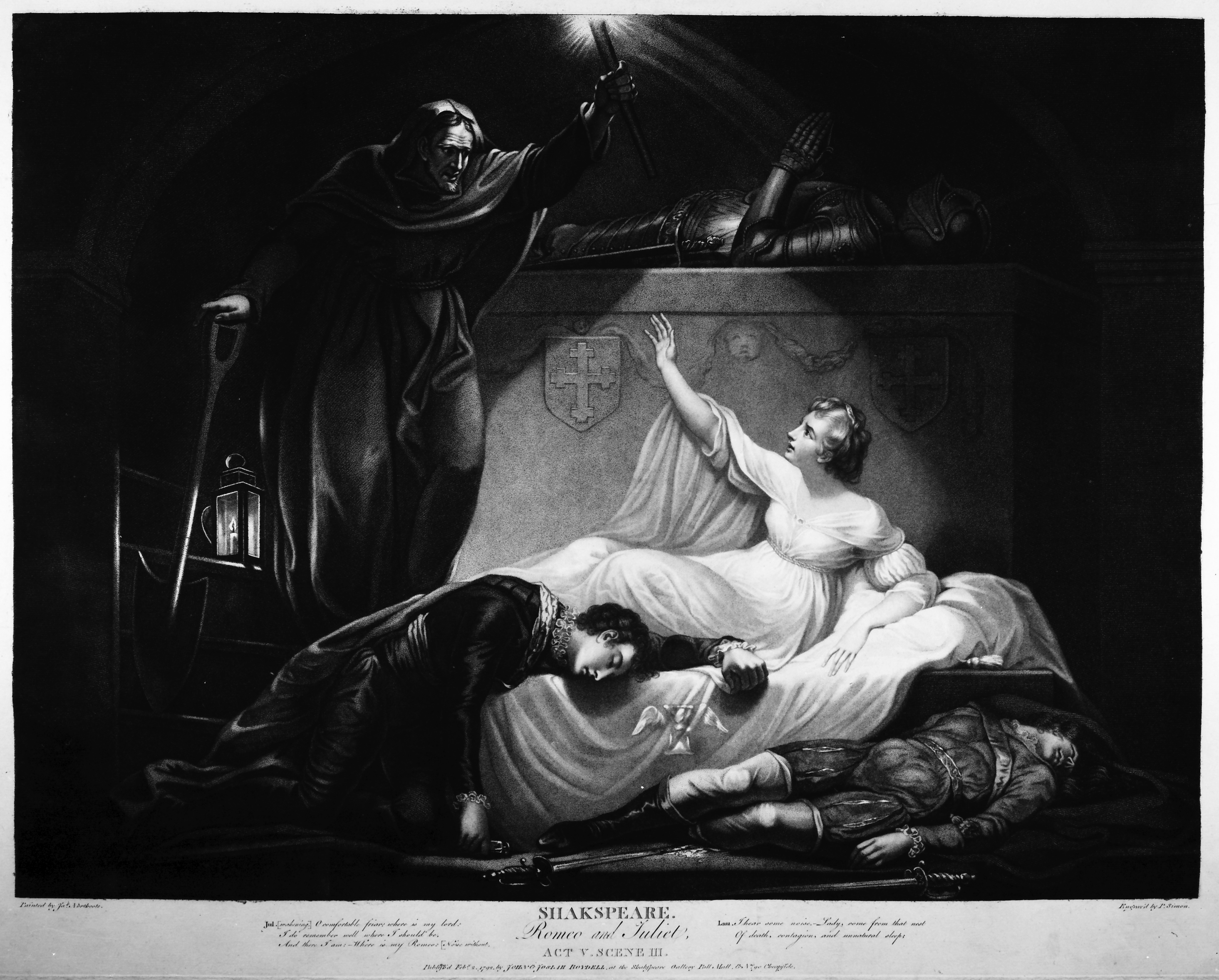
Reminder: RIN’s summer event, ‘Staging Shakespeare’, London July 19th

‘Staging Shakespeare: picturing Shakespeare’s plays in the 18th and 21st centuries’.
Professor Fred Burwick, University of California Los Angeles

Tuesday 19th July 2016
6.30pm – 8pm
City of Westminster Archives Centre, 10 St Ann’s St, London, SW1P 2DE

Join us for an event to celebrate Shakespeare’s 400th Anniversary, with a free public lecture followed by a wine reception (sponsored by the British Association for Romantic Studies).

Download the poster at https://romanticillustrationnetwork.wordpress.com/2016/05/03/rin-event-fred-burwick-staging-shakespeare-public-lecture-at-westminster-archives-july-19th-2016/.


RIN member Fred Burwick will share his expert knowledge of the Boydell Shakespeare Gallery, opened in Pall Mall in 1789. The talk will examine the extent to which any of the scenes in the Boydell Gallery might be presumed to represent how Shakespeare was actually performed during the period, and also consider present-day models of representation.

Prints from the Gallery will be on view, as well as a display about Shakespeare.

To book, contact: City of Westminster Archives Centre, 10 St Ann’s St,London, SW1P 2DE
Tel: 020 7641 5180
Email: archives@westminster.gov.uk


AHRC Collaborative Doctoral Partnership: Fully-funded PhD studentship

AHRC Collaborative Doctoral Partnership: Fully-funded PhD studentship

Modern Mistresses on the Old Masters: nineteenth-century women writers on western European art – their networks and influence

Birkbeck, University of London (School of Arts)

The National Gallery, London

Application Deadline: 12 noon, 22nd April 2016.

Applications are invited for an AHRC-funded PhD studentship on the role of women as disseminators of knowledge about the Old Masters, focusing especially on those who induced a greater interest in the collection at Trafalgar Square. It explores the social and cultural history of the Gallery’s present-day efforts to democratize access to its collections and reach new audiences by examining the understudied critical and art-historical writings of nineteenth-century women, which typically had a more popular reach than that of their male counterparts while also speaking to specialists, then and now.

This studentship is one of a number awarded to the National Gallery, as part of the AHRC’s new Collaborative Doctoral Partnership Scheme.

The supervisors of the project have identified the following issues for research, although the student has the scope to develop both the topic and approach, in conjunction with the supervisors.

What contribution did Victorian women writers make to scholarship on the Old Masters in the National Gallery’s collection? Did women tend to write about particular artists and periods, and if so why? Did their work affect the canon? How was their work received, and what was its reputation? What has been the subsequent fortuna critica? How might it speak to modern audiences?

Through what networks were these women connected with the National Gallery? How important to their success were such networks and relationships? To what extent did these women’s writings affect acquisition and collecting behaviours at the National Gallery and in the private sphere? Were their opinions taken seriously by the institutional art world? What forms did the work of women writers take, and to what audiences was it was addressed? What was the effect of their cross over between different genres and media? What was the role of the penny press in widening access to the Old Masters in the mid nineteenth century? Were women writers interested in the role of the National Gallery and other art institutions as places of advocacy for mass education?

This project will be supervised by Professor Hilary Fraser, Geoffrey Tillotson Chair in Nineteenth-Century Studies and Dean of Arts at Birkbeck, University of London, whose recent work focuses on women writers and the emergence of art history in the nineteenth century, and Dr Susanna Avery-Quash, Senior Research Curator in the History of Collecting at the National Gallery, whose research interests encompass the history of important private and public art collections.

This studentship will provide the student with invaluable academic skills and experience of working in a major national art museum, as well as deep understanding of women and nineteenth-century approaches to the Old Masters. It will involve the student in a range of interdisciplinary research activities, drawing on archival and primary textual material, various types of art collections and the resources of the National Gallery and Birkbeck.

In addition to working directly on the PhD thesis, it is envisaged that the student will also be engaged in a range of related activities, such as the delivery of research papers, assisting with conference organization, and contributing to a Room 1/Sunley Room exhibition at the National Gallery. She or he will also be expected to play a full role in the research cultures of both institutions.

For application details, please visit:
http://www.bbk.ac.uk/arts/research/research-bursaries-studentships-funding/ahrc-collaborative-doctoral-award-fully-funded-phd-studentship

CFP. Abusing Power: The Visual Politics of Satire

AbusingPowerAbusing Power: The Visual Politics of Satire
23rd Sep 2016 9:00am – 24th Sep 2016 6:00pm
Brighton Museum and Pavilion

A conference organised by the University of Brighton in association with the Royal Pavilion and Brighton Museum. Abstracts due: 9th May 2016 


http://arts.brighton.ac.uk/research/c21/events/events-calendar2/abusing-power-the-visual-politics-of-satire

Speakers include:

Steve Bell, political cartoonist
Martin Rowson, political cartoonist
Professor Ian Haywood, University of Roehampton
The Curator of the Cartoon Museum, London
The Curator of Fine Art at the Royal Pavilion Museums

In January 2015, 12 of France’s most familiar cartoonists were shot dead in Paris. The aftermath of the attack on Charlie Hebdo raises significant questions about the status and the potential impact of an image and gives this conference a political urgency. The events in Paris underline both the power of the political cartoonist and the dangers of causing offence to political and religious sensibilities.

In 1820, George Cruikshank and his brother Robert were summoned to Brighton Pavilion by George IV, in an attempt to buy them off from reproducing their salacious satirical cartoons. They were paid off, but continued to produce scurrilous images of the royal family and political figures. The Royal Pavilion now houses one of the best collections of Cruikshank, Hogarth and Gillray in the world, three of the most eminent caricaturists in visual history.

The city of Brighton and the University have a long history of association with cartoon and caricature. This conference offers the opportunity to celebrate the rich history of caricature and cartoons associated with Brighton and to address the important ethical questions that now confront the contemporary cartoonist. It celebrates the rich collections of Cruikshank, Gillray and Hogarth at the Brighton Pavilion and brings together the expertise of practitioners, curators, academic historians and cultural analysts. The conference draws upon the research expertise of the University, on the curatorial experience of museum staff and on cartoonists who currently practice.

This conference is organised by three research groupings from the College of Arts and Humanities at the University of Brighton, the Centre for Applied Philosophy Politics and Ethics, the Centre for Research in Memory, Narrative and Histories and C21: Research in Twenty-First Century Writings, which allows for the interdisciplinary focus that the subject merits.

We invite proposals (c300 words) for both papers and panels on topics which may include, but are not limited to:

Comedy and ethics – what are the responsibilities of a cartoonist? || The curation of cartoons – what should be kept? || How far can you go? Are there limits to what a cartoonist can lampoon? || The legacies of Cruikshank, Gillray and Hogarth || Religion and caricature || Representations of history through cartoon || The impact of caricature on popular ideas of politics || Celebrity and caricature || In what contexts does satire flourish and why? || Is satire necessary?

DEADLINE: Email your proposal and short bio to C21Writings@brighton.ac.uk by 9th May 2016 

Keeping Sketchbooks: Talk and Book Launch, The House of Illustration, King’s Cross, London

Keeping Sketchbooks

14 Apr 2016, 7:00pm

2 Granary Square, King’s Cross London, N1C 4BH

Celebrate the importance of the sketchbook in this evening of illustrated talks as The House of Illustration launch Martin Ursell’s ‘Keeping Sketchbooks’

Sketchbooks are vital to the work of illustrators, artists, designers and even medical professionals. Come along for an evening of talks to celebrate the publication of Martin Ursell’s new book Keeping Sketchbooks.

Hear from three of the book’s nineteen contributors. John Vernon Lord will share his spectacularly detailed and brilliant sketchbooks of doodles and jottings complied over fifty years. Phil Carter of Carter Wong studio gives us a rare opportunity to view his stunning reportage sketchbooks. And hand surgeon Donald Summat provides insight into his immaculate working sketchbooks complied during operations and consultations.

The book will be available in the shop for signing, and Martin Ursell is offering a free copy of his limited edition Zootime, featuring a selection from thirty years of zoo drawings to anyone buying the book.

To book tickets, go to the House of Illustration’s website: http://www.houseofillustration.org.uk/whats-on/current-future-events/keeping-sketchbooks

New Open Access Journal: British Art Studies

Published jointly by the Paul Mellon Centre for Studies in British Art and the Yale Centre for Studies in British Art, British Art Studies is a new online, open access, peer-reviewed journal for new research and scholarship of the highest quality on all aspects of British art, architecture and visual culture in their most diverse and international contexts.

British Art Studies is one of the few completely open access journals in the field of art history, providing a forum for the growing debate about digital scholarship, publication and copyright. The Editorial of the first issue is an interesting summary of the aims and digital strategies of the journal.

Issue 1 (Autumn 2015) is avaliable now.