Romantic London: new digital project

Romantic London is a research project by Dr Matthew Sangster (Birmingham) exploring life and culture in London around the turn of the nineteenth century using Richard Horwood’s pioneering ‘PLAN of the Cities of LONDON and WESTMINSTER the Borough of SOUTHWARK, and PARTS adjoining Shewing every HOUSE’ (published between 1792 and 1799). It considers the ways in which the writers and works later grouped under the umbrella of Romanticism interacted with London’s communities and institutions while also examining a wide range of alternative approaches to representing and organising urban existence.

The site is based around a digital version of Horwood’s Plan laid over and georeferenced to modern maps of the city; this allows for detailed examinations and comparisons. As well as considering the Plan and its creator, the site is using Horwood’s work as a means of thinking about the ways in which writers, publishers and artists sought to communicate insights into London’s general character and particularities. By using Horwood’s Plan as a base map and adding other kinds of information to it using annotated markers, the site reflects upon the social, geographical and aesthetic assumptions made in late eighteenth- and early nineteenth-century attempts to make sense and art of the burgeoning metropolis.

Texts brought into conversation with Horwood’s Plan on the site at present include:
•Entries from the dual-language New Guide for Foreigners prepared around 1790 and sold by the printseller S.W. Fores from his shop opposite the Paris Diligence office.
•Descriptions and images from Modern London, an 1804 publication put together by the radical publisher Richard Phillips, which included two sets of plates of the city, one showing major landmarks, the other showing itinerant traders hawking their wares in more out-of-the-way locations.
•The lavish aquatints from Rudolf Ackermann’s Microcosm of London (1808-10), engraved from collaborations between the artist and architectural draftsman Auguste Charles Pugin and the uproarious caricaturist Thomas Rowlandson.
•The text of the 1788 edition of Harris’s List of Covent-Garden Ladies, a disreputable register of London prostitutes.

The site at present is a work in progress; there are a great number of additions still to be made. You can follow the changes and developments on the site’s blog.
CFP: NeMLA 2016 panel: “Word and Image on Page, Stage, and Screen in the Long Nineteenth Century.”

NeMLA 2016 panel

“Word and Image on Page, Stage, and Screen in the Long Nineteenth Century.”

Chairs Robert Hasenfratz and Kate Holterhoff are asking for abstracts: they welcome projects engaging any aspect of the word-image nexus in illustrated novels, stage productions, or film in Anglo-European or North American culture during the long nineteenth century.

‘The relationship between text and image has an important and suggestive place in the humanities. While in decades past literary scholars have been apt to treat any visual elements accompanying literary texts as supplemental, a growing number of visual and media studies theorists have expressed interest in the important and under-theorized role of paratexts in the form of advertisements, book illustrations, and film and stage adaptations. We have a particular interest in the visual culture of the long nineteenth century. For example, the craze for tableaux vivants, re-creations of famous paintings on stage with living actors, infected both the popular stage, early film, and book illustration in the mid-1890s. The visual culture leading to this moment had itself been conditioned by pre-cinematic arts like magic lantern shows and stereoscopic viewers. We are interested in the complex ways that this visual culture not only supplemented but determined the representational conditions of literary texts, films, and stage productions.’

Abstracts should be submitted by September 30, 2015 through the following link: https://www.cfplist.com/nemla/Home/S/15947

Topographies: London Group of Historical Geographers Autumn Seminar Series

LONDON GROUP OF HISTORICAL GEOGRAPHERS
Seminar Programme, Autumn 2015
TOPOGRAPHIES
Talks in this series may well be of interest to RIN members. Seminars are held on Tuesdays at 5.15pm in the Wolfson Conference Suite (NB01), Institute of Historical Research, North Block, Senate House, University of London.

For further details please visit the LGHG homepage or the seminar listing on the IRH website.

6 October 2015
Stephen Daniels (University of Nottingham)
“’Map-work”: John Britton and the topographical imagination in nineteenth-century Britain.
20 October 2015
Veronica della Dora (Royal Holloway, University of London)
“And he walked from country to country”: Vasilij Grigorovich Barskij’s pious topographies, 1723–1747.
3 November 2015
William Bainbridge (Paul Mellon Centre for Studies in British Art)
“Mountains run mad”: shared topographies and conflicting memories in the Dolomites.
17 November 2015
Jordan Goodman (UCL)
Making places, knowing lives: Joseph Banks learns Australia, 1770–1810.
1 December 2015Felicity Myrone (British Library)Re-evaluating topography: the case of Captain Thomas Davies’ An east view of the great cataract of Niagara (1762).

Image of the Month: William Blake, Sealing the Stone and Setting a Watch (c.1800-1803).

Blake Sealing the Stone

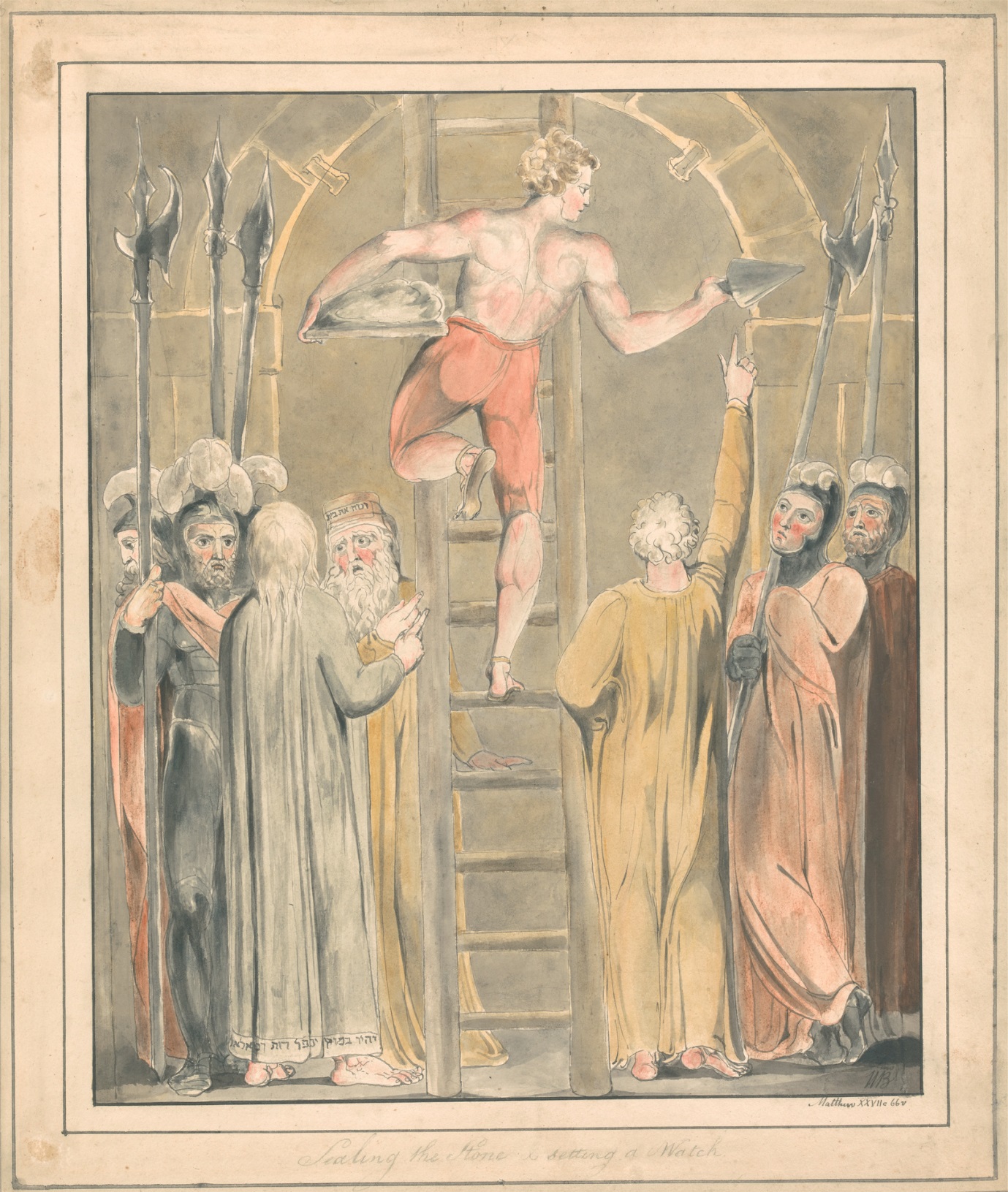
William Blake, Sealing the Stone and Setting a Watch (c.1800-1803). Watercolor, with pen, in gray ink, black ink and graphite on moderately thick, slightly textured, wove paper. Yale Center for British Art, Yale Art Gallery Collection, Everett V. Meeks, B.A. 1901 Fund.

In an ‘Image of the Month’ in February, I wrote about Blake’s watercolour Mary Magdalen at the Sepulchre (c.1805). In this post, I’m jumping back a bit to another of Blake’s watercolour illustrations to the Bible, Sealing the Stone and Setting a Watch (c.1800-03), which depicts a moment slightly earlier in the biblical narrative, and was probably also produced several years earlier (the exact dates of these works are not known, but they have been assigned dates based on stylistic features).

The text illustrated is Matthew 27:66 which describes the sealing of Jesus’ tomb on the day after his death and burial. The chief priests and Pharisees had heard Jesus say that he would rise again on the third day, and they feared that the disciples would try to take away the body to fabricate a resurrection. They therefore asked Pilate to secure the tomb, so he sent a watch and instructed them make the tomb as sure as they could (27:62-65).

In Blake’s illustration, the task is being undertaken very diligently. At the centre of the design is a young man balancing on a ladder, holding a palette of cement and a knife. He is turning to his right, directed by a priest standing below who appears to be pointing out a gap in the cement for the young man to seal. There are two more priests to the left of the ladder, and five soldiers are standing guard.

This is a relatively unusual subject, which is perhaps unsurprising; illustrators of the New Testament have tended to focus on the acts of Jesus and his disciples, not on those of Jesus enemies. We cannot be certain whether the subject was chosen by Blake or by his patron, Thomas Butts; either way, its inclusion in the series of biblical illustrations emphasises that the tomb was firmly shut. Thus, when Blake added The Angels Hovering over the body of Christ in the Sepulchre (c.1805, V&A) to the series, he was giving the viewer privileged access to a scene inside the firmly-sealed tomb, and then in The Angel Rolling Away the Stone from the Sepulchre (c.1805, V&A) and The Resurrection (c.1805, Fogg Art Museum), Blake depicts Christ bursting that seal.

As a stand-alone design the subject may not have obvious appeal, but in a series of illustrations to the narrative of Jesus’ death and resurrection, Sealing the Stone and Setting a Watch plays a key role.

Naomi Billingsley (Manchester)

CFP: “Tracing Types: Comparative Analyses of Literary and Visual Sketches (1830-1860)”, Ghent University Belgium, 3-4 June 2016.

“Tracing Types: Comparative Analyses of Literary and Visual Sketches (1830-1860)”, Ghent University Belgium, 3-4 June 2016.

Deadline for abstracts: October 1, 2015

In the wake of the pioneering work of Nathalie Preiss and Martina Lauster, a new wave of scholarship has emerged in recent years, which examines nineteenth-century sketches (sometimes referred to as ‘panoramic literature’) from a transnational perspective.

Two recent examples of this interest are the special issue of Interférences littéraires, “Croqués par eux-mêmes. La société à l’épreuve du panoramique” (2012), directed by Nathalie Preiss and Valérie Stiénon, and the recent NYU conference “Dissecting Society: Periodical Literature and Social Observation (1830-1850)” (March 2015), organized by Christiane Schwab and Ana Peñas Ruiz.

The present call for papers seeks to continue this comparative reflection by placing the spotlight on the comparative analysis of texts and images of specific types and by tracing how these representations vary across sketches from different places, media and editorial contexts.

We welcome presentations that address the following types of questions:

– How do the representations and definitions of a type (or group of related types) vary from one national context to another?
– How do different collections, periodicals or editorial contexts inflect a type in different ways?
– How do visual representations of a type differ from one another or from literary representations of the same figure?
– How does the type transform as it is taken up in other genres, registers or types of discourse?
– Does the type exist in a system? Does it belong to a collection or series of types and if so, how does it relate to or interact with other types in the system? How do different collections position the type within their systems?
In short, we invite each participant to choose a type (or group of related types) and to trace how it shifts or remains the same across different contexts and in relation to different co-texts. Presentations that explore less known types are particularly welcome.

The long term goal of this project is to publish an edited volume exploring these issues. It is our hope that the combined insights of the seminar will allow us to draw a series of general reflections about how portrayals of types shift across contexts, borders and media.

We would like to invite expressions of interest in the form of a short abstract (of around 300 words in English or French) describing your idea. Please submit your idea to Leonoor Kuijk at l.kuijk@ugent.be by October 1, 2015.

http://www.tracingtypes.ugent.be/

Organizers: Leonoor Kuijk, Elizabeth Amann and Marianne Van Remoortel (Ghent University), Valérie Stiénon (Université Paris 13)

NEW Online Resource: The Romantic Illustration Network Shakespeare Gallery

Announcing: The Romantic Illustration Network Shakespeare Gallery
 
Ready for the 2016 anniversary of Shakespeare’s birth, the Romantic Illustration Network is delighted to announce its digitisation of prints from Boydell’s Shakespeare Gallery, courtesy of negatives provided by Professor Frederick Burwick (UCLA).
 
The Boydell Shakespeare Gallery was open to the public on London’s Pall Mall from 1789 to 1805. Featuring paintings of scenes from Shakespeare by major artists of the day, including Fuseli, Reynolds, and Kauffmann, the gallery was a popular if not a financial success.
 
Prints of the paintings were published in volumes (as well as in an illustrated edition of Shakespeare), and are now digitised here by the University of Roehampton for use under a Creative Commons license. Images are arranged alphabetically by play, and new plays will be added over the coming months, so do keep checking back on the site. We have also digitised the front matter from the volumes.
 
Click on the thumbnails to access larger versions of the images, and to view the full-sized image. Once you have clicked on a thumbnail there is space to add comments on each image, and we very much encourage you to do so.
 
If you have any feedback, questions, or suggestions, please do let us know.
 

Musings on the Romantic Illustration Network: The Story So Far

This year, facilitating the Romantic Illustration Network has taught me three things: be ready shift furniture and sweep floors at 9am in your best conference jacket; never underestimate the importance of the well-timed tea break; and the most important work is often done in the pub after the symposium, so always choose a good watering-hole and book a large table. It’s been a great pleasure developing the Network and getting to know the regulars and the new faces who attend each event. I’ve become familiar with the inside workings of the British Academy, the Tate, and the House of Illustration, and I now have a really good sense of the goals and constraints of what are often loosely termed ‘heritage organisations’. It’s exciting to see, particularly after our recent event on Saturday June 6th, how our convivial gatherings, individual research papers, and gallery tours are actually building towards an understanding of shared interests and emerging research questions. Intellectually the awareness of a shared agenda and new theoretical approaches is growing, and alongside this, there is now a real sense of the Network as a collaborative international team of scholars. I hope we can continue to build on this. The great strength of the network is, I think, that relationships have been built both in person and virtually. The website and blog goes from strength to strength, with more than 6700 views in over 25 countries. We are currently developing a digitised gallery of 18th century prints of scenes from Shakespeare, courtesy of a generous donation from Frederick Burwick at UCLA. These beautiful high-definition images will be ready for the Shakespeare 2016 commemorations. I’ve enjoyed keeping in touch with network members via the blog: I post news of CFPs and events, but also useful resources and members’ research: ‘Image of the Month’ is a popular series of posts. RIN members are a collegiate bunch. The Network events have shaped my own research in unexpected ways: I never imagined I’d write a scholarly article about Dickens’s chair, for example. Most importantly, they have been great fun: as someone said to me at the recent symposium, ‘Why don’t we do this every week?’. Why don’t we, indeed.

REGISTRATION OPEN: The Arts And Feeling in Nineteenth-Century Literature and Culture, Birkbeck, University of London, 16-18 July 2015

The Arts And Feeling in Nineteenth-Century Literature and Culture
Birkbeck, University of London, 16-18 July 2015

Keynote Speakers: Caroline Arscott, Tim Barringer, Meaghan Clarke, Kate Flint, Hilary Fraser, Michael Hatt, Lynda Nead, Jonah Siegel, Alison Smith

This conference will explore the ways in which nineteenth-century authors, artists, sculptors and musicians imagined and represented emotion and how writers and critics conceptualised the emotional aspects of aesthetic response. It aims to map the state of the field in this growing area of interest for nineteenth-century scholars by locating recent interdisciplinary work on sentimentality and art and writing and the senses within wider debates about the relationship between psychology and aesthetics in the long-nineteenth century.

Speakers will investigate the physiology and psychology of aesthetic perception and the mind/body interactions at play in the experience of a wide range of arts. Key questions include: How did Victorian artists represent feeling and how were these feelings aestheticised? What rhetorical strategies did Victorian writers use to figure aesthetic response? What expressive codes and conventions were familiar to the Victorians? Which nineteenth-century scientific developments affected artistic production and what impact did these have on affective reactions?

Registration is now open for the main conference. To register, please visit: https://www2.bbk.ac.uk/artsandfeeling/

For more information, please visit the conference website: http://www.artsandfeeling.com/

Event Report: ‘The Art of Quotation and the Miniaturised Gallery’, RIN 4, Saturday 6 June 2015

The fourth Romantic Illustration Network symposium took place at the House of Illustration on Saturday the 6th of June. Once again the event was well-attended with a friendly mix of regulars and new faces, local and international.house-of-illustration-logo-kids-in-the-halls-column-arts-agency

We had two inter-related themes for the symposium:

1.Miniaturization: Drawing on Peter Otto’s work on virtual culture in the Romantic period, is the illustration a form of virtual gallery? How does visual meaning change when an image is resized?
2.The Art of Quotation: How were literary quotations used to conceptualise visual images? How important are framing devices to the meaning of an image?

However, speakers were free to interpret the terms ‘quotation’ and ‘miniaturised gallery’ in any way they saw fit, and to raise any other questions they chose.

We kicked off with David Worrall (Roehampton/Nottingham Trent) who presented us with his concept of ‘locations of curation’. After crediting William St Clair in RIN 3 for inspiring his quest for a new theory of illustration, Worrall explored what he described as two currently disconnected narratives – Romanticism and eighteenth-century theatre – to consider the changing moments when images interact with other objects, such as the people who view them. He used the example of theatrical portraits to demonstrate how images moved from stage, to page, to prints, to household objects.

Susan Matthews’s (Roehampton) paper interrogated questions of scale, domesticity, and artistic encounter, the idea of ‘meeting’ an artist though their illustrations. She pointed out that the name ‘House of Illustration’ (as opposed to ‘Gallery of Illustration’) is significant: we often seem to want to give illustration a ‘home’. She focused on Fuseli’s illustrations to an edition of Cowper’s popular poem The Task (1785), and revealed the awkward tensions between Fuseli’s depictions of domestic scenes and Cowper’s lines, whilst also showing that Fuseli could produce powerful images on a small scale when he really wanted to. Matthews drew parallels between Fuseli’s techniques and the recent exhibition of Paula Rego’s work at House of Illustration.

urizen_a_p11-17_100

Plate 17, The Book of Urizen William Blake Archive

From here we zoomed in still further, with Peter Otto’s (Melbourne) paper on plate 17 of Blake’s The Book of Urizen (1794). Otto gave a detailed and original reading of the plate which encompassed The Terror and images of decapitation by guillotine, the story of Adam and Eve, Perseus and the Gorgon, and the Narcissus myth to show how the plate connects primal history with events unfolding in the present through an art of visual and textual quotation. He argued that the plate illustrated a turning point in society, represented as a decapitation, and that Blake was constructing an imagined reality through quotation which in turn tries to shape or frame what reality is.

From royal executions to royal collections, Kate Heard (Royal Collection) showed us how George III and George IV both engaged with the reproductive print market, albeit in very different ways, as prints enabled middle-class consumers to gain access to items in the Royal Collection. We saw how Royal Collection items circulated as prints, so much so that satirical caricaturists could imitate them, and she argued that the print market played a crucial role in the public sense of the King. We also saw what a fantastic resource the Collection is for scholars.

Taking us through to the Victorian period, Bethan Stevens (Sussex) spoke about her work on the albums of proofs put together by the dominant mid-century London wood-engraving firm, the Dalziel family. The firm of Dalziel produced the illustrations to a vast range of literary and non-literary texts, including such classics as the Alice books and Tennyson’s Idylls of the King. Stephens showed how, in the albums, the exclusion of words affects the status, form and narrative of illustration, and provokes a new attention to illustrations as images which enables all kinds of subversive and intriguing readings.

Three Bibliographical Society Studentships were awarded: Anne Musset (Warwick/Paris-Diderot), Tessa Kilgariff (National Portrait Gallery/Bristol), and Naomi Billingsley (Manchester). We ended the day, as usual, with a period of open discussion about the broader themes of the event and the future of the network (upcoming ventures include the panel at BARS 2015 in Cardiff and the digitised Shakespeare Gallery, currently under construction). After that we adjourned to the pub, to round off a successful and fun day with a friendly drink.

Details of the BARS panel will be appearing on the blog and website soon: we hope to see you there!

IMG_20150606_180246993IMG_20150606_180306094_HDRIMG_20150606_180236143

REMINDER: RIN 4: The Art of Quotation and the Miniaturized Gallery. Saturday 6 June 2015, 10 – 5pm, The House of Illustration, London

The Art of Quotation and the Miniaturized Gallery.
Saturday 6 June 2015, 10 – 5pm 
The House of Illustration, London
Peter Otto (Melbourne), David Worrall (Roehampton/Nottingham Trent), Kate Heard (Royal Collection), Susan Matthews (Roehampton), Bethan Stevens (Sussex).
Supported by the University of Roehampton and the Bibliographical Society. Organised with the assistance of House of Illustration.

This session follows two themes:
1.Miniaturization: Drawing on Peter Otto’s work on virtual culture in the Romantic period, is the illustration a form of virtual gallery? How does visual meaning change when an image is resized?
2.The Art of Quotation: How were literary quotations used to conceptualise visual images? How important are framing devices to the meaning of an image?

…and other related questions.

Registration is free, and includes free entry to the main exhibition. You can download the full programme here.

To register, please email Mary.Shannon@roehampton.ac.uk, giving your name, job title, and institution (if applicable).