Image of the Month: Theodore von Holst, ‘Frankenstein’ (1831)


In November 1831, a new edition of Mary Shelley’s Frankenstein was published by Richard Bentley and Henry Colburn in their recently launched ‘Standard Novels’ series. The publishers were responding to a major shift in the fiction market as expensive three-decker fiction gave way to cheaper, octavo-sized single-volume novels which could be purchased rather than borrowed.[i] Significantly, this new format included illustrations as a ‘standard’ of quality and value for money. Following on from Robert Cadell’s successful, illustrated reprinting of the Waverley novels in 1829, Bentley and Colburn provided the reading (and viewing) public with two images per volume: a vignette on the title page and a frontispiece. For Frankenstein, they hired a young protégé of Henry Fuseli named Theodor Von Holst (1810-1844). The son of émigré Russian parents who fled Napoleonic conflict, Holst’s talent for drawing was spotted by both Fuseli and Sir Thomas Lawrence, and he entered the Royal Academy in 1824. Holst’s renown as a master of Fuselian themes and forms made him an obvious choice for being the first illustrator of Shelley’s novel, though his famous image outlived his own reputation, and it was not until the 1990s that he merited a major retrospective.[ii]


shelley-mary-1831-b20116-89

Theodore von Holst, frontispiece to Frankenstein, 3rd ed (1831), engraved by William Chevalier [British Library 1135.a.9.(1.)]

For the frontispiece, Holst illustrated one of the novel’s most dramatic and seminal moments: the awakening of the creature. Following the format pioneered by John Bell’s Poets of Great Britain series in the late eighteenth century, a short quotation from the text was placed beneath each image, usually with a page reference.[iii] This had a dual function: to locate the illustration and to act as hook for the potential purchaser of the volume. In this case the epigraph reads: ‘By the glimmer of the half-extinguished light, I saw the dull, yellow eye of the creature open; it breathed hard, and a convulsive agitation seized its limbs…I rushed out of the room.’ Holst’s challenge was to incorporate the two conflicting elements of unhallowed creation and horrified paternal rejection into his compact, octavo-sized design. To do this he borrowed from both high and popular culture, and from Romantic and Renaissance art. The melodramatic aspect of the tableau is captured in Victor Frankenstein’s arrested exit, and his backward-looking, wide-eyed posture (and it is worth adding here that, strictly, this image was not the first visual depiction of the text: the popular theatrical adaptation Presumption, first staged in 1823 produced a number of commercial and satirical paratexts which may have influenced Holst; unlike the epigraph which is from Victor’s point of view, the illustration is framed like a proscenium arch and the creature is front-stage and therefore closer to the reader-viewer who is like a member of the audience,).[iv] The diagonal sight-line, magnified by the shaft of light, connects his gaze to the creature’s larger, bewildered visage. The expanding beam of illumination is one of the scene’s most conspicuous tropes as it has no logical function, contradicting the epigraph’s ‘half-extinguished light’ and the text’s mention of a moon that ‘struggled’ to pierce the gloom. By adding this fiat lux, Holst reinforced the scene’s (and the novel’s) troubling religious and political connotations, as the motif is most commonly found in medieval and Renaissance representations of the Annunciation, though it also figured in British royalist propaganda (in Eikon Basilike (1649), for example, it signifies the apotheosis of the executed Charles I) and in anti-Catholic satirical prints, particularly those depicting or alluding to the anti-hero Guy Fawkes.[v] Holst’s shaft of light also falls on the creature’s cocked left arm, which was a pose used in both sculpture and painting to represent sleeping beauty, as in Titian’s painting The Bacchanal of the Andrians (1523-6) and the Vatican’s famous Roman statue the Sleeping Ariadne. This allusion, together with the creature’s ‘lustrous’ hair, handsome visage (another departure from text) and classical torso, mitigates the horror of the ‘filthy’ anatomical hands and legs – features which are reinforced by the theatrically placed skeleton whose raised knee echoes the creature’s posture and who appears to be grinning like an episode from the Romantic revival of the Dance of Death – and implies considerable sympathy for this new Adam. Drawing on his academic training, Holst blended classical and Fuselian, Gothic motifs in order to give his illustration authority and to open up for contemplation the text’s central moral and aesthetic dilemma: should we, like Victor, be repelled by the creature?

The illustration also exemplifies how much significant detail could be included in such a small image. If the bottom half of the scene is dominated by a momento mori, the upper half is crammed with signifiers of modernity and the pursuit of knowledge. In order to impress on the viewer the importance of science, Holst takes liberties with the text and places a cluster of instruments not specified by the novel: a bell jar, two bottles connected by a tube, and a remarkable, horn-like set of Galvanic electrodes that anticipate the Hollywood appropriation of this scene in the early twentieth century. This scientific paraphernalia is also positioned above the creature’s head like some king of surreal coronation, capping a grave-like stone backrest which no doubt alludes to his ‘filthy’ genesis in exhumed corpses (though in the text we are told that he is lying down, not sitting up). The large bookcase with several tomes confirms that this is Victor’s secreted study in Ingolstadt and not, as the large vaulted window implies, a stereotypical Gothic castle. The bookcase also alludes to Goethe’s Faust, which Holst had illustrated several years earlier, but which Mary Shelley could not have read (in English) when she published the novel in 1818.[vi] Hence the illustration adds another tier of intertextuality to an already mythopoeic text. Finally, the tantalizingly open book in the bottom left, next to the creature’s emaciated right hand is a narrative prop: this is Victor’s lab-diary from which the creature later learns his life-story and discovers his ‘author’.

Illustration is never a simple transcription of a text: it simultaneously illuminates, embellishes and interprets. More could be said about the skill of the engraver W. Chevalier (about whom little is known) in realising the central tropes of light and darkness through cross-hatching and contrast. Perhaps more importantly, further thought could be given to the way in which the medium of engraving reduplicates the text’s concern with mechanical reproduction: this illustration marks the point at which Frankenstein is reborn and remythologized as a visual commodity, for better or worse. Does the fiat lux announce this epistemic transformation as its divine light passes through the creature’s body to the unillustrated open book? Viewed as a bibliographical allegory, the electrode-wielding creature is a portent of mass visual culture, a naked, unrealised potential that has burst from the ruined shell of an antique codex which is revealingly draped in a single sheet ( a page?), a symbol of its own demise. Holst’s Frankenstein is an emblem of a new era of mass illustration, though the future lay with wood rather than metal engraving: wood allowed images and letter-press to be printed together cheaply on the same page, and enabled the growth of the illustrated periodical press and the professional literary illustrator.[vii]

There is another sense in which Holst’s image re-allegorized the text. Max Browne suggests that Holst represented the last gasp of Romantic art before Victorian cultural hegemony stripped visual fantasy of its sublime, revolutionary associations and subjected it to the generic codes of melodrama, domestication and sentimentality.[viii] Holst seemed to be aware of these imminent changes in taste as his title-page vignette for Frankenstein shows Victor’s agonized parting from Elizabeth. But what neither Holst nor his publishers could have predicted is that the timing of the book’s appearance reinforced its association with revolution. The novel was published in November 1831, a month which saw devastating Reform Bill riots in Nottingham and Bristol. There is an uncanny convergence of chronology between these events and the ‘dreary night in November’ of the creature’s ‘convulsive agitation’, a lexis which, as Chris Baldick has shown, clearly connotes revolution.[ix] This potential is, as yet, stored up in creature’s incredulous stare. Given the technical difficulties of portraying bodily ‘agitation’ in the frozen medium of art, the scene uses a different method and arranges possible futures around the creature: the way of science and books, or the way of death. As readers viewed for the first time the modern Prometheus, they would also know that Bristol rioters had destroyed the cathedral library, and that Britain was poised on the brink of a political earthquake. Mary Shelley’s creature had a double revolutionary genesis: in 1831, just as in 1818, the text resonated with anxieties about the causes and consequences of radical reform.[x] Holst’s pioneering illustration compressed these concerns into a self-reflexive, compact image in which illumination is both a theme and method.

Ian Haywood, University of Roehampton

November 2016

[i] See Michael Sadleir, ‘Bentley’s Standard Novel Series: Its History and Achievement’, The Colophon 10 (May 1932), 45-60; Catherine Chittick, Dickens and the 1830s (Cambridge: Cambridge University Press, 1990), 28-9, 66-7.

[ii] Max Browne, ed. The Romantic Art of Theodor Von Holst (London: Lund Humphries, 1994). For many years Holst’s works were attributed to Fuseli.

[iii] See Thomas Frank Bonnell, The Most Disreputable Trade: Publishing the Classics of English Poetry 1765-1810 (Oxford: Oxford University Press, 2008), chapter 4.

[iv] See the online edition of Presumption edited by Stephen Behrendt for Romantic Circles (2001): http://www.rc.umd.edu/editions/peake/

[v] See, for example, The Double Deliverance (1588), British Museum Satires 41, and James Gillray, The Pillar of the Constitution (1807), British Museum Satires 10738.

[vi] This image is reproduced in Browne, 47 and in the British Museum Database. The bookcase and window are in the same position.

[vii] See Patricia Anderson, The Printed Image and the Transformation of Popular Culture (Oxford: Clarenson Press, 1991), and Laurel Brake and Marysa Demoor, eds, The Lure of Illustration in the Nineteenth Century: Picture and Press (Houndmills: Palgrave Macmillan, 2009).

[viii] Browne, 26-7.

[ix] Chris Baldick, In Frankenstein’s Shadow: Myth. Monstrosity and Nineteenth-Century Writing (Oxford: Clarendon, 1990). It is surely no coincidence that a Reform Bill caricature by John Doyle (‘H.B.’) had already appeared in 1831 under the title ‘Political Frankensteins’: see British Museum Satires 16551.

[x] See Adriana Craciun, ‘Frankenstein’s Politics’, in The Cambridge Companion to Frankenstein, ed. Andrew Smith (Cambridge: Cambridge University Press, 2016), 84-100.

Victorian Illustrated Shakespeare Archive

Michael Goodman of the University of Cardiff has launched his PhD project, ‘The Victorian Illustrated Shakespeare Archive’.

The site contains more than 3000 illustrations from the illustrated editions of Charles Knight (1842), Kenny Meadows (1846), John Gilbert (1865-7)and H. C. Selous (1864-8). Combining high-resolution images, bibliographical and iconographical tags, and straightforward navigation, the Archive represents a rich and accessible resource for scholars and students. Explore the Archive online at shakespeareillustration.org.

Political Caricature Workshop

In the run-up to the US elections RIN organised a lecture and workshop on political caricature featuring recent research by Ian Haywood. The event was held at House of Illustration near London’s King’s Cross and is the first part of new collaborations with House of Illustration’s education and learning team, and with London branches of the University of the Third Age (U3A).

lectureThe day began with Ian Haywood’s lecture on ‘The Golden Age of Caricature’, which highlighted the evolution of British political caricature from the late eighteenth to the mid-nineteenth century, as well as the production and consumption of caricatures by contemporary reader-viewers. Following a discussion and Q&A session, participants enjoyed a guided tour of the galleries led by Emily Jost, House of Illustration’s Head of Education.
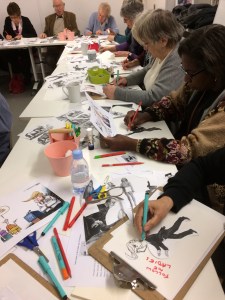
caricature-close-upAfter the tour participants returned to the classroom for a practical workshop led by professional illustrator Merlin Evans. Merlin taught participants how to exaggerate select facial features to create caricatures of today’s political target par excellence, Donald Trump. In addition to creating their own images students also cut and pasted Victorian illustrations to create hybrid images. (One of these, a glowing orange Trump head on the body of a woodcut dragon, was particularly popular.) For many of the participants drawing was a familiar but uncommon experience. According to one U3A member, ‘I have not drawn for 60 years and really enjoyed this’.

A number of participants talked about how much they enjoyed the chance to look at caricature from a variety of perspectives. ‘The background talk mixed with attempts to do our own [drawings] was a great way to learn’, said one member of Ealing U3A.

RIN is pleased to be able to build on the day’s success and bring members’ work on illustration to new audiences. We will partner with House of Illustration to provide a series of lecture-workshops like this one in 2017. First on the list is Susan Matthews on William Blake and Medical Illustration on February 14.

Romantic Antiquarianism

Romantic Antiquarianism: A Conference Celebrating Scott’s The Antiquary

Saturday 26 November 2016, 09.30–15.30

The Georgian Group, 6 Fitzroy Square, London

Co-organised by Fiona Robertson (Durham) and Peter Lindfield (Stirling)


This one-day conference in the heart of London celebrates the bicentenary of the publication of Sir Walter Scott’s novel, The Antiquary, by looking at the multi-faceted nature of antiquarianism in Georgian Britain. Leading scholars from across the UK gather to present new and engaging material on the topic.

Registration — at the time of writing only 10 places remain — (£30) includes teas/coffees and lunch in one of Robert Adam’s town houses.

Register at: https://www.eventbrite.co.uk/e/romantic-antiquarianism-a-conference-celebrating-scotts-the-antiquary-tickets-27322980771

Event – Late Victorian Book Illustration: Progress, Knowledge and Democracy, 1 December, Sheffield Central Library

silverforketiquette's avatarThe Victorianist: BAVS Postgraduates

Late Victorian Book Illustration: Progress, Knowledge and Democracy

Thu 1 December 2016, 10:30-11:30 GMT

Sheffield Central Library

Carpenter Room

Surrey Street Sheffield S1 1XZ

Event is free, but is ticketed:

https://www.eventbrite.co.uk/e/late-victorian-book-illustration-progress-knowledge-and-democracy-tickets-27598247100

Encyclopaedias are a snapshot of a particular time, place, and world view.  Historian Rose Roberto shares images from early Encyclopaedias to tell the history of British publishing and the movement to democratise knowledge.

View original post

Image of the Month: ‘Alfred in the Isle of Athelney’ (1751/1778)

alfred-in-athelney

Last month I joined RIN in a new role as the network co-ordinator, following in the footsteps of Mary Shannon. By way of introduction I want to share ‘Alfred in the Isle of Athelney, receiving News of a Victory over the Danes’, a depiction of Alfred the Great that has loomed large in my recent work on the eighteenth-century reception and representation of the early middle ages.

Nicholas Blakey painted ‘Alfred in the Isle of Athelney’ c.1750 and it was engraved by Gérard Scotin II for inclusion in the series English History Delineated, published by John and Paul Knapton in 1751. Although the series failed after only six prints (covering the period from the Britons to the Battle of Hastings), the plates were bought by Richard Sayer, who had them reworked for a 1778 reissue. The image above is Sayer’s re-issue, reworked by the landscape-engraver François Vivares. Although Blakey’s design shows clear neoclassical influences, the image is remarkable for its (proto-)romantic, sympathetic depiction of Anglo-Saxon history and for the fact that it seems to illustrate a scene from James Thomson and David Mallet’s Alfred: A Masque rather than the relevant passage from Paul Rapin de Thoyras’ History of England, a best-selling history published by the Knaptons in numerous editions and subsequently by John Harrison. Rapin presented Alfred as an English hero; Thomson and Mallet presented him to Frederick, Prince of Wales and to audiences at Drury Lane as a model of virtuous English masculinity.

Blakey’s image captures this affective nearness perfectly. Alfred is shown in his prime, a rustic poet whose harp and bow rest against the roots of a massive oak. He is on the verge of military greatness, a figure who, despite his humble dress, commands the respect of the Earl of Devon (holding the Raven banner of the Vikings – or ‘Danes’ – that Alfred will soon defeat at Edington) and of the English soldiers flocking to join him. During the eighteenth century Alfred the Great rose steadily in the popular imagination to become ‘England’s Darling’, the Romantic and increasingly romanticised Anglo-Saxon hero-king of England. Blakey’s image, informed by history and drama, offers us a glimpse of that transformation in action.

Dalziel Archive Launched

Longstanding RIN member Dr Bethan Stevens of the University of Sussex has recently launched a new website, ‘Woodpeckings: The Dalziel Archive, Victorian Print Culture, and Wood Engravings’.

Brothers George and Edward Dalziel were the founders of Dalziel Brothers, nineteenth-century London’s most substantial wood engraving firm and the producers of illustrations for a huge range of printed materials, from books to packaging. According to the site, ‘The Dalziel Archive in the British Museum is a visual archive of the firm’s oeuvre from 1839 to 1893: around 54,000 fine burnished proofs kept chronologically in albums. The albums offer a new path into 19th-century wood engravings, usually approached exclusively through designers or the texts that they illustrated’.

Developed as part of the AHRC-funded Dalziel project in partnership with The British Museum and Sylph Editions, the site contains a virtual exhibition, recordings of research events and links to extended catalogue descriptions of every album in the Dalziel Archive.


CfP: Association of Art Historians 2017

AAH2017 

43rd Annual Conference and Art Book Fair

Loughborough University

6 – 8 April 2017

Deadline for Proposals: 7 November 2016


AAH2017’s Call for Papers includes two sessions of interest to RIN’s members, readers and followers:


Prints in Books: the materiality, art history and collection of illustrations

Convenor: Elizabeth Savage, Cambridge University, leu21@cam.ac.uk


Speculative Libraries

Convenor: Nick Thurston, University of Leeds, n.thurston@leeds.ac.uk


Please email your paper proposals straight  to the session convenor(s). Provide a title and abstract for a 25 minute paper (max 250 words). Include your name, affiliation and email. Your paper title should be concise and accurately reflect what the paper is about (it should ‘say what it does on the tin’) because the title is what appears most first and foremost online, in social media and in the printed programme.

You should receive an acknowledgement of receipt of your submission within two weeks.


CFP: Object Matters: Making Memory: material and visual culture of commemoration in Ireland c.1800 – 2016

CFP: ‘Object Matters: Making Memory: material and visual culture of commemoration in Ireland c.1800 – 2016’

13-15 October 2016

National Gallery of Ireland, Merrion Square, Dublin 2

Funded by the Irish Research Council ‘New Foundations’ Scheme

Deadline for proposals 12 July, 2016

Proposals of c.300 words accompanied by a short CV are invited for 20-minute papers related to the material and visual culture of commemoration in Ireland from c.1800 to the present day. Please email to makingmemory@ncad.ie.

This cross-disciplinary conference will address how objects, images, artworks, buildings, spaces and bodies have worked and been understood in the creation and maintenance of public and private memory in Ireland since c.1800. While topics might include key personages and events such as World War 1, the Irish Civil War and the Manchester Martyrs, we also encourage proposals that address the commemoration of lesser-known histories.

Commemorative culture might encompass events such as ceremonies and parades, artefacts such as souvenirs or artworks, institutional practices such as collecting and exhibiting, particular sites such as commemorative buildings, graveyards and ceremonial spaces, and private modes of visual and material remembrance such as domestic mnemonic objects.

The conference should contribute to our understanding of how ideas about the past have been visualised, manufactured, articulated, materialised, distributed and performed.

Proposals are welcomed from researchers and practitioners across various fields including Art practice, Archaeology, Anthropology, Geography, Architectural History, History of Design, Material Culture, Visual Culture, Memory Studies, Museum Studies, Art History, History of Media, Cultural History, Sociology and Critical theory. A publication is planned based on the conference proceedings. For the proceedings of the first Object Matters conference Making 1916: material and visual culture of the Easter Rising, see http://liverpooluniversitypress.co.uk/products/60501.

Deadline July 12, 2016. Participants will be notified by July 22.

Conference Convenor Dr. Lisa Godson, National College of Art & Design

Conference Administrator Kate Butler, BL

Supported by the National College of Art and Design + University College Dublin Centre for Creative Arts and Critical Cultures / National Gallery of Ireland/Irish Museums Association / Irish Architecture Foundation / GradCAM

Enquiries and proposals should be directed to: makingmemory@ncad.ie

Angelica Kauffman (1741-1807): the artist as businesswoman

Ellen Moody's avatarReveries Under the Sign of Austen, Two

National Trust; (c) Saltram; Supplied by The Public Catalogue Foundation
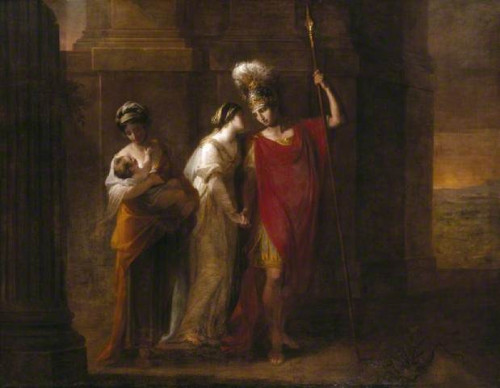
Angelica Kauffman, Hector Taking leave of Andromache (1768)

‘All I possess has been attained by my work and industry … ‘ (from Angelica Goddden’s Miss Angel, Kauffman)

Friends and readers,

I return to my series of blogs on women artists. Thus far in this second round, we’ve looked at Giovanna Garzoni (1600-70), Strange and magnificent still lifes; Sofonsiba and Lucia Anguissola (1535/6-1625; 1546/8-1565), Sober, contemplative and self-aware portraits; and Mary Beale(1633-99), An unknown famous Restoration painter. As in the first series I can’t ignore altogether those women artists whose work has been paid a great deal of attention to, at least at times, and if not uniformly respectfully. So we come to Angelica Kauffman, one of two women to help found and be inducted into the Royal Academy of Art in England.

selfportrait
A self-portrait In the Traditional Costume of the Bregenz Forest (1781)

The…

View original post 3,035 more words