Ashmolean Blake Exhibition: Lectures and Conferences

Members of the Illustration Network might be interested in the upcoming events associated with the Blake exhibition at the Ashmolean.

LECTURES

Towards a New Era in Printmaking: Innovation in the 18th Century With Dr Ad Stijnman FRHistS, private researcher, Ashmolean Lecture Theatre, Friday 16 January, 2-3pm £5/£4 concessions. Printmaking changed dramatically after 1700 with the introduction of new plate-making and plate-printing processes, coloured inks and state of the art print presses. Dr Stijnman looks at this era in which artists, printers, engravers and publishers produced work that astonished audiences. BOOK NOW AT http://www.ashmolean.org/exhibitions/whatsontickets/

Reading in the Spirit of Blake With Saree Makdisi, Professor of English and Comparative Studies at UCLA Ashmolean Lecture Theatre, Friday 23 January, 4.30-5.30pm £5/£4 concessions. This lecture explores the relationship between William Blake’s words and the images in his illustrated books and hopes to show you how to read ‘in the spirit of Blake’. Part of the ‘Inspired by Blake’ Festival. BOOK NOW AT http://www.ashmolean.org/exhibitions/whatsontickets/

Italian Old Master Prints Through the Eyes of Blake and His Friends With Michael Bury, University of Edinburgh. Ashmolean Lecture Theatre, Thursday 19 February, 2-3pm £5/£4 concessions. In the late 18th century, Blake and his contemporaries developed a distinctive approach to the study of Italian Renaissance prints. They paid attention to printmakers whose work has been largely ignored or disparaged in preceding years. This talk examines these artworks and identifies why Blake admired them so much. BOOK NOW AT http://www.ashmolean.org/exhibitions/whatsontickets/

CONFERENCE

Apprentice & Master: Conference With the University of Oxford’s Faculty of English and the Birkbeck Centre for 19th-century Studies. Ashmolean Lecture Theatre, Saturday 24 January, 10am-8pm £30/£25 concessions. Leading academics in the study of Blake will explore a variety of perspectives on the exhibition. The conference includes lunch and is followed by a reception and private viewing of the exhibition. BOOK NOW AT http://www.oxforduniversitystores.co.uk/

Event Report: ‘The Artist and the Writer’, IES, 29th November 2014. Supported by the British Association of Victorian Studies and the University of Roehampton.

‘The Artist and the Writer’, IES, 29th November 2014.

Supported by the British Association of Victorian Studies (www.bavs.ac.uk) and the University of Roehampton.

‘The Artist and the Writer’ at IES told a chronological narrative of the relationship between artists and writers c. 1750 – 1850, revealing the contrasts and connections in book illustration from the eighteenth century to the Victorian period. The day opened with Lynn Shepherd’s paper on ‘Illustrating Pamela’. Shepherd showed how the illustrations to Pamela by Hayman and Gravelot create a narrative with a significantly different perspective from that provided by Pamela’s narration.  In the 28 illustrations – chosen on literary rather than visual grounds by Richardson himself – the ‘warm scenes’ are totally omitted.  Mr B’s assaults therefore exist only in Pamela’s words and not in the third person visual narration of the illustrations.  Lynn Shepherd read the images in terms of the pyramidal structures of contemporary conversation pieces, and also traced the gradual disappearance of barriers placing Pamela outside the class territory occupied by Mr B. The following discussion focused on the question of the kinds of visual literacy that readers might have brought to the task of reading the illustrations.  Shepherd argued that those who had sat for portraits would have understood the visual languages of these images.
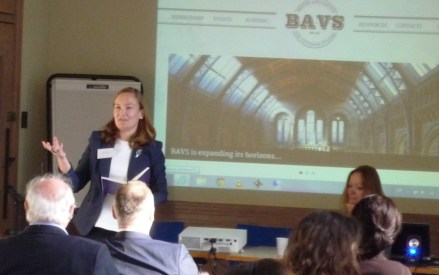
Mary L. Shannon (Roehampton) introduces novelist and scholar Lynn Shepherd

Mary L. Shannon (Roehampton) introduces novelist and scholar Lynn Shepherd

Sandro Jung’s paper on ‘Thomas Stothard, Romantic Literature and the Illustrative Vignette’ took an ephemeral publication – The Royal Engagement Pocket Atlas  – as a means to overturn some of the key assumptions of illustration studies, namely that illustrators focused on old canon works newly freed from copyright. Stothard’s more than 800 head vignettes for Baker’s annual diary featured illustrations to recent and fashionable authors, prompting purchasers to discuss their current reading.  Baker followed Bell’s example in commissioning illustrations, but Baker made the decision to include recent poets not illustrated by Bell. Stothard, for instance, illustrated Crabbe, Byron and Scott, as well as Hayley’s Triumphs of Temper and Rogers’ Pleasures of Memory.  Stothard’s recognizable visual style thus provided a branding device not just for Baker’s publication but also for the concept of literature.  Jung argued that the Baker series offers a snapshot of consumer historical conditions.

Tim Fulford presented the early nineteenth-century as a period of virtual travel, when travellers prepared themselves by visiting exhibitions and looking at engravings, and picture books changed what the Romantic poets published.  Turning away from an earlier anti-picturesque aesthetic, and an earlier hostility about literary annuals, after 1818 Wordsworth and Southey repeatedly produced virtual topography, which functioned as guides for tourists.  The new urban bourgeoisie craved reminders of the countryside they had left, and technical developments made illustrations increasingly affordable.  Industrialization lowered the cost of paper, while from the 1820s the move to steel rather than copper engraving made larger print runs possible.  The Lake District gained its name through the sale of books of engraved views which were more popular than verse.  The Lake poets were therefore keen to foster links with artists and by the 1820s were working on jointly authored picture books in which poems were written to accompany pictures.  In the following discussion William St Clair argued that we needed to follow the logic of two industries and two media, tracing the links between them.

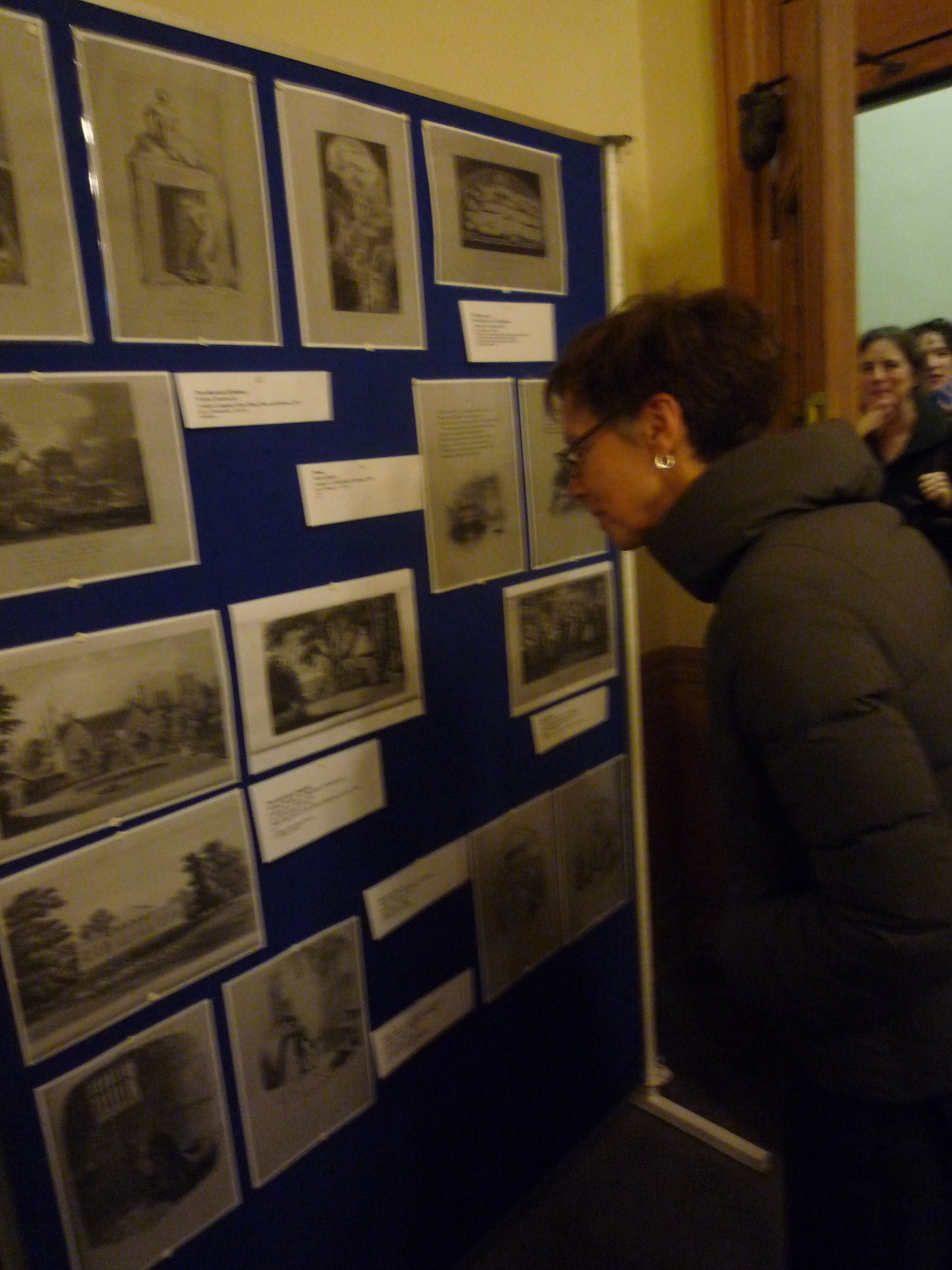
Exhibition of images from Senate  House Special Collections

Exhibition of images from Senate
House Special Collections

After a lunch sponsored by the British Association for Victorian Studies, and a visit to see some beautiful illustrated books in the Senate House library Special Collections (chosen to complement the day’s talks), Sophie Thomas traced the pre-history of the figure of the Bard in painting and illustration, from Thomas Jones’ the Bard (1774) via West, Sandby, Fuseli, Turner and Martin to the Bard in Blake’s illustrations to Gray and his painting of Gray’s Bard for his 1809 exhibition. Thomas’s paper on ‘Bardic Exhibitionism’ showed how Gray’s Bard appeared in Bentley’s illustrated Gray and reappeared in a lower illustrative mode in editions by Bell and Cooke, carrying complex meanings.

In the final session on Dickens, Mary L. Shannon’s ‘What did Dickens learn from Romantic Illustration?’ argued that Dickens drew on the more recognizable figure of Cruikshank to establish his own public identity, creating a visual image which drew on the conventions of visual Byronism.  Sadly, Ruth Richardson was unable to speak due to a bereavement, so more time was then devoted to open discussion. This ranged across author portraits, later images of Dickens and Victorian authors, continuities between the Romantic and Victorian periods, and links between theatre and visual culture. Anthony Mandal reminded us of the influence of Scott on Dickens, and Julia Thomas raised the significance of Luke Fildes’ watercolour tribute to Dickens, ‘The Empty Chair’ (1870).  The day concluded with a sociable drink nearby, at which it was agreed that the lively atmosphere, high-quality papers, and the trip to Special Collections had all made the event enjoyable, varied, and successful.

Susan Matthews, University of Roehampton
‘The Artist and the Writer’: room confirmation

If you are coming next Saturday 29th November to ‘The Artist and the Writer’, we can now confirm that it will be held in Room 349 of the Institute of English Studies, Senate House, Malet Street, London.

Signs will direct you there from Senate House reception on the day.

See the Events page of the RIN website for full details of the location and latest programme.

We look forward to seeing you there!

Guest Lecture: ‘A Private Space as Visual Text in 17th-century England’ University of Tampa, FL.

‘Never less alone than when alone’ 
A Private Space as Visual Text in 17th-century England

Guest Lecture
with Digital Images & Display Table
Sunday, October 19th, 2014. 1:30pm
University of Tampa Library, Room 203. Tampa, FL.
(Some traffic rerouting on West Kennedy Blvd.)

Speaker:
Professor Heather Meakin
University of South Florida-Tampa
Department of English.

Hosted by the Florida Bibliophile Society

Professor Meakin will speak on her recent book, The Painted Closet of Lady Anne Bacon Drury (Ashgate, 2013), an extraordinary subject engaging art installation, women and the visual arts, and the specialness of private space in the design and use of the early-modern home.

For particulars & illustrated poster see: http://www.floridabibliophilesociety.org/id2.html

Event Initiated & Coordinated by Maureen E. Mulvihill
Princeton Research Forum, Princeton NJ.

CFP: ‘James Gillray@200: Caricaturist without a Conscience?’ Oxford, March 2015

http://www.new.ox.ac.uk/james-gillray200-caricaturist-without-conscience

James Gillray@200: Caricaturist without a Conscience?

The Ashmolean Museum, Oxford & New College, Oxford present:
A one-day symposium to be held at the Ashmolean Museum
Saturday 28 March 2015

CFP deadline: 15 November 2014

Programme will be announced: 21 November 2014

James Gillray’s reputation in the two centuries since his death has been as varied and layered as his prints. Trained at the Royal Academy, he failed at reproductive printmaking, yet became, according to the late-eighteenth-century Weimar journal London und Paris, one of the greatest European artists of the era. Napoleon, from his exile on St Helena, allegedly remarked that Gillray’s prints did more to run him out of power than all the armies of Europe. In England, patriots had hired him to propagandize against the French and touted him as a great national voice, but he was an unreliable gun-for-hire. At a large public banquet, during the heat of anti-Revolutionary war fever, he even raised a toast to his fellow artist, the regicide, Jacques-Louis David. Gillray produced a highly individual, highly schooled, and often outlandish body of work with no clear moral compass that undermines the legend of the caricaturist as the voice and heart of the people, so that the late Richard Godfrey described him as a caricaturist without a conscience. Following 2001 and 2004 retrospectives in London and New York, and fuelled by scholarship of a new generation of thinkers, our era’s Gillray is just now coming into focus.

To commemorate the 200th anniversary of Gillray’s death, and in conjunction with the Ashmolean Museum’s exhibition, Love Bites: Caricatures of James Gillray (26 March-21 June 2015), based on New College’s outstanding collection, we are organising a one-day conference at the Ashmolean Museum to hear and see the latest Gillray scholarship.

We seek proposals for papers that address any aspect of Gillray’s work or that consider artistic duty or purposeful negligence of duty in the period around 1800. Comparative, formal, contextual, and theoretical approaches to Gillray and our theme are all welcome. Proposals should be a maximum of 200 words and be accompanied by a short biographical statement.

Organised by Todd Porterfield, Université de Montréal; Martin Myrone, Tate Britain; and Michael Burden, New College, Oxford; with Ersy Contogouris, Université de Montréal.

All enquiries should be addressed initially to the New College Dean’s Secretary, Jacqui Julier, jacqui.julier@new.ox.ac.uk, to whom all abstracts should be submitted by:
15 November 2014

The programme will be announced on 21 November 2014.

REGISTRATION open and PROGRAMME confirmed: ‘The Artist and the Writer’, Saturday 29th Nov. 10-5, IES, Senate House, London

We are delighted to announce that REGISTRATION is OPEN and the PROGRAMME CONFIRMED for:

‘The Artist and the Writer’ (a Romantic Illustration Network event)

29 November 2014, 10am – 5pm

Institute of English Studies, University of London, Senate House, Malet Street, London WC1E 7HU

Supported by the British Association for Victorian Studies (BAVS): http://www.bavs.ac.uk/ and the University of Roehampton.

REGISTRATION is FREE, but places are LIMITED. Register at: http://www.ies.sas.ac.uk/ies-conferences/ArtistWriter

Full programme below, and at https://romanticillustrationnetwork.wordpress.com/events/, where all abstracts will be posted in advance of the event.

We look forward to seeing you in November!

10.00 Registration

10.15 Lynn Shepherd (Richardson scholar and novelist): ‘Reading Pamela, picturing Pamela: Samuel Richardson illustrates his novel’

11.00 tea and coffee

11.15 Sandro Jung (Ghent): ‘Thomas Stothard, Romantic Literature, and the Illustrative Vignette’

12.00 Tim Fulford (De Montfort): ‘William Westall and the Lake Poets’

12.45 sandwich lunch

2.00 Sophie Thomas (Ryerson, Canada): ‘Bardic Exhibitionism: Illustration and the ‘Open’ Text in Blake and Gray’

2.45 tea and coffee

3.15 Mary L. Shannon (Roehampton): ‘What Did Dickens Learn From Romantic Illustration?’

3.45 Ruth Richardson (King’s College London; Cambridge): ‘Dickens, Cruikshank, and Oliver Twist’

4.30 Open discussion

5.00pm Close. Please join us for a drink at a pub nearby.

‘The Artist and the Writer’, Saturday 29th November, IES, Senate House, London

The Artist and the Writer: second symposium of the Romantic Illustration Network

Saturday 29 November 2014, 10 – 5pm

Institute of English Studies, Senate House, London WC1E 7HU

Lynn Shepherd (Richardson scholar and novelist), Tim Fulford (De Montfort), Sandro Jung (Ghent); Sophie Thomas (Ryerson, Canada); Nicky Watson (Open University); Mary L. Shannon (Roehampton). Supported by the British Association for Victorian Studies (BAVS): http://www.bavs.ac.uk/

Registration required: details, and full programme, to be advertised soon.

T:  0207 862 8675
W: ies.sas.ac.uk for map and directions.
 

CFP: ‘Adapted Materials’, Nineteenth-Century Studies Association’s conference in Boston, March 26-28, 2015

Lissette Szwydky and Marie Léger-St-Jean are seeking papers to round out a panel entitled “Adapted Materials” that includes presentations on theatrical adaptations and serial novels sold in penny numbers. We wish to convey a historical understanding of adaptation in its numerous forms —including illustration— as a popular and profitable cultural practice.
 
We will submit the panel to the Nineteenth-Century Studies Association’s conference in Boston, March 26-28, 2015.
 
Deadline for paper proposals: September 1, 2014
 
Missed the deadline or can’t make it? We’d still like to hear from all those studying the emergence of a global mass multimedia culture in the form of entertainment industries led by commercial interests, so please get in touch!
 

Seminar ‘Early popular visual culture: dissemination networks and image traditions, 1700-1914’.

An invitation from Dr. Jeroen Salman,
Faculty of Humanities, Utrecht University:

Seminar:  ‘Early popular visual culture: dissemination networks and image traditions, 1700-1914’.

Location and date
Bijzondere Collecties UvA,  Turfmarkt 129, 1012 GC, Amsterdam, Van Leerzaal
Friday 26 September, 9.30 until 16.30

Registration

Information and registration
Dafna Ruppin                (d.ruppin@uu.nl)

Outline
This seminar is about  image traditions in print and film culture as well as on the infrastructure, that is the production, distribution and reception, behind popular media such as penny prints, photographs and early movies (from the 18th until the 20th century).  The leading questions are: In what way did images of narratives, fictional heroes, national identities and colonial cultures change over time, and how was this influenced by the context in which these images were produced?  Who was responsible for the publication and production of these texts and images and what were their motives? What were the networks behind the production and distribution and how functioned the reception (reading, using, reviewing) of this material?

This seminar is a joint collaboration between two Utrecht projects: ‘Popularisation and Media Strategies (1700-1900)’ lead by Jeroen Salman and ‘The Nation and Its Other: The Emergence of Modern Popular Imagery and Representations’ lead by Frank Kessler. These projects are financed by NWO and part of the Cultural Dynamics research program.

The program of the seminar comprises keynote lectures by John Plunkett (Exeter) and Alexandra Franklin (Oxford) and lectures by the members of the two research groups: Frank Kessler, Sarah Dellmann, Dafna Ruppin, Jeroen Salman and Talitha Verheij.

Besides scholars in the field, we also invite research master students and PhD-students to participate (they will receive credits for it: 1 ECTS). The students have to prepare for this seminar by reading articles, formulating questions and handing in an abstract of a recent paper/thesis.

During lunch time the participants will be offered  a guided tour through the exhibition ‘Sterke verhalen’ (‘Tall tales’).

post 1post 2

Blake, The Flaxmans, and Romantic Sociability: 18-19 July 2014

RIN member Luisa Calè (Birkbeck) asks me to post the following:

I hope you are enjoying the summer. I am writing to invite you to attend

Blake, The Flaxmans, and Romantic Sociability
18-19 July 2014
Keynes Library, School of Arts, Birkbeck, 43 Gordon Square, London

Registration and Programme:

http://www.bbk.ac.uk/events-calendar/blake-the-flaxmans-and-romantic-sociability

Blake’s sociability encompasses the real, the satyrical, and the imaginary. His visionary company includes ‘Companions from Eternity’, corporeal friends, and spiritual enemies. From the salon to the moon, across the geographies of ‘a certain island near by a mighty continent’, a mighty cast of characters intermingle. Enter Steelyard the Lawgiver and Mrs Nannicantipot, Suction the Epicurean, Sipsop the Pythagorean, Quid the Cynic, Inflammable Gas the Wind Finder, Etruscan Column the Antiquarian, Aradobo the Dean of Morocco, Obtuse Angle, Tilly Lally the Siptippidist, Miss Gittipin, Gibble Gabble, and Scopprell. Their imaginary, emergent, and satyrical disciplines include ‘Fissic Follogy, Pistinology, Aridology, Arography, Transmography, Phizography, Hogamy HAtomy,& Hall that’. This wild jamboree is a record of the convivial friendship and patronage of John and Ann Flaxman, Harriet and her husband the Reverend Anthony Stephen Mathew, who provided the young artist with ‘The Bread of sweet Thought and the Wine of Delight’.

Starting from the world of An Island in the Moon, this conference illuminates Blake’s relationship with the ‘Sculptor of Eternity’ and his circle from the early days to the ‘Regions of Reminiscence’, from the 1780s to the 1820s, following the Flaxmans across the channel, into the cosmopolitan networks of the Grand Tour, in order to recover the material cultures, sites, and dynamic forms of their Romantic sociability.

Conference organizers: Helen Bruder and Luisa Calè
Contact: blakeflaxman@bbk.ac.uk
To book a place to attend the conference, you need to follow the link at the bottom of the website.