Political Caricature Workshop

In the run-up to the US elections RIN organised a lecture and workshop on political caricature featuring recent research by Ian Haywood. The event was held at House of Illustration near London’s King’s Cross and is the first part of new collaborations with House of Illustration’s education and learning team, and with London branches of the University of the Third Age (U3A).

lectureThe day began with Ian Haywood’s lecture on ‘The Golden Age of Caricature’, which highlighted the evolution of British political caricature from the late eighteenth to the mid-nineteenth century, as well as the production and consumption of caricatures by contemporary reader-viewers. Following a discussion and Q&A session, participants enjoyed a guided tour of the galleries led by Emily Jost, House of Illustration’s Head of Education.
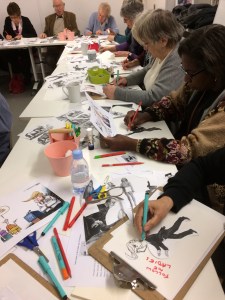
caricature-close-upAfter the tour participants returned to the classroom for a practical workshop led by professional illustrator Merlin Evans. Merlin taught participants how to exaggerate select facial features to create caricatures of today’s political target par excellence, Donald Trump. In addition to creating their own images students also cut and pasted Victorian illustrations to create hybrid images. (One of these, a glowing orange Trump head on the body of a woodcut dragon, was particularly popular.) For many of the participants drawing was a familiar but uncommon experience. According to one U3A member, ‘I have not drawn for 60 years and really enjoyed this’.

A number of participants talked about how much they enjoyed the chance to look at caricature from a variety of perspectives. ‘The background talk mixed with attempts to do our own [drawings] was a great way to learn’, said one member of Ealing U3A.

RIN is pleased to be able to build on the day’s success and bring members’ work on illustration to new audiences. We will partner with House of Illustration to provide a series of lecture-workshops like this one in 2017. First on the list is Susan Matthews on William Blake and Medical Illustration on February 14.

Romantic Antiquarianism

Romantic Antiquarianism: A Conference Celebrating Scott’s The Antiquary

Saturday 26 November 2016, 09.30–15.30

The Georgian Group, 6 Fitzroy Square, London

Co-organised by Fiona Robertson (Durham) and Peter Lindfield (Stirling)


This one-day conference in the heart of London celebrates the bicentenary of the publication of Sir Walter Scott’s novel, The Antiquary, by looking at the multi-faceted nature of antiquarianism in Georgian Britain. Leading scholars from across the UK gather to present new and engaging material on the topic.

Registration — at the time of writing only 10 places remain — (£30) includes teas/coffees and lunch in one of Robert Adam’s town houses.

Register at: https://www.eventbrite.co.uk/e/romantic-antiquarianism-a-conference-celebrating-scotts-the-antiquary-tickets-27322980771

Satire, prints and theatricality in the French Revolution

The Voltaire Foundation has recently announced the publication of Claire Trévien’s new book, Satire, prints and theatricality in the French Revolution. According to the Foundation:

Following an account of the historical and social contexts of Revolutionary printmaking, the author analyses over 50 works, incorporating scenes such as street singers and fairground performers, unsanctioned Revolutionary events, and the representation of Revolutionary characters in hell. Through analysing these depictions as an ensemble, focusing on style, vocabulary, and metaphor, Claire Trévien shows how prints were a potent vehicle for capturing and communicating partisan messages across the political spectrum. In spite of the intervening centuries, these prints still retain the power to evoke the Revolution like no other source material.

  1. Introduction: the other stage of the French Revolution
  2. Singing the scene: chansons and images in prints
  3. Le monde à l’envers: the carnivalesque in prints
  4. The spectacle of science: illusion in prints
  5. Théâtre de l’ombre: visions of afterlife in prints
  6. Conclusion

A blog post by Trévien and information on ordering are available here.

Event – Late Victorian Book Illustration: Progress, Knowledge and Democracy, 1 December, Sheffield Central Library

silverforketiquette's avatarThe Victorianist: BAVS Postgraduates

Late Victorian Book Illustration: Progress, Knowledge and Democracy

Thu 1 December 2016, 10:30-11:30 GMT

Sheffield Central Library

Carpenter Room

Surrey Street Sheffield S1 1XZ

Event is free, but is ticketed:

https://www.eventbrite.co.uk/e/late-victorian-book-illustration-progress-knowledge-and-democracy-tickets-27598247100

Encyclopaedias are a snapshot of a particular time, place, and world view.  Historian Rose Roberto shares images from early Encyclopaedias to tell the history of British publishing and the movement to democratise knowledge.

View original post

Image of the Month: ‘Alfred in the Isle of Athelney’ (1751/1778)

alfred-in-athelney

Last month I joined RIN in a new role as the network co-ordinator, following in the footsteps of Mary Shannon. By way of introduction I want to share ‘Alfred in the Isle of Athelney, receiving News of a Victory over the Danes’, a depiction of Alfred the Great that has loomed large in my recent work on the eighteenth-century reception and representation of the early middle ages.

Nicholas Blakey painted ‘Alfred in the Isle of Athelney’ c.1750 and it was engraved by Gérard Scotin II for inclusion in the series English History Delineated, published by John and Paul Knapton in 1751. Although the series failed after only six prints (covering the period from the Britons to the Battle of Hastings), the plates were bought by Richard Sayer, who had them reworked for a 1778 reissue. The image above is Sayer’s re-issue, reworked by the landscape-engraver François Vivares. Although Blakey’s design shows clear neoclassical influences, the image is remarkable for its (proto-)romantic, sympathetic depiction of Anglo-Saxon history and for the fact that it seems to illustrate a scene from James Thomson and David Mallet’s Alfred: A Masque rather than the relevant passage from Paul Rapin de Thoyras’ History of England, a best-selling history published by the Knaptons in numerous editions and subsequently by John Harrison. Rapin presented Alfred as an English hero; Thomson and Mallet presented him to Frederick, Prince of Wales and to audiences at Drury Lane as a model of virtuous English masculinity.

Blakey’s image captures this affective nearness perfectly. Alfred is shown in his prime, a rustic poet whose harp and bow rest against the roots of a massive oak. He is on the verge of military greatness, a figure who, despite his humble dress, commands the respect of the Earl of Devon (holding the Raven banner of the Vikings – or ‘Danes’ – that Alfred will soon defeat at Edington) and of the English soldiers flocking to join him. During the eighteenth century Alfred the Great rose steadily in the popular imagination to become ‘England’s Darling’, the Romantic and increasingly romanticised Anglo-Saxon hero-king of England. Blakey’s image, informed by history and drama, offers us a glimpse of that transformation in action.

Dalziel Archive Launched

Longstanding RIN member Dr Bethan Stevens of the University of Sussex has recently launched a new website, ‘Woodpeckings: The Dalziel Archive, Victorian Print Culture, and Wood Engravings’.

Brothers George and Edward Dalziel were the founders of Dalziel Brothers, nineteenth-century London’s most substantial wood engraving firm and the producers of illustrations for a huge range of printed materials, from books to packaging. According to the site, ‘The Dalziel Archive in the British Museum is a visual archive of the firm’s oeuvre from 1839 to 1893: around 54,000 fine burnished proofs kept chronologically in albums. The albums offer a new path into 19th-century wood engravings, usually approached exclusively through designers or the texts that they illustrated’.

Developed as part of the AHRC-funded Dalziel project in partnership with The British Museum and Sylph Editions, the site contains a virtual exhibition, recordings of research events and links to extended catalogue descriptions of every album in the Dalziel Archive.


CfP: Association of Art Historians 2017

AAH2017 

43rd Annual Conference and Art Book Fair

Loughborough University

6 – 8 April 2017

Deadline for Proposals: 7 November 2016


AAH2017’s Call for Papers includes two sessions of interest to RIN’s members, readers and followers:


Prints in Books: the materiality, art history and collection of illustrations

Convenor: Elizabeth Savage, Cambridge University, leu21@cam.ac.uk


Speculative Libraries

Convenor: Nick Thurston, University of Leeds, n.thurston@leeds.ac.uk


Please email your paper proposals straight  to the session convenor(s). Provide a title and abstract for a 25 minute paper (max 250 words). Include your name, affiliation and email. Your paper title should be concise and accurately reflect what the paper is about (it should ‘say what it does on the tin’) because the title is what appears most first and foremost online, in social media and in the printed programme.

You should receive an acknowledgement of receipt of your submission within two weeks.