Thoughts wanted: Eighteenth-Century Book Illustration Reader

From Dr. Christina Ionescu, Associate Professor Modern Languages and Literatures, Mount Allison University:

Dear colleagues,

Leigh G. Dillard and I are engaged in the planning stages of a reader on eighteenth-century book illustration that would encompass various traditions (English, French, German, Spanish, etc.). In order to best position the reader, we would be most grateful if those of you who work on book illustration (and perhaps also teach courses on the subject) could provide some feedback on our preliminary ideas.

You could write to us directly (cionescu@mta.ca and Leigh.Dillard@ung.edu) and we will compile a report for the SHARP list.

1) Would you use such a reader in a course? What type of course would you consider using it in? Would your library be interested in purchasing it?

2) Do you have any suggestions about its contents? Any specific texts that you believe should be included? Any translations of seminal texts that we should commission?

This is what is currently on our list:

i) some relevant excerpts from nineteenth-century texts (Dibdin, the Goncourt brothers, etc.)

ii) some reprints/translations of key chapters from important 1980s/1990s studies on eighteenth-century book illustration (Hodnett, Ph. Stewart, etc.)

iii) theoretical approaches to book illustration as it pertains to the chosen timeframe (e.g. book illustration and word and image, book illustration and book history, book illustration and visual culture, etc.)

iv) the mechanics of book illustration (etching, woodcut, copperplate engraving, frontispieces, colour plates, etc.)

v) illustrators (Stothard, Marillier, Chodowiecki, Gravelot, Hogarth, Cochin, etc.)

vi) genres (illustrated travelogues, gothic novels, sentimental fiction, erotica, etc.)

vii) examples of eighteenth-century illustrated bestsellers (The Sentimental Journey, La Nouvelle Héloïse, etc.)

viii) overviews by geographical region (illustration in England, France, Spain, etc.)

3) Would you be interested in contributing a chapter? (The deadline for submission of chapters will likely be December 2016.)

Many thanks,
Christina and Leigh

QMCECS Seminar: ‘Exhibiting the Eighteenth Century’: 11 March 2015

Queen Mary Eighteenth-Century Studies Seminar 2014-2015
‘Exhibiting the Eighteenth Century’

Joint meeting with the IHR British History in the Long 18th Century Seminar
Wednesday 11 March 2015
Time: 5.15pm.
Venue: Clore Learning Centre, Kensington Palace State Apartments, Kensington Gardens, London W8 4PX

Joanna Marschner (Historic Royal Palaces), Moira Goff (The Garrick Club), Alex Werner (Museum of London).

The seminar will take place in the Clore Learning Centre at Kensington Palace at 5.15 p.m. and will be followed by a drinks reception. As usual the seminar is free and open to all, but as numbers are limited at the venue, you need to reserve a place by emailing Gillian Williamson (gswilliamson@virginmedia.com).

Download a map of Kensington Palace access.

Convenors: Prof Markman Ellis, English (m.ellis@qmul.ac.uk); Prof Colin Jones, History (c.d.h.jones@qmul.ac.uk); Prof Miles Ogborn, Geography (m.j.ogborn@qmul.ac.uk); Prof Amanda Vickery, History (a.vickery@qmul.ac.uk), Prof Barbara Taylor, English and History (b.g.taylor@qmul.ac.uk), Prof John Barrell, English (j.barrell@qmul.ac.uk).

For updates and more information, see our blog: <http://qmcecs.wordpress.com/

Lecture: Rosie Dias (Warwick), ‘From Counting House to Country House: Building the Image of the East India Company’

The Birkbeck Eighteenth-Century Research Group is delighted to announce a lecture in the new year by Rosie Dias, Associate Professor in History of Art at the University of Warwick.

‘From Counting House to Country House: Building the Image of the East India Company’

6pm, Thursday 15th January
Room 407, 30 Russell Square

Rosie Dias’s research focuses on eighteenth and early nineteenth-century British art and visual culture. Her monograph, Exhibiting Englishness: John Boydell’s Shakespeare Gallery and the Formation of a National Aesthetic, was published by Yale University Press in 2013.

All very welcome! For further information, please contact Kate Retford: k.retford@bbk.ac.uk

best wishes,
Ann Lewis, Kate Retford, Luisa Cale and Emily Senior

Event Report: ‘The Artist and the Writer’, IES, 29th November 2014. Supported by the British Association of Victorian Studies and the University of Roehampton.

‘The Artist and the Writer’, IES, 29th November 2014.

Supported by the British Association of Victorian Studies (www.bavs.ac.uk) and the University of Roehampton.

‘The Artist and the Writer’ at IES told a chronological narrative of the relationship between artists and writers c. 1750 – 1850, revealing the contrasts and connections in book illustration from the eighteenth century to the Victorian period. The day opened with Lynn Shepherd’s paper on ‘Illustrating Pamela’. Shepherd showed how the illustrations to Pamela by Hayman and Gravelot create a narrative with a significantly different perspective from that provided by Pamela’s narration.  In the 28 illustrations – chosen on literary rather than visual grounds by Richardson himself – the ‘warm scenes’ are totally omitted.  Mr B’s assaults therefore exist only in Pamela’s words and not in the third person visual narration of the illustrations.  Lynn Shepherd read the images in terms of the pyramidal structures of contemporary conversation pieces, and also traced the gradual disappearance of barriers placing Pamela outside the class territory occupied by Mr B. The following discussion focused on the question of the kinds of visual literacy that readers might have brought to the task of reading the illustrations.  Shepherd argued that those who had sat for portraits would have understood the visual languages of these images.

Mary L. Shannon (Roehampton) introduces novelist and scholar Lynn Shepherd

Mary L. Shannon (Roehampton) introduces novelist and scholar Lynn Shepherd

Sandro Jung’s paper on ‘Thomas Stothard, Romantic Literature and the Illustrative Vignette’ took an ephemeral publication – The Royal Engagement Pocket Atlas  – as a means to overturn some of the key assumptions of illustration studies, namely that illustrators focused on old canon works newly freed from copyright. Stothard’s more than 800 head vignettes for Baker’s annual diary featured illustrations to recent and fashionable authors, prompting purchasers to discuss their current reading.  Baker followed Bell’s example in commissioning illustrations, but Baker made the decision to include recent poets not illustrated by Bell. Stothard, for instance, illustrated Crabbe, Byron and Scott, as well as Hayley’s Triumphs of Temper and Rogers’ Pleasures of Memory.  Stothard’s recognizable visual style thus provided a branding device not just for Baker’s publication but also for the concept of literature.  Jung argued that the Baker series offers a snapshot of consumer historical conditions.

Tim Fulford presented the early nineteenth-century as a period of virtual travel, when travellers prepared themselves by visiting exhibitions and looking at engravings, and picture books changed what the Romantic poets published.  Turning away from an earlier anti-picturesque aesthetic, and an earlier hostility about literary annuals, after 1818 Wordsworth and Southey repeatedly produced virtual topography, which functioned as guides for tourists.  The new urban bourgeoisie craved reminders of the countryside they had left, and technical developments made illustrations increasingly affordable.  Industrialization lowered the cost of paper, while from the 1820s the move to steel rather than copper engraving made larger print runs possible.  The Lake District gained its name through the sale of books of engraved views which were more popular than verse.  The Lake poets were therefore keen to foster links with artists and by the 1820s were working on jointly authored picture books in which poems were written to accompany pictures.  In the following discussion William St Clair argued that we needed to follow the logic of two industries and two media, tracing the links between them.

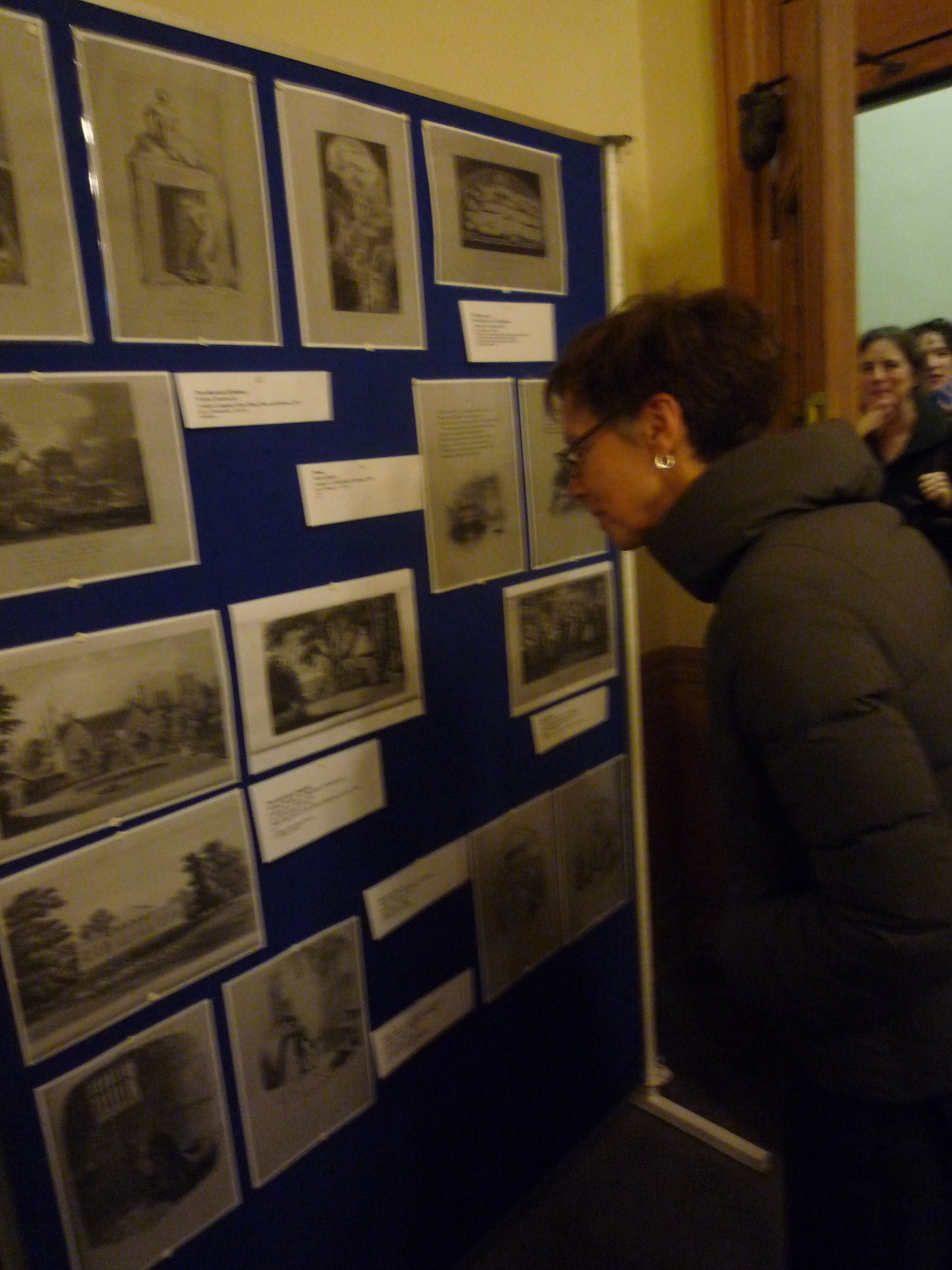
Exhibition of images from Senate  House Special Collections

Exhibition of images from Senate
House Special Collections

After a lunch sponsored by the British Association for Victorian Studies, and a visit to see some beautiful illustrated books in the Senate House library Special Collections (chosen to complement the day’s talks), Sophie Thomas traced the pre-history of the figure of the Bard in painting and illustration, from Thomas Jones’ the Bard (1774) via West, Sandby, Fuseli, Turner and Martin to the Bard in Blake’s illustrations to Gray and his painting of Gray’s Bard for his 1809 exhibition. Thomas’s paper on ‘Bardic Exhibitionism’ showed how Gray’s Bard appeared in Bentley’s illustrated Gray and reappeared in a lower illustrative mode in editions by Bell and Cooke, carrying complex meanings.

In the final session on Dickens, Mary L. Shannon’s ‘What did Dickens learn from Romantic Illustration?’ argued that Dickens drew on the more recognizable figure of Cruikshank to establish his own public identity, creating a visual image which drew on the conventions of visual Byronism.  Sadly, Ruth Richardson was unable to speak due to a bereavement, so more time was then devoted to open discussion. This ranged across author portraits, later images of Dickens and Victorian authors, continuities between the Romantic and Victorian periods, and links between theatre and visual culture. Anthony Mandal reminded us of the influence of Scott on Dickens, and Julia Thomas raised the significance of Luke Fildes’ watercolour tribute to Dickens, ‘The Empty Chair’ (1870).  The day concluded with a sociable drink nearby, at which it was agreed that the lively atmosphere, high-quality papers, and the trip to Special Collections had all made the event enjoyable, varied, and successful.

Susan Matthews, University of Roehampton

‘Lost Visions’ Workshop Report: Cardiff, 4th November 2014

‘Lost Visions: Retrieving the Visual Element of Printed Books from the Nineteenth Century’

lost visions logoWorkshop Report

Cardiff, 4th November 2014

http://lostvisions.weebly.com/about.html

‘Lost Visions’ is an AHRC-funded project led by Professor Julia Thomas in the School of English, Communication & Philosophy, Cardiff University. It attempts to tackle the challenges of big-data by working with more than a million illustrations from books in the British Library’s collection. Although many historical texts have been digitally stored, the illustrations in these texts are frequently without the information needed to help people understand them. The Cardiff team will devise methods that will enable the collection of illustrations to become fully searchable via an online database.

At the workshop in Cardiff, we were introduced to the scope and the challenges of the project, as well as the early version of the online database itself. Julia Thomas explained the vast dataset given to them by the British Library, with over 65,000 mixed-genre volumes c. 1528 – 1946, with the majority from the eigtheenth and nineteenth centuries. This gives a total of about 1 million illustrations in the database. Ian Harvey then gave us an introductory demonstration of the database in its current form, and Nicola Lloyd explained the many research applications that the database has already had for academics at Cardiff, but also beyond.

Ian Harvey then spoke in more details about the implemetationa challenegs faced so far in the project, not least the vast amount of images and the missing or inaccurate metadata that came with them. He demonstrated how dates, page numbers, and even names of illustrators need adding and/or correcting. They plan to use crowd-sourcing to encourage users (whether academics, teachers, or the general public) to tag images and help make the database more easily and accurately searchable.

After coffee, we all had chance to try out the search functions and the tagging. The closing roundtable discussion was full of praise for the project. It was noted how important it was to focus on visual culture when so many digital projects were text-based. It also became clear the ‘Lost Visions’ will enable us to rethink the author/artist hierarchy, especially in the context of the eigtheenth and nineteenth centuries.

The full database will be launched in March 2015, and once it has been launched RIN members are encouraged to try searching and tagging for themselves.

CFP: ‘James Gillray@200: Caricaturist without a Conscience?’ Oxford, March 2015

http://www.new.ox.ac.uk/james-gillray200-caricaturist-without-conscience

James Gillray@200: Caricaturist without a Conscience?

The Ashmolean Museum, Oxford & New College, Oxford present:
A one-day symposium to be held at the Ashmolean Museum
Saturday 28 March 2015

CFP deadline: 15 November 2014

Programme will be announced: 21 November 2014

James Gillray’s reputation in the two centuries since his death has been as varied and layered as his prints. Trained at the Royal Academy, he failed at reproductive printmaking, yet became, according to the late-eighteenth-century Weimar journal London und Paris, one of the greatest European artists of the era. Napoleon, from his exile on St Helena, allegedly remarked that Gillray’s prints did more to run him out of power than all the armies of Europe. In England, patriots had hired him to propagandize against the French and touted him as a great national voice, but he was an unreliable gun-for-hire. At a large public banquet, during the heat of anti-Revolutionary war fever, he even raised a toast to his fellow artist, the regicide, Jacques-Louis David. Gillray produced a highly individual, highly schooled, and often outlandish body of work with no clear moral compass that undermines the legend of the caricaturist as the voice and heart of the people, so that the late Richard Godfrey described him as a caricaturist without a conscience. Following 2001 and 2004 retrospectives in London and New York, and fuelled by scholarship of a new generation of thinkers, our era’s Gillray is just now coming into focus.

To commemorate the 200th anniversary of Gillray’s death, and in conjunction with the Ashmolean Museum’s exhibition, Love Bites: Caricatures of James Gillray (26 March-21 June 2015), based on New College’s outstanding collection, we are organising a one-day conference at the Ashmolean Museum to hear and see the latest Gillray scholarship.

We seek proposals for papers that address any aspect of Gillray’s work or that consider artistic duty or purposeful negligence of duty in the period around 1800. Comparative, formal, contextual, and theoretical approaches to Gillray and our theme are all welcome. Proposals should be a maximum of 200 words and be accompanied by a short biographical statement.

Organised by Todd Porterfield, Université de Montréal; Martin Myrone, Tate Britain; and Michael Burden, New College, Oxford; with Ersy Contogouris, Université de Montréal.

All enquiries should be addressed initially to the New College Dean’s Secretary, Jacqui Julier, jacqui.julier@new.ox.ac.uk, to whom all abstracts should be submitted by:
15 November 2014

The programme will be announced on 21 November 2014.