New Resource Added: Walter Scott Illustrations

The following resources were suggested by Paul Barnaby, Project Officer for the Walter Scott Digital Archive, which draws upon the collections of Edinburgh University Library.

1) Walter Scott Image Collection (Paul Barnaby):

http://www.walterscott.lib.ed.ac.uk/imdata.html

This is an image library of just over 1000 illustrations to the works of Walter Scott and other Scott-related publications. It is part of a larger site, the Walter Scott Digital Archive.

2) Illustrating Scott: A Database of Printed Illustrations to the Waverley Novels, 1814-1901 (Peter Garside and Ruth McAdams):

http://illustratingscott.lib.ed.ac.uk/


Blake, The Flaxmans, and Romantic Sociability: 18-19 July 2014

RIN member Luisa Calè (Birkbeck) asks me to post the following:

I hope you are enjoying the summer. I am writing to invite you to attend

Blake, The Flaxmans, and Romantic Sociability
18-19 July 2014
Keynes Library, School of Arts, Birkbeck, 43 Gordon Square, London

Registration and Programme:

http://www.bbk.ac.uk/events-calendar/blake-the-flaxmans-and-romantic-sociability

Blake’s sociability encompasses the real, the satyrical, and the imaginary. His visionary company includes ‘Companions from Eternity’, corporeal friends, and spiritual enemies. From the salon to the moon, across the geographies of ‘a certain island near by a mighty continent’, a mighty cast of characters intermingle. Enter Steelyard the Lawgiver and Mrs Nannicantipot, Suction the Epicurean, Sipsop the Pythagorean, Quid the Cynic, Inflammable Gas the Wind Finder, Etruscan Column the Antiquarian, Aradobo the Dean of Morocco, Obtuse Angle, Tilly Lally the Siptippidist, Miss Gittipin, Gibble Gabble, and Scopprell. Their imaginary, emergent, and satyrical disciplines include ‘Fissic Follogy, Pistinology, Aridology, Arography, Transmography, Phizography, Hogamy HAtomy,& Hall that’. This wild jamboree is a record of the convivial friendship and patronage of John and Ann Flaxman, Harriet and her husband the Reverend Anthony Stephen Mathew, who provided the young artist with ‘The Bread of sweet Thought and the Wine of Delight’.

Starting from the world of An Island in the Moon, this conference illuminates Blake’s relationship with the ‘Sculptor of Eternity’ and his circle from the early days to the ‘Regions of Reminiscence’, from the 1780s to the 1820s, following the Flaxmans across the channel, into the cosmopolitan networks of the Grand Tour, in order to recover the material cultures, sites, and dynamic forms of their Romantic sociability.

Conference organizers: Helen Bruder and Luisa Calè
Contact: blakeflaxman@bbk.ac.uk
To book a place to attend the conference, you need to follow the link at the bottom of the website.

CFA: Picturing the Eighteenth-Century Novel Through Time: Illustration, Intermediality and Adaptation

Title:   Picturing the Eighteenth-Century Novel Through Time: Illustration, Intermediality and Adaptation

Call for Articles

Christina Ionescu <cionescu@MTA.CA>

Deadline for abstracts: 1 August 2014

‘Have you noticed that no book ever gets well illustrated once it becomes a classic?’, asked in passing Aubrey Beardsley when faced with the challenge of illustrating Les Liaisons Dangereuses in the Art Nouveau era. Yet visually intriguing and conceptually intricate illustrations of eighteenth-century classics are abundantly present at key moments in the history of the book (Romanticism, the fin-de-siècle, the interwar period, amongst others). Defoe’s Robinson Crusoe, Swift’s Gulliver’s Travels, Voltaire’s Candide, Rousseau’s La Nouvelle Héloïse, Goethe’s Werther and Bernardin’s Paul et Virginie are just some examples of canonical texts that have inspired artists not only through time but also across national boundaries and different media. Such texts have produced visual corpora that are as vast as they are diverse. The timeless fascination with Paul et Virginie, for example, has resulted not only in illustrative series that steadily accompanied the text in its various incarnations as a book, but also in drawings, prints, sculptures, caricatures, tapestries, ceramics, clocks, etc., which circulated and were displayed independently of the text. Artistic transpositions and intermedial engagements with eighteenth-century bestsellers range from these visually static, yet geographically mobile forms of expression, to dynamic, performative adaptations such as films, operas and plays.

In spite of the increasing availability of digital images, critical approaches still tend to privilege the authorially sanctioned series (such as Gravelot’s engravings for Rousseau’s bestselling novel, commissioned and designed with the writer’s direct involvement), or ‘intervisual paradigms’ (patterns of iconographic representation considered independently of their text of origin). Moreover, theatrical or cinematic adaptations of eighteenth-century novels are seldom considered in relation to other forms of visual crossover, such as book illustration and decorative objects, though they all a priori rely on similar processes of visualising and adapting the text. The comparative analysis of different series of illustrations and of other forms of artistic representation of the same novel through time and space, however, allows us to explore the complexity of adaptation, to understand the visual representation inspired by text as an intermedial product and cultural phenomenon, and perhaps to grasp the fascination that the eighteenth century continues to exert upon us.

We invite submissions of papers that address any of the following questions through interdisciplinary and cross-cultural approaches:
•       How does the illustration of an eighteenth-century novel through time respond to new techniques and to changing views of the function of illustration itself?
•       How do successive generations of artists shape the reception of an eighteenth-century novel at different moments in time?
•       How do illustrated translations of eighteenth-century classics reflect the geographical, linguistic and cultural displacement of the original text?
•       How does the gradual shift from the poorly paid artisan to the internationally known artist affect the illustration of an eighteenth-century classic?
•       How do publishers operating from lucrative centres of book production (Amsterdam, Brussels, The Hague, London, Paris, etc.) respond to the specific expectations of their subscribers or readerships in regard to illustration?
•       How do artists, publishers and/or stage directors facilitate or negotiate verbal/visual crossover? What is their respective involvement in this process?
•       How do individual artists re-view an eighteenth-century text when they illustrate it again for a different publisher or edition?
•       How does the phenomenon of extra-illustration exemplify a unique rapport of visual closeness between the collector and text? How is the reading process impacted by the insertion within a single volume of parallel illustrations of the same scenes, which were executed at different moments in time?
•       How do objects inspired by eighteenth-century novels become cultural artefacts and exist independently of the text? How are they integrated in home décor, private collections or museum space? And what impact do they have as things commissioned, inherited, or collected?
•       How is visual representation transposed from one medium to another (for example, from book illustration to film adaptation)? What are the similarities and differences in the ways in which the text is visually adapted for each medium of expression?

Please send an abstract of 500 words to a.lewis@bbk.ac.uk and cionescu@mta.ca by 1 August 2014. The deadline for submission of completed articles will be June 2015 (approximately 8000 words).  Articles may be in French or English. As is usual for peer-reviewed journals, all final decisions concerning the acceptance of articles for this special issue will be made by the JECS editorial board. We also intend to host a workshop around the collection at the BSECS annual conference in January 2016.
Report: 1st Reading Group Session

The inaugural meeting of the ‘Illustration: So What?!’ Reading Group took place on May 19th 2014 at the University of Roehampton, introduced by Mary L. Shannon and Susan Matthews. We convened for a varied and lively discussion, reflecting the nature of our chosen subject as well as the fields of scholarship represented at the table.

Susan Matthews opened the session with her observations regarding the etymology of ‘illustration’. The careful consideration given to the development of our contemporary usage of the word, in contract with its earlier meanings, emphasised just how much has the publishing industry and book design and decoration have evolved, even in recent times. This point is perhaps particularly poignant for the illustration scholar with a background as an illustrator, such as myself. As students – and scholars – it is often considered that illustration has existed since the earliest days of human creativity, and is at the heart of creative and intellectual development. The implication that in name at least this is not the case is quite profound; the acknowledgement that a timeless occupation is actually only 198 years-old (according to the OED definition) is a novel perspective. The idea that the Romantic illustrators were working in a newly named field, perhaps makes them more radical than was previously thought.

The core text, J Hillis Miller’s Illustration (1992), provided a number of interesting points for discussion. It was observed and agreed that Miller used ‘illustration’ with a multiplicity of meanings – with a particular penchant for added connotations of ‘light’. This, of course, married perfectly with discussion of pre-1816 definitions of ‘illustration’ as well as with the glowing glass books of Olafur Eliasson in his 2013 artwork A View Becomes a Window. Examination of Miller was as stimulating and varied as the contents of his book, with the group drawing parallels between all texts discussed as well as to fields as diverse as theatre and architecture.

The first meeting of the ‘Illustration: So What?!’ Reading Group did, as promised, throw new light on the idea of illustration. With future meetings planning to discuss texts just as varied as those considered here, and likely to be approached with the same enthusiasm and varied perspectives, I have no doubt that further light will be shed on this very rich area of study.

– Bee Hughes (PhD student, Liverpool John Moores)

The Political Economy of Book Illustration – 6/6/2014

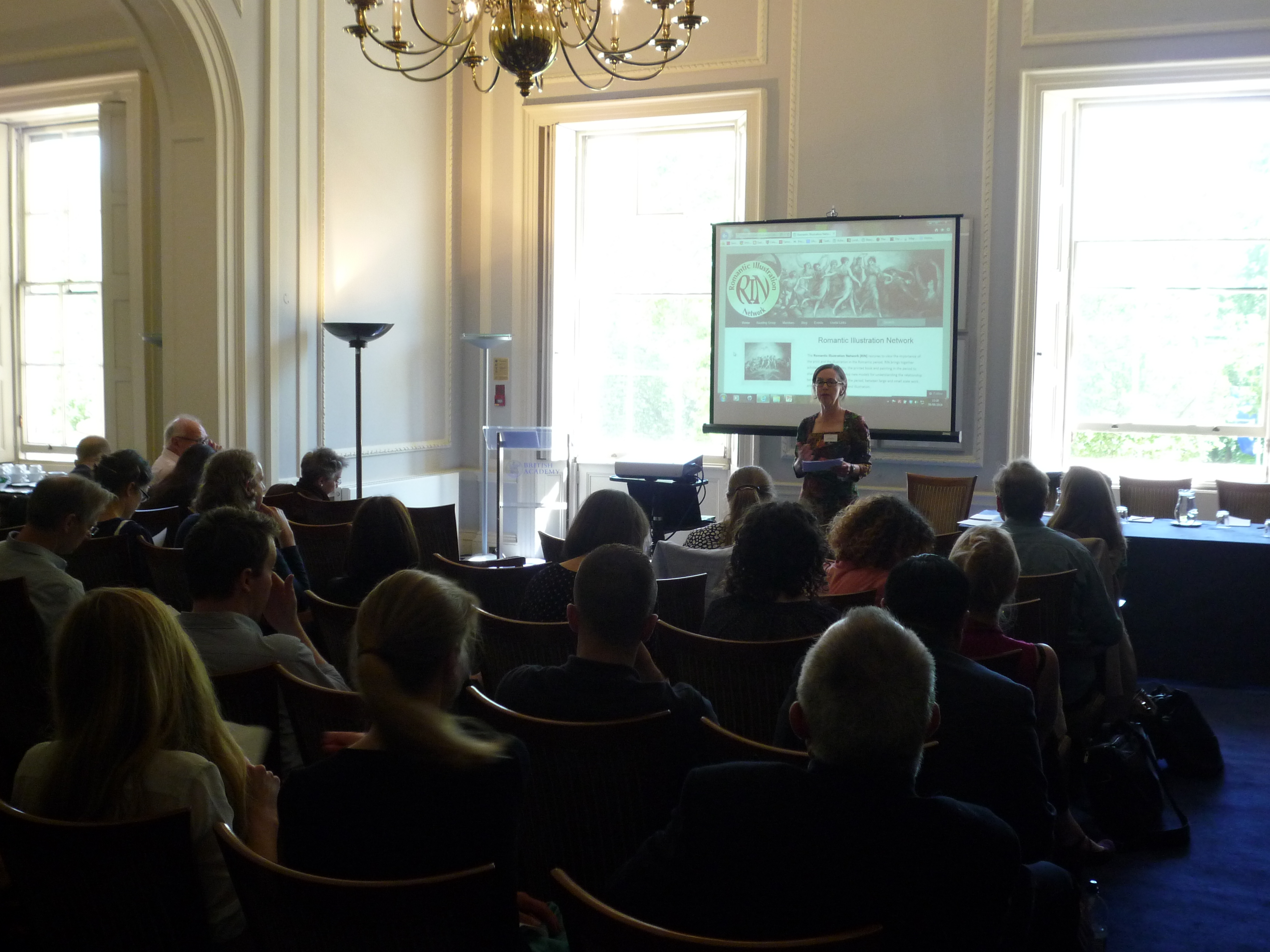
The Romantic Illustration Network held its opening event at the British Academy in London last Friday.

Leading and emerging scholars of eighteenth- and nineteenth- century visual culture gathered to discuss the materiality of the visual image and the printed text, in the beautiful surroundings of the British Academy’s Lee Reading Room.

RIN OpeningSusan Matthews (Roehampton) welcomed attendees, and used the OED’s definition of ‘illustration’ to suggest that the term itself is odder than we have come to believe it is. She pointed out that in the early nineteenth-century the word was used regularly in both its visual and its verbal senses, and proposed that the world of book illustration is one which is less straightforward than one might initially think.

This theme of the inter-relation of text and image in the illustrated book was picked up by William St Clair (IES, London) in his paper ‘Towards a Political Economy of Book Illustration’, c. 1800-1820. St Clair showed us how a focus on literature and art as material transactions can move us away from notions of ‘cultural emanation’ or ‘influence’, if we ask questions such ‘who had access to which texts at which time?’ and ‘how did images get from producer to consumer?’. He argued that expected demand, rather than supply, drove the publishers’ offerings of illustrated books. St Clair brought items from his own collection to display as a mini exhibition during the symposium.

Brian Maidment (Liverpool John Moores) took us into the next part of the century; he surveyed ‘Comic Illustration in the Marketplace 1820-40’ through a close reading of a series of comic caricatures, prints, and illustrations. He emphasised that the Victorians did not invent the serialised illustrated magazine, and that examples from the 1820s and 1830s are under-researched and understood. He also discussed questions of the democratic nature of popular serial culture, and made the point that any discussion of visual radicalism needs to recognise the willingness of artists such as Robert Seymour to work in multiple kinds of publications for money.

RIN DelegatesMoving into the Victorian period and digital materiality, Anthony Mandal, Julia Thomas, Nicky Lloyd, and Michael Goodman from Cardiff’s ‘Centre for Editorial and Intertextual Research’ presented three digital resources: the Database of Mid-Victorian Illustration (http://www.dmvi.org.uk/), the Victorian Illustrated Shakespeare Archive (under construction), and Lost Visions; Retrieving the Visual Element of Printed Books from the Nineteenth Century(http://cardiffbookhistory.wordpress.com/2014/02/09/lost-visions/). Together these papers demonstrated how practical and theoretical considerations must be tackled in tandem on such digital projects, and how online academic resources can be rigorous and scholarly as well as accessible.

The symposium closed with an open discussion which drew together various different strands from across the day, and also pointed towards profitable new lines of inquiry, before we all headed for a sociable drink nearby. Apart from the lively buzz at the event itself, if such Network-building events are to be judged by the resources shared and the connections made, then RIN has got off to a productive and promising start.

– Mary L. Shannon (Roehampton)


Inaugural Symposium – 06/06/14

Details of our inaugural symposium are below! Registration is free but places are limited. Please download the attached proforma, and return to Mary L. Shannon (Mary.Shannon@roehampton.ac.uk). Any queries can also be sent to this address.

We look forward to seeing you in June.

1.30pm: Welcome: Susan Matthews (Roehampton)
1.40pm: William St Clair (London IES) ‘Towards a Political Economy of Book Illustration’
(Chair: Susan Matthews, Roehampton)
2.30pm: Brian Maidment (Liverpool John Moores) ‘Comic Illustration in the Marketplace 1820-1840’ (Chair: Ian Haywood, Roehampton)
3.20pm: tea/coffee break
3.40pm: Workshop, ‘Digital Humanities and Romantic Illustration’
Run by Anthony Mandal, Julia Thomas and Nicola Lloyd, and Michael Goodman (Cardiff)
(Chair: Mary L. Shannon, Roehampton)
digitising visual artefacts – working with large image corpora – illustrations and the digital archive
5pm: Open Discussion
5.30pm: Close. Do join us to continue discussions over a drink at Walkers of Whitehall http://walkersofwhitehall.co.uk/

Getting there:

Map

The Academy’s address is:
10-11 Carlton House Terrace
London
SW1Y 5AH
It is adjacent to the Duke of York steps leading to The Mall.

Tel: 020 7969 5200 (Click to call.)
Fax: 020 7969 530

Nearest tube: Charing Cross (Cockspur Street exit), Piccadilly Circus (Lower Regent Street exit).
Buses: Piccadilly Circus, Lower Regent Street, Haymarket, Trafalgar Square.
Wheelchair access: The British Academy has access for most wheelchairs. For more information please see details of disabled access arrangements.


First Meeting – 19/05/2014

You are invited to the first session of our new Reading Group!

‘Illustration: So What?!’ Reading Group,

5.30pm – 7pm
Monday 19th May,
Fincham 001,
Digby Stuart College,
University of Roehampton,
London SW15 5PU.

First session introduced by Susan Matthews (Roehampton) and Mary L. Shannon (Roehampton). ‘Illustration’ only takes on its central modern meaning (an illustrative picture; a drawing, plate, engraving, cut, or the like, illustrating or embellishing a literary article, a book, etc.) in 1816: its modern sense is a creation of the Romantic period. But this modern sense also marks a limitation and a decline from the word’s earlier history when it carried a sense closer to ‘illustrious’. This Reading Group will throw new light on the idea of illustration: our first session will ask whether we can recapture the earlier sense of light central both to this word and to illumination.

All welcome.

Texts:

1) OED definition, ‘illustration’ (accessible online)
2) Hillis Miller, ‘Illustration’ (1992): pp. 61-75; pp. 88-111; pp. 146-151 (Contact Mary.Shannon@roehampton.ac.uk for a pdf)
3) JMW Turner, ‘The Sun of Venice Going to Sea’ (exhibited 1843), Tate
http://www.tate.org.uk/art/artworks/turner-the-sun-of-venice-going-to-sea-n00535
4) Olafur Eliasson: ‘A View Becomes a Window’ (2013)
http://www.channel4.com/news/olafur-eliasson-glass-books-tate-modern-turbine-hall
http://vimeo.com/75012416
(Eliasson’s earlier work, The Weather Project (2003-4), Tate, is here, if you are interested
http://www.tate.org.uk/whats-on/tate-modern/exhibition/unilever-series-olafur-eliasson-weather-project)

We look forward to seeing you there.