CFP: RIN panel at Romantic Imprints, BARS’ 2015 International Conference

Romantic-Imprints-image The deadline for submission of abstracts to the RIN panel at BARS 2015 approaches: February 15th.


Of particular interest for RIN members is the RIN panel ‘Romantic Illustration’: see the panels page on the BARS 2015 website here.

The full CFP is below:

———————————————————————————————————-

2nd Call for Papers: Romantic Imprints

British Association for Romantic Studies, 14th International Conference

Cardiff University, 16–19 July 2015

Proposals are invited for the 2015 British Association for Romantic Studies international conference which will be held at Cardiff University, Wales (UK) on 16–19 July 2015. The theme of the interdisciplinary conference is Romantic Imprints, broadly understood to include the various literary, cultural, historical and political manifestations of Romantic print culture across Europe, the Americas and the rest of the world. Our focus will fall on the ways in which the culture of the period was conscious of itself as functioning within and through, or as opposed to, the medium of print. The conference location in the Welsh capital provides a special opportunity to foreground the Welsh inflections of Romanticism within the remit of the conference’s wider theme. The two-hundredth anniversary of Waterloo also brings with it the chance of thinking about how Waterloo was represented within and beyond print.

The confirmed keynote speakers for Romantic Imprints will be John Barrell (Queen Mary, London), James Chandler (Chicago), Claire Connolly (Cork), Peter Garside (Edinburgh) and Devoney Looser (Arizona State).

The conference is open to various forms of format:  we encourage proposals for special open-call sessions and for themed panels of invited speakers as well as individual proposals for the traditional 20-minute paper. Subjects covered might include:

  • Nation and print: the British archipelago; cities of print; transatlantic and transnational exchanges; Romantic cosmopolitanism and print; translation; landscape and/in print; Wales and its Romantic contexts; national (especially Welsh) patterns of influence and exchange in the international context.
  • Producing and consuming print: Romantic readerships; publishers; circu­lating print; legislation, copyright and print; technologies of print; plagiarism, forgery and piracy; popular and subaltern cultures of print; periodicals and journalism; gender and genre; print as new and old, ephemeral and collectable objects; print beyond reading (paper money, cards, etc.); the fate of print as ‘rubbish’.
  • Intertextual exchanges: politics and print (e.g. revolution and radicalism, war, Napoleon, Waterloo); satire and parody; science and print culture; performance and print; Romantic visual cultures (including art and illustration); representations of print and printing; fashion; adaptation and remediation; the Romantic essay; print and its others – epitaphs, manuscripts, marginalia, etc.; print and imprint as Romantic metaphor or ideology; popular pastimes.
  • Textual scholarship: editing texts; bibliography and book history; manuscripts, correspondence and diaries; analysis and quantification; digital humanities.
  • Romantic legacies: physical traces and imprints; architecture; Romantic anti­quarianism; Victorian Romanticism; Romanticism and modernity; Romanticism and new media; Romantic biography; lives in print; Romantic afterlives; celebrity and print; adapting the Romantics (film, art, literature).

Format of conference proposals

  • Traditional 20-minute paper proposals (250-word abstracts), submitted individually.
  • Poster presentations showcasing innovative projects or digital outputs (250-word abstracts), submitted individually.
  • Proposals for open-call sessions (350-word descriptions of potential session, outlining its importance and relevance to the conference theme). Accepted open-call sessions will be advertised on the BARS 2015 conference website from mid-January 2015. Please note: the deadline for submission of open-call panels has now expired.
  • Proposals for themed panels of three 20-minute or four 15-minute papers (250-word abstracts for each paper with speakers’ details and an outline of the panel’s rationale from the proposer).

Extended deadline for submission of abstracts: 15 February 2015. Submissions can comprise proposals for individual papers, poster presentations and submissions to open-call panels (which will be published online from mid-January 2015). If you are applying to an open-call session, you should include the name of the session on your proposal.

All proposals should include your name, academic affiliation (if any), preferred email address and a biography of 100 words. Please send proposals and direct enquiries to the BARS 2015 conference organisers, Anthony Mandal and Jane Moore (Cardiff University) at BARS2015@cardiff.ac.uk.

For the latest updates about the conference, follow us on Twitter @2015BARS and join our Facebook group at https://www.facebook.com/groups/BARS2015/.
CFP – “Visual Print Culture in Europe 1500-1850”, Venice, December 2015

Visual Print Culture in Europe: techniques, genres, imagery and markets in a comparative perspective, 1500-1850

University of Warwick at: Palazzo Pesaro Papafava, Venice, Italy

December 5-6, 2015

Call for Papers – closing date June 1, 2015

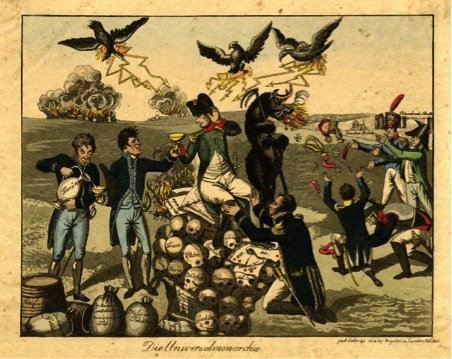
universalmonarchie

Under Napoleon’s Empire we find London acting as a hub for printing caricatures of Napoleon in a range of languages, and with a number of distinctive styles.  The above print, Die Universalmonarchie, for example, claims to have been published by Boydell & Co. in London in 1815, but the Boydells were based at Cheapside, not – as the print states – at Pall Mall (once the location of the late Josiah Boydell’s famous Shakespeare Gallery). The publication information would seem to be spurious and the British Museum suggests that it was likely published in Paris. Is this print, then, German, French, or even possibly English? Who exactly is its market? How far is its imagery tailored to a particular “national” audience and in what ways might it be distinctively comprehensible to such an audience? Besides London, what other European hubs were important, at what moments and why?

‘Visual Print Culture in Europe 1500-1850’ aims to draw together scholars with a range of disciplinary skills to discuss the methods, representational forms, and distribution of and audience for visual print media in Europe between 1500 and 1850.  Its seeks to de-nationalize the study of visual print culture, and to explore the extent to which interactions between engravers and printers, artists and consumers in Europe, and a range of common representational practices produced a genuinely European visual print culture – with local modulations, but nonetheless with a common core.

Papers can draw on a range of disciplinary backgrounds in exploring the exchange of techniques and processes, the analysis of imagery, and the identification of markets, and in analysing the conditions under which particular generic forms crossed or failed to cross national boundaries.  Although the emphasis is on European visual print culture, the impact of that culture on, and its interaction with, the wider world is also of interest.

The conference language will be English.

The Conference will be held at the University of Warwick’s Palazzo and conference centre in Venice, December 5-6, 2015.

The Conference organisers, acting under the European History Research Centre are:
Mark Philp, History, EHRC Director, Warwick  (mark.philp@warwick.ac.uk)
Kate Astbury, French Studies, Warwick
Mark Knights, History, Warwick
David Taylor, English, Warwick

Proposals for papers should be submitted to t.smith.2@warwick.ac.uk by June 1st 2015 but please feel free to contact Mark Philp in advance with any queries.

The conference may be able to provide some financial assistance to those whose home institutions are unable to support their attendance, especially postgraduate students.

CFP: The Romantic Eye (Yale, 17-18 April 2015)

Please see below for a Call for Papers for an exciting-sounding symposium on the Romantic Eye at Yale this April.  The organisers are particularly keen to secure contributions from early career scholars (including people working on their doctorates).  Flights and accommodation will be provided for those invited to speak, so if you’re working on a topic in this area, this could be a really great opportunity.

(Taken from the BARS blog)

— — — — —

The Romantic Eye, 1760–1860 and Beyond
April 17, 2015-April 18, 2015
Yale University
Yale-Conference-300x222

This symposium examines Romanticism as a shape-shifting cultural phenomenon that resists easy categorization. Focusing on the period from 1760 to 1860, the symposium embraces the amorphousness that has been ascribed to Romanticism historically by eschewing any limiting definition of it, seeking instead to explore the broad range of art and visual culture characterized as “Romantic” during this hundred-year span. We are interested in what the Romantic “eye” pursued and perceived, and how it set itself the task of recording those perceptions. In addition to interrogations of the relationship between the visual arts and Romanticism, we welcome papers on writers, composers, scientists, and philosophers whose projects engaged the visual. Papers also are sought for a special panel that will address the legacies of Romanticism in contemporary art.

This symposium coincides with a major collaborative exhibition organized by the Yale Center for British Art and the Yale University Art Gallery, The Critique of Reason: Romantic Art, 1760–1860, which opens March 6, 2015. The exhibition comprises more than three hundred paintings, sculptures, medals, watercolors, drawings, prints, and photographs by such iconic artists as William Blake, John Constable, Honoré Daumier, David d’Angers, Eugène Delacroix, Henry Fuseli, Théodore Géricault, Francisco de Goya, John Martin, and J. M. W. Turner. Talks that respond explicitly to works in the collections of the Yale Center for British Art or the Yale University Art Gallery are particularly encouraged, as are cross-disciplinary and comparative studies.

We are seeking presentations of thirty minutes in length. Graduate students and early career scholars are particularly encouraged to apply. Travel and accommodation costs will be covered by the organizers. Please e-mail abstracts of no more than three hundred words and a short CV or bio (no more than two pages) by February 2, 2015, to romanticism2015@gmail.com.

The symposium is cosponsored by the Department of the History of Art at Yale University, the Yale Center for British Art, the Yale University Art Gallery, and the Yale Student Colloquia Fund.

CFP: Print Culture and the Arts

‘Print Culture and the Arts’
SHARP @ SAMLA
Durham, North Carolina
13-15 November 2015

Papers are invited for the SHARP affiliate session at the 2015 South
Atlantic Modern Language Association (SAMLA) Convention. Potential
topics include print culture, history of the book, authorship,
publishing history, ephemera, illustration, publishers’ archives,
circulation, and reception. Papers addressing this year’s theme, “In
Concert: Literature and the Other Arts” are especially welcome. What
connections can be made between print culture/book history and the
areas of visual art, theatre, and music? How has the relationship
between print culture and the arts evolved from the manuscript age to
the digital world of the 21st century?

The 87th annual SAMLA Convention will be held November 13-15, 2015, at
the Sheraton Imperial Hotel & Convention Center, located in Durham,
North Carolina. Proposers need not be members of SHARP to submit, but
panelists must be members of both SHARP and SAMLA in order to present.
By June 1, 2015, please email a 350-word abstract and short biography
(including contact information) to SHARP liaison Dr. Melissa Makala,
at me.makala@gmail.com.

Please also visit SHARP at SAMLA’s Facebook page for more updates:
https://www.facebook.com/SHARPatSAMLA

CFA: ‘Illustration and Gender’

Dear Colleagues,

As you wrap up the end of your semester and look forward to the spring, I hope you will consider submitting an article to the Summer 2015 special issue of Nineteenth-Century Gender Studies on the topic of “Illustration and Gender.” We welcome articles of 5,000-8,000 words reflecting interdisciplinary approaches and international perspectives on illustration and gender studies. NCGS endorses a broad definition of gender studies, and we welcome submissions that consider nineteenth-century illustration and gender and sexuality in conjunction with race, class, place and nationality. The submission deadline for complete articles is March 15, 2015 (earlier submission is encouraged). We hope to address a variety of possible topics including but not limited to:

Studies of female illustrators of the nineteenth century

Critical histories of illustrators marked by gender and sexuality

Depictions of gender, race, sexuality, and/or class in illustrated literary works

Depictions of gender, race, sexuality, and/or class in illustrated advertisements

Illustration and gender in periodical publications

Illustration and gender in the novel

Illustration and gender in poetry

Illustration and gender in the fin-de-siècle

The influence of scientific theories and discoveries (phrenology, evolution, ethnography) on illustration and gender

Avenues opened up by the digital humanities for visualizing gender in nineteenth-century culture.

Please adhere to MLA style, using endnotes rather than footnotes, and include a coversheet with your contact information and a short (100-150 word) bio with your article submission. Please contain all identifying information to the coversheet. Feel free contact us at the email addresses listed below with any questions or concerns. You can find more information online at the following link, CFP: Illustration and Gender or please feel free to distribute the CFP to colleagues or graduate students who may be working at the intersections of nineteenth-century illustration and gender studies.

We look forward to reading your submissions!

Dr. Nicole Lobdell, Georgia Institute of Technology, nicole.lobdell@lmc.gatech.edu

Kate Holterhoff, Carnegie Mellon University, kholterh@andrew.cmu.edu

CFP: ‘James Gillray@200: Caricaturist without a Conscience?’ Oxford, March 2015

http://www.new.ox.ac.uk/james-gillray200-caricaturist-without-conscience

James Gillray@200: Caricaturist without a Conscience?

The Ashmolean Museum, Oxford & New College, Oxford present:
A one-day symposium to be held at the Ashmolean Museum
Saturday 28 March 2015

CFP deadline: 15 November 2014

Programme will be announced: 21 November 2014

James Gillray’s reputation in the two centuries since his death has been as varied and layered as his prints. Trained at the Royal Academy, he failed at reproductive printmaking, yet became, according to the late-eighteenth-century Weimar journal London und Paris, one of the greatest European artists of the era. Napoleon, from his exile on St Helena, allegedly remarked that Gillray’s prints did more to run him out of power than all the armies of Europe. In England, patriots had hired him to propagandize against the French and touted him as a great national voice, but he was an unreliable gun-for-hire. At a large public banquet, during the heat of anti-Revolutionary war fever, he even raised a toast to his fellow artist, the regicide, Jacques-Louis David. Gillray produced a highly individual, highly schooled, and often outlandish body of work with no clear moral compass that undermines the legend of the caricaturist as the voice and heart of the people, so that the late Richard Godfrey described him as a caricaturist without a conscience. Following 2001 and 2004 retrospectives in London and New York, and fuelled by scholarship of a new generation of thinkers, our era’s Gillray is just now coming into focus.

To commemorate the 200th anniversary of Gillray’s death, and in conjunction with the Ashmolean Museum’s exhibition, Love Bites: Caricatures of James Gillray (26 March-21 June 2015), based on New College’s outstanding collection, we are organising a one-day conference at the Ashmolean Museum to hear and see the latest Gillray scholarship.

We seek proposals for papers that address any aspect of Gillray’s work or that consider artistic duty or purposeful negligence of duty in the period around 1800. Comparative, formal, contextual, and theoretical approaches to Gillray and our theme are all welcome. Proposals should be a maximum of 200 words and be accompanied by a short biographical statement.

Organised by Todd Porterfield, Université de Montréal; Martin Myrone, Tate Britain; and Michael Burden, New College, Oxford; with Ersy Contogouris, Université de Montréal.

All enquiries should be addressed initially to the New College Dean’s Secretary, Jacqui Julier, jacqui.julier@new.ox.ac.uk, to whom all abstracts should be submitted by:
15 November 2014

The programme will be announced on 21 November 2014.

CFP: “Illustration and Gender,” Special Issue of Nineteenth-Century Gender Studies, Deadline: March 15, 2015

In Reading Victorian Illustration, 1855-1875 (Ashgate 2012), Paul Goldman calls for an “enlargement” of illustration studies; “[t]he breadth and depth of what exists and remains relatively unexplored is staggering” (15). In response to Goldman’s call and the increasing critical interest in nineteenth-century illustration, brought about by better digital access and the digitization of obscure materials, we are devoting the summer 2015 special issue of Nineteenth-Century Gender Studies to the topic “Illustration and Gender.”

The mechanization of print during the nineteenth century led to the proliferation of illustrations that generated cultural and aesthetic ideals and changed social perceptions on issues of identity such as race, nationality, class, and gender. Illustrations filled Victorian print culture, and accompanied novels in both serial and book form. British illustrated newspapers (The Illustrated London News and Illustrated Police News), advertisements (Pear’s Soap), satirical publications (Punch and Fun), and children’s literature, all served to foreground visual culture, ultimately redefining it. The intersection of illustration studies and gender studies occurred not only within the illustrations that accompanied nineteenth-century texts but also outside of them. Although illustrators of the period were largely male, there were several skilled female illustrators including the well-known artists Kate Greenaway and Beatrix Potter, as well as the lesser known Amy Sawyer, Mabel Lucie Attwell, Elinor Darwin, and Edith Holden.

Illustrations are complex and never synesthetic versions of written texts. They adapt texts by including their own content and exist on the unstable ground between written and visual signs. Combining aspects of art history, cultural studies, media studies and print history, illustration studies are innately interdisciplinary and an increasingly influential subset of visual-culture studies. This special issues seeks to advance not only an understanding of the relationships between illustration studies and gender studies but also ways in which digitization, including such resources as NINEs, Google Books, and Internet Archive, have increased both awareness of and access to nineteenth-century illustrations. We welcome articles reflecting interdisciplinary approaches and international perspectives on illustration and gender studies. We hope to address a variety of possible topics including but not limited to:

Studies of female illustrators of the period

Critical histories of illustrators marked by gender and sexuality

Depictions of gender, race, sexuality, and/or class in illustrated literary works

Depictions of gender, race, sexuality, and/or class in illustrated advertisements

Illustration and gender in periodical publications

Illustration and gender in the novel

Illustration and gender in poetry

Illustration and gender in the fin-de-siècle

The influence of scientific theories and discoveries (phrenology, evolution, ethnography) on illustration and gender

Avenues opened up by the digital humanities for visualizing gender in Victorian culture.

Please send articles of 5-8,000 words to both the guest editors, by March 15, 2015 (earlier submission is encouraged). Adhere to MLA style, using endnotes rather than footnotes.

Please include a coversheet that includes your contact information and a short (100-150 word) bio with your article submission. Please contain all identifying information to the coversheet.

Feel free contact us at the email addresses listed below with any questions or concerns.

We look forward to reading your submissions!

Kate Holterhoff, Carnegie Mellon University, kholterh@andrew.cmu.edu

Dr. Nicole Lobdell, Georgia Institute of Technology, nicole.lobdell@lmc.gatech.edu

CFP: ‘Adapted Materials’, Nineteenth-Century Studies Association’s conference in Boston, March 26-28, 2015

Lissette Szwydky and Marie Léger-St-Jean are seeking papers to round out a panel entitled “Adapted Materials” that includes presentations on theatrical adaptations and serial novels sold in penny numbers. We wish to convey a historical understanding of adaptation in its numerous forms —including illustration— as a popular and profitable cultural practice.
 
We will submit the panel to the Nineteenth-Century Studies Association’s conference in Boston, March 26-28, 2015.
 
Deadline for paper proposals: September 1, 2014
 
Missed the deadline or can’t make it? We’d still like to hear from all those studying the emergence of a global mass multimedia culture in the form of entertainment industries led by commercial interests, so please get in touch!