Ian Haywood on Robert Seymour’s ‘The Looking Glass’ at the Huntington Library

The Huntington possesses a trove of images from the golden age of British caricature—most notably by artists Thomas Rowlandson (1756–1827) and Isaac Cruikshank (1764–1811). It also owns some gems by Robert Seymour (1798–1836), an illustrator whose fame grew around the time of Rowlandson’s death. Today, Seymour is probably best known as the illustrator of the […]

via Robert Seymour, 19th-Century Political Cartoonist — VERSO | The Huntington’s Blog

Westminster Archives Event: ‘Dickens vs Reynolds on Wellington Street’

On Tuesday, 21st February Mary Shannon will present a version of her Colby lecture, ‘Dickens vs Reynolds on Wellington Street: Writing and Fighting in Victorian London’, at Westminster Archives Centre. Mary’s talk will be followed by a wine reception.

Attendance is free but registration is requested as places are limited.

Full details and how to book can be found here: https://www.westminster.gov.uk/archives-news-and-events

CfP Reminder: Borders and Border Crossings

The Research Society for Victorian Periodicals 2017 conference, ‘Borders and Border Crossings’, will take place at Freiburg University, Germany, 27-29 July.

In addition to proposals that address the primary theme of British periodicals’ engagements with the continent the organisers invite proposals for a special session on women’s history and Victorian periodicals in memory of Sally Mitchell. Proposals (250 words maximum) and short CVs (200 words maximum) should be sent to rs4vp2017@gmail.com by 31 January 2017.

Full details of the conference and full details of the CfP can be found on the RSVP website.

JECS 39(4): ‘Picturing the Eighteenth-Century Novel Through Time: Illustration, Intermediality, and Adaption’ – A Guest Post by Christina Ionescu

The latest issue of the Journal for Eighteenth-Century Studies (December 2016), guest-edited by Christina Ionescu and Ann Lewis, explores the illustration of eighteenth-century bestsellers through time. Entitled Picturing the Eighteenth-Century Novel Through Time: Illustration, Intermediality, and Adaptation, it includes an introduction and nine articles.

Some relevant excerpts from the introduction co-written by the editors:

‘Have you noticed that no book ever gets well illustrated once it becomes a classic?’, asked Aubrey Beardsley in passing during a late creative period when he was facing the challenge of illustrating Les Liaisons dangereuses. The talented British artist was emphatic in his belief that ‘[c]ontemporary illustrations are the only ones of any value or interest’, in other words, those produced during the initial publication and reception of a text. Is this statement, however, unequivocally true? Beardsley’s premature death put an end to his ambitious endeavour to produce an elaborate visual supplement for the fin-de-siècle edition of Choderlos de Laclos’s epistolary novel commissioned by Leonard Smithers and, consequently, we will never know if he would indeed have succeeded in illustrating this eighteenth-century classic ‘well’ approximately 114 years after its first appearance in print. The question of whether images which were produced for editions other than those princeps deserve critical attention is certainly worth asking, and it has provided us with the premise for our special issue, the second to be entirely devoted to the subject of book illustration by the Journal for Eighteenth-Century Studies. The current issue takes the illustration and adaptation of eighteenth-century bestsellers beyond the restrictive confines of the historical period in which they were first published, in an attempt to shed new light on the reception of the Enlightenment novel, on the phenomena of ‘parallel illustration’, ‘afterlife’, and ‘remediation’, as well as on print, material, and visual cultures more generally.

The contributions to this special issue show that visually intriguing and conceptually intricate illustrations of eighteenth-century novels are abundantly present at key moments in the history of the book (Romanticism, the fin de siècle, the interwar period, amongst others). Defoe’s Robinson Crusoe, Swift’s Gulliver’s Travels, Voltaire’s Candide, Rousseau’s Julie, ou La Nouvelle Héloïse, Goethe’s Werther, and Bernardin’s Paul et Virginie are just some examples of canonical texts which have inspired artists not only through time but also across national boundaries and different media. Such texts have produced visual corpora that are as vast as they are diverse. The timeless fascination with Paul et Virginie, for example, has resulted not only in illustrative series that steadily accompanied the text in its various incarnations as a book, but also in drawings, prints, sculptures, caricatures, tapestries, ceramics, clocks, etc., which circulated and were displayed independently of the text. Similarly, visual responses to Gulliver’s Travels have created a rich ensemble of print and material objects, which in our time includes a graphic novel adaptation by Lewis Helfand and illustrated by Vinod Kumar, a Hollywood studio movie starring Jack Black, and a storybook puzzle by Milton Bradley. Artistic transpositions and intermedial engagements with eighteenth-century bestsellers range from the visually static, yet geographically mobile forms of expression like book illustrations and standalone prints, to dynamic, performative adaptations such as plays, ballets, operas, and films.

The present journal issue is organised into three main groupings, each of which identifies and interrogates iconographical material and approaches that have been less explored in traditional studies of illustration or text/image relations. The first three articles may be understood as contributions to the history of the illustrated book, in their shared concern with situating the production and consumption of images within different editorial and publishing contexts (illustrated books, chapbook abridgements, and collected reprint editions), and in the creation of different types of iconographical practices within these contexts. Each explores the notion of ‘recycled’ rather than ‘original’ illustrations and the important functions of such images within different strata of print culture (where aesthetic originality, artistic quality, and semiotic complexity might be less important than establishing a ‘brand’, reinforcing or simplifying a moral message, or cultivating a sense of literary heritage). Focusing on the 1690-1740 period, Helen Cole examines the phenomenon of the repeated use of the same frontispiece to illustrate texts through time, providing a bibliographical table to chart instances of such recycled images. She examines Giovanni Paolo Marana’s Letters Writ by a Turkish Spy and Daniel Defoe’s Robinson Crusoe, amongst other examples, to suggest various functions of such visual material when appearing in successive editions over a period of many years. Sandro Jung identifies a hitherto unstudied corpus of copperplate and woodcut engravings appearing in chapbook abridgements of Samuel Richardson’s Pamela in Britain and America from the late 1760s onward, which also frequently involved the recycling or reprinting of the same stock images. The affordability and availability of such illustrated chapbooks, which were sometimes marketed at children, shaped the text’s popular reception in ways that must be understood as significantly different to the deluxe Gravelot-Hayman illustrations that have been the focus of most critical studies of the novel’s illustration. Leigh Dillard draws our attention to the importance of illustrations within works of collected fiction, focusing on the 1820s reprint trade, and in particular, John Limbird’s British Novelist, which has received little critical attention before now. She situates this publisher’s use of images in the context of previous reprint collections (such as James Harrison’s Novelist’s Magazine in the 1780s or Charles Cooke’s Pocket Edition of Select Novels in the 1790s), and reflects on the use of new or recycled images in the illustration of the same eighteenth-century texts appearing in anthologies of collected fiction, while adopting Oliver Goldsmith’s The Vicar of Wakefield as a case study for evaluating the practice of illustration in Limbird’s collection in particular. In different ways, these three contributions bring out the social dimension of the reading experience, in their identification of visual material that appeared in affordable, even ‘cheap’ publications. As such, they suggest a range of reading/viewing practices that differ substantially from the aesthetic and semiotic approaches that characterise the critical readings of modern literary scholars.

Whereas the first three articles of this special issue focus on the English context, the next three contributions turn to French bestsellers of the eighteenth century, each providing an overview of numerous illustrated editions in order to draw out different interpretative strategies and patterns of representation that are brought to bear on each text in different periods. Christina Ionescu surveys the vast iconographical corpus surrounding Abbé Prévost’s Manon Lescaut, which has never been studied before as a visual ensemble. She identifies five highly original series published between the late eighteenth and the twentieth century, and in two different geographic locations (France and America), in order to analyse a range of approaches to illustrating this text. Catriona Seth examines four series of illustrations for Choderlos de Laclos’s Les Liaisons dangereuses that appeared in the eighteenth century, none of which were commissioned by Laclos himself, in order to consider what the varying emphasis of each series suggests about the reception of the novel in this period, and particularly, the way in which contemporaries may have reacted to the different characters in the story. An interesting aspect of the series of illustrations examined in this context is the existence of prints which were intended for display independently of the text (such as Romain Girard’s pairs of images, designed to be hung on walls), and also the inclusion of images by three different artists within the well-known 1796 series of fifteen illustrations (which provide different slants on the story from within the same iconographic sequence). Síofra Pierse provides a wide-ranging survey of illustrated editions of Denis Diderot’s La Religieuse from the eighteenth century to the present time, uncovering several sets of illustrations that have never previously been identified, and suggesting a new chronology for the novel’s first illustrations. In addition to these bibliographical discoveries, Pierse analyses the corpus in terms of a set of recurring representational dilemmas which result from problematic ambiguities in the text—picturing La Religieuse involves making decisions on what to ‘show’, where the first-person narration leaves much unsaid and/or uncertain. Each of these three articles considers the shifting interpretations suggested by the selection of different scenes for illustration in various series, and concomitantly the establishment of iconographic traditions, where the same scenes are illustrated time and again and become part of the visual repertoire associated with each novel.

The final three articles of this collection are more exploratory in their approach, aiming to open up new perspectives on the notion of ‘picturing the novel through time’ by testing out various theoretical frameworks on different types of visual corpus. Ann Lewis uses the contested but productive notion of ‘figurative intermediality’ as a way of analysing Pierre Carlet de Chamblain de Marivaux’s La Vie de Marianne in relation to specific illustrations of the novel produced in different periods and to a sequence within Benoît Jacquot’s film adaptation Marianne, focusing on a set of episodes centred on Marianne and her benefactor. This approach allows us to see various forms of ‘visualisation’ less in terms of a linear progression between ‘adapted text’ and ‘adaptation’, than in terms of each artefact’s anticipation of and engagement with other media (theatre, painting, illustration, and cinema), a self-reflexive dimension which generates meanings of its own. Brigitte Friant-Kessler also explores the idea of ‘intermedial migration’, and relates it to the concept of the ‘graphic afterlife’, to examine how several late twentieth-century illustrations and contemporary visual adaptations convey a sense of ‘mobility’ in Laurence Sterne’s fiction. Her focus on materials such as Martin Rowson’s 1996 comic book adaptation of Tristram Shandy, Paul Brandford’s 2004-2005 charcoal drawing Pause on the Landing, a 2015 myriorama game designed by Tom Gauld, and a 2014 book sculpture by Brian Dettmer is set in the context of previous trends in illustration and visualisation surrounding Sterne’s œuvre, and develops the category of ‘chrono-visual conflation’ as a means of analysing the complex ways in which such artefacts combine different narrative threads and time frames. A concern with narratological perspectives and categories is carried through in Jonathan Hensher’s study of illustrations for Jacques Cazotte’s Le Diable amoureux, a novella which has been considered a prototype of the fantastic genre. Using narratological models developed from Gérard Genette and subsequent theorists, Hensher identifies various types of ‘spectator’ embedded in a corpus of eighteenth-, nineteenth-, and twentieth-century illustrations, and considers how these ‘spectators’ (categorised as ‘homopractic’, ‘isopractic’, and ‘metapractic’) are used to generate ambiguity and uncertainty on the part of the reader, when viewed alongside the text. The focus on the use of perspective and focalisation in the context of illustrations of first-person narratives, and the question of whose field of vision the reader’s corresponds to, is one which is implicitly addressed in many of the earlier articles of this collection.

This special issue as a whole brings together perspectives arising from different disciplines: literary scholarship and critical theory, the history of the book and of material culture, text-and-image and illustration studies, as well as art history and visual culture. It also provides a cross-cultural perspective, in the examination of the iconographical corpuses surrounding bestselling eighteenth-century novels from both France and England (Cazotte’s Le Diable amoureux, Defoe’s Robinson Crusoe, Diderot’s La Religieuse, Goldsmith’s The Vicar of Wakefield, Laclos’s Les Liaisons dangereuses, Delarivier Manley’s The New Atalantis, Marana’s Letters Writ by a Turkish Spy, Marivaux’s La Vie de Marianne, Prévost’s Manon Lescaut, Richardson’s Pamela, and Sterne’s Tristram Shandy), works which still tend to be studied separately rather than in juxtaposition. With a few exceptions, scholarly work on illustration and visual culture most usually remains within national boundaries, and tendencies within French and English critical writing are often quite distinct (whether in the greater focus on the history of print culture as the context for the examination of illustrations in the British tradition, or the treatment of iconographical themes in illustrations separately from their texts of origin following the model of the ‘intervisual paradigm’, in the French field). On both sides of the Channel, the comparative analysis of different types of visualisation of novels through time is less explored than other avenues of research, and it is still relatively rare to bring together book illustration with other forms of graphic afterlife or adaptation. However, as we hope that the contributions to follow will show, fruitfully combining these different texts and approaches allows us to see important connections at a theoretical, methodological, and thematic level: whether in the key notions of ‘recycling’ of images and ‘graphic afterlives’, the importance of perspective and of the notion of the ‘spectator’, and in the changing visual representation of femininity and of the erotic encounter, whose meaning might shift depending on different contexts of reception. It is at these levels, and in these different ways, that we aim to contribute to an exciting and expanding field of study.

Table of Contents

Christina Ionescu and Ann Lewis, ‘Introduction’, 479-87

Helen Cole, ‘From the Familiar to the New: Frontispiece Engravings to Fiction in England from 1690 to 1740’, 489-511

Sandro Jung, ‘The Other Pamela: Readership and the Illustrated Chapbook Abridgement’, 513-31

Leigh Grey Dillard, ‘The Cheapest Work Ever Printed’: Illustrating the Classics in Limbird’s British Novelist’, 533-557

Christina Ionescu, ‘The Visual Journey of Manon Lescaut: Emblematic Tendencies and Artistic Innovation’, 559-77

Catriona Seth, ‘Picturing Les Liaisons Dangereuses: Eighteenth-Century Illustrations of Laclos’s Novel’, 579-97

Síofra Pierse, ‘The Spectatorial Gaze: Viewer-Voyeur Dynamics in Book Illustrations of Diderot’s La Religieuse’, 599-620

Ann Lewis, ‘Intermedial Approaches to Marivaux’s La Vie de Marianne: Text, Illustration, Film’, 621-42

Brigitte Friant-Kessler, ‘Visual Sterneana: Graphic Afterlives and a Sense of Infinite Mobility’, 643-62

Jonathan Hensher, ‘Glimpsing the Devil’s Tale? Towards a Visual Narratology of the Fantastic in Illustrated Editions of Cazotte’s Le Diable amoureux’, 663-81

For more information, see http://onlinelibrary.wiley.com/doi/10.1111/jecs.v39.4/issuetoc.
19 (Issue 23): The Arts and Feeling

19: Interdisciplinary Studies in the Long Nineteenth Century has published its 23rd issue, on the theme of ‘The Arts and Feeling’. The issue’s ten articles are introduced by Victoria Mills’ essay ‘Curating Feeling’, a response to the recent Fallen Woman exhibition at The Foundling Museum.

This issue explores the ways in which Victorian writers, artists, composers, sculptors, and architects imagined, conceptualized, and represented emotion. Its diverse articles respond to and extend recent interdisciplinary work on emotions, sentimentality, and the senses, locating such work within wider debates about the physiology and psychology of aesthetic perception, the historicization of aesthetic response, and the role of media specificity in the production of affect. What were the expressive codes and conventions that resonated for the Victorians? And what of the terminology used today in academic discourse to locate, recognize, and describe feeling? ‘The Arts and Feeling’ interrogates such questions in relation to canonical artworks, like John Everett Millais’s Autumn Leaves or William Holman Hunt’s The Awakening Conscience. It investigates the role of feeling in religious visual and material culture, and in John Ruskin’s vision of architecture as an emotional art; it looks at Victorian exhibition culture and the ‘hurried’ nature of aesthetic response, and at women viewing art and the gendering of perception. Vernon Lee offers us ‘historic emotion’, while George Eliot’s The Mill of the Floss makes us think about feeling hungry. Richard Dadd’s Passions series stages interaction between madness, visual culture, and theatricality; and the Aesthetic Movement provides opportunity to reflect on the relationship between art and music and how, together, they both produce and repress emotion.

Articles include:

Kate Flint, ‘Feeling, Affect, Melancholy, Loss: Millais’s Autumn Leaves and the Siege of Sebastopol’

Kate Nichols, ‘Diana or Christ?: Seeing and Feeling Doubt in Late-Victorian Visual Culture’

Sophie Ratcliffe, ‘The Trouble with Feeling Now: Thomas Woolner, Robert Browning, and the Touching Case of Constance and Arthur

Lesa Scholl, ‘”For the cake was so pretty”: Tactile Interventions in Taste; or, Having One’s Cake and Eating It in The Mill on the Floss

Tim Barringer, ‘Art, Music, and the Emotions in the Aesthetic Movement’

Karen Lisa Burns, ‘The Awakening Conscience: Christian Sentiment, Salvation, and Spectatorship in Mid-Victorian Britain’

Karen Stock, ‘Richard Dadd’s Passions and the Treatment of Insanity’

Katherine Wheeler, ‘”They cannot choose but look”: Ruskin and Emotional Architecture’

Sarah Barnette, ‘Vernon Lee’s Composition of ‘The Virgin of the Seven Daggers’: Historic Emotion and the Aesthetic Life’

Meaghan Clarke, ‘On Tempera and Temperament: Women, Art, and Feeling at the Fin de Siècle

All articles are open-access at: http://www.19.bbk.ac.uk/

Image of the Month: Theodore von Holst, ‘Frankenstein’ (1831)


In November 1831, a new edition of Mary Shelley’s Frankenstein was published by Richard Bentley and Henry Colburn in their recently launched ‘Standard Novels’ series. The publishers were responding to a major shift in the fiction market as expensive three-decker fiction gave way to cheaper, octavo-sized single-volume novels which could be purchased rather than borrowed.[i] Significantly, this new format included illustrations as a ‘standard’ of quality and value for money. Following on from Robert Cadell’s successful, illustrated reprinting of the Waverley novels in 1829, Bentley and Colburn provided the reading (and viewing) public with two images per volume: a vignette on the title page and a frontispiece. For Frankenstein, they hired a young protégé of Henry Fuseli named Theodor Von Holst (1810-1844). The son of émigré Russian parents who fled Napoleonic conflict, Holst’s talent for drawing was spotted by both Fuseli and Sir Thomas Lawrence, and he entered the Royal Academy in 1824. Holst’s renown as a master of Fuselian themes and forms made him an obvious choice for being the first illustrator of Shelley’s novel, though his famous image outlived his own reputation, and it was not until the 1990s that he merited a major retrospective.[ii]


shelley-mary-1831-b20116-89

Theodore von Holst, frontispiece to Frankenstein, 3rd ed (1831), engraved by William Chevalier [British Library 1135.a.9.(1.)]

For the frontispiece, Holst illustrated one of the novel’s most dramatic and seminal moments: the awakening of the creature. Following the format pioneered by John Bell’s Poets of Great Britain series in the late eighteenth century, a short quotation from the text was placed beneath each image, usually with a page reference.[iii] This had a dual function: to locate the illustration and to act as hook for the potential purchaser of the volume. In this case the epigraph reads: ‘By the glimmer of the half-extinguished light, I saw the dull, yellow eye of the creature open; it breathed hard, and a convulsive agitation seized its limbs…I rushed out of the room.’ Holst’s challenge was to incorporate the two conflicting elements of unhallowed creation and horrified paternal rejection into his compact, octavo-sized design. To do this he borrowed from both high and popular culture, and from Romantic and Renaissance art. The melodramatic aspect of the tableau is captured in Victor Frankenstein’s arrested exit, and his backward-looking, wide-eyed posture (and it is worth adding here that, strictly, this image was not the first visual depiction of the text: the popular theatrical adaptation Presumption, first staged in 1823 produced a number of commercial and satirical paratexts which may have influenced Holst; unlike the epigraph which is from Victor’s point of view, the illustration is framed like a proscenium arch and the creature is front-stage and therefore closer to the reader-viewer who is like a member of the audience,).[iv] The diagonal sight-line, magnified by the shaft of light, connects his gaze to the creature’s larger, bewildered visage. The expanding beam of illumination is one of the scene’s most conspicuous tropes as it has no logical function, contradicting the epigraph’s ‘half-extinguished light’ and the text’s mention of a moon that ‘struggled’ to pierce the gloom. By adding this fiat lux, Holst reinforced the scene’s (and the novel’s) troubling religious and political connotations, as the motif is most commonly found in medieval and Renaissance representations of the Annunciation, though it also figured in British royalist propaganda (in Eikon Basilike (1649), for example, it signifies the apotheosis of the executed Charles I) and in anti-Catholic satirical prints, particularly those depicting or alluding to the anti-hero Guy Fawkes.[v] Holst’s shaft of light also falls on the creature’s cocked left arm, which was a pose used in both sculpture and painting to represent sleeping beauty, as in Titian’s painting The Bacchanal of the Andrians (1523-6) and the Vatican’s famous Roman statue the Sleeping Ariadne. This allusion, together with the creature’s ‘lustrous’ hair, handsome visage (another departure from text) and classical torso, mitigates the horror of the ‘filthy’ anatomical hands and legs – features which are reinforced by the theatrically placed skeleton whose raised knee echoes the creature’s posture and who appears to be grinning like an episode from the Romantic revival of the Dance of Death – and implies considerable sympathy for this new Adam. Drawing on his academic training, Holst blended classical and Fuselian, Gothic motifs in order to give his illustration authority and to open up for contemplation the text’s central moral and aesthetic dilemma: should we, like Victor, be repelled by the creature?

The illustration also exemplifies how much significant detail could be included in such a small image. If the bottom half of the scene is dominated by a momento mori, the upper half is crammed with signifiers of modernity and the pursuit of knowledge. In order to impress on the viewer the importance of science, Holst takes liberties with the text and places a cluster of instruments not specified by the novel: a bell jar, two bottles connected by a tube, and a remarkable, horn-like set of Galvanic electrodes that anticipate the Hollywood appropriation of this scene in the early twentieth century. This scientific paraphernalia is also positioned above the creature’s head like some king of surreal coronation, capping a grave-like stone backrest which no doubt alludes to his ‘filthy’ genesis in exhumed corpses (though in the text we are told that he is lying down, not sitting up). The large bookcase with several tomes confirms that this is Victor’s secreted study in Ingolstadt and not, as the large vaulted window implies, a stereotypical Gothic castle. The bookcase also alludes to Goethe’s Faust, which Holst had illustrated several years earlier, but which Mary Shelley could not have read (in English) when she published the novel in 1818.[vi] Hence the illustration adds another tier of intertextuality to an already mythopoeic text. Finally, the tantalizingly open book in the bottom left, next to the creature’s emaciated right hand is a narrative prop: this is Victor’s lab-diary from which the creature later learns his life-story and discovers his ‘author’.

Illustration is never a simple transcription of a text: it simultaneously illuminates, embellishes and interprets. More could be said about the skill of the engraver W. Chevalier (about whom little is known) in realising the central tropes of light and darkness through cross-hatching and contrast. Perhaps more importantly, further thought could be given to the way in which the medium of engraving reduplicates the text’s concern with mechanical reproduction: this illustration marks the point at which Frankenstein is reborn and remythologized as a visual commodity, for better or worse. Does the fiat lux announce this epistemic transformation as its divine light passes through the creature’s body to the unillustrated open book? Viewed as a bibliographical allegory, the electrode-wielding creature is a portent of mass visual culture, a naked, unrealised potential that has burst from the ruined shell of an antique codex which is revealingly draped in a single sheet ( a page?), a symbol of its own demise. Holst’s Frankenstein is an emblem of a new era of mass illustration, though the future lay with wood rather than metal engraving: wood allowed images and letter-press to be printed together cheaply on the same page, and enabled the growth of the illustrated periodical press and the professional literary illustrator.[vii]

There is another sense in which Holst’s image re-allegorized the text. Max Browne suggests that Holst represented the last gasp of Romantic art before Victorian cultural hegemony stripped visual fantasy of its sublime, revolutionary associations and subjected it to the generic codes of melodrama, domestication and sentimentality.[viii] Holst seemed to be aware of these imminent changes in taste as his title-page vignette for Frankenstein shows Victor’s agonized parting from Elizabeth. But what neither Holst nor his publishers could have predicted is that the timing of the book’s appearance reinforced its association with revolution. The novel was published in November 1831, a month which saw devastating Reform Bill riots in Nottingham and Bristol. There is an uncanny convergence of chronology between these events and the ‘dreary night in November’ of the creature’s ‘convulsive agitation’, a lexis which, as Chris Baldick has shown, clearly connotes revolution.[ix] This potential is, as yet, stored up in creature’s incredulous stare. Given the technical difficulties of portraying bodily ‘agitation’ in the frozen medium of art, the scene uses a different method and arranges possible futures around the creature: the way of science and books, or the way of death. As readers viewed for the first time the modern Prometheus, they would also know that Bristol rioters had destroyed the cathedral library, and that Britain was poised on the brink of a political earthquake. Mary Shelley’s creature had a double revolutionary genesis: in 1831, just as in 1818, the text resonated with anxieties about the causes and consequences of radical reform.[x] Holst’s pioneering illustration compressed these concerns into a self-reflexive, compact image in which illumination is both a theme and method.

Ian Haywood, University of Roehampton

November 2016

[i] See Michael Sadleir, ‘Bentley’s Standard Novel Series: Its History and Achievement’, The Colophon 10 (May 1932), 45-60; Catherine Chittick, Dickens and the 1830s (Cambridge: Cambridge University Press, 1990), 28-9, 66-7.

[ii] Max Browne, ed. The Romantic Art of Theodor Von Holst (London: Lund Humphries, 1994). For many years Holst’s works were attributed to Fuseli.

[iii] See Thomas Frank Bonnell, The Most Disreputable Trade: Publishing the Classics of English Poetry 1765-1810 (Oxford: Oxford University Press, 2008), chapter 4.

[iv] See the online edition of Presumption edited by Stephen Behrendt for Romantic Circles (2001): http://www.rc.umd.edu/editions/peake/

[v] See, for example, The Double Deliverance (1588), British Museum Satires 41, and James Gillray, The Pillar of the Constitution (1807), British Museum Satires 10738.

[vi] This image is reproduced in Browne, 47 and in the British Museum Database. The bookcase and window are in the same position.

[vii] See Patricia Anderson, The Printed Image and the Transformation of Popular Culture (Oxford: Clarenson Press, 1991), and Laurel Brake and Marysa Demoor, eds, The Lure of Illustration in the Nineteenth Century: Picture and Press (Houndmills: Palgrave Macmillan, 2009).

[viii] Browne, 26-7.

[ix] Chris Baldick, In Frankenstein’s Shadow: Myth. Monstrosity and Nineteenth-Century Writing (Oxford: Clarendon, 1990). It is surely no coincidence that a Reform Bill caricature by John Doyle (‘H.B.’) had already appeared in 1831 under the title ‘Political Frankensteins’: see British Museum Satires 16551.

[x] See Adriana Craciun, ‘Frankenstein’s Politics’, in The Cambridge Companion to Frankenstein, ed. Andrew Smith (Cambridge: Cambridge University Press, 2016), 84-100.

Victorian Illustrated Shakespeare Archive

Michael Goodman of the University of Cardiff has launched his PhD project, ‘The Victorian Illustrated Shakespeare Archive’.

The site contains more than 3000 illustrations from the illustrated editions of Charles Knight (1842), Kenny Meadows (1846), John Gilbert (1865-7)and H. C. Selous (1864-8). Combining high-resolution images, bibliographical and iconographical tags, and straightforward navigation, the Archive represents a rich and accessible resource for scholars and students. Explore the Archive online at shakespeareillustration.org.

Political Caricature Workshop

In the run-up to the US elections RIN organised a lecture and workshop on political caricature featuring recent research by Ian Haywood. The event was held at House of Illustration near London’s King’s Cross and is the first part of new collaborations with House of Illustration’s education and learning team, and with London branches of the University of the Third Age (U3A).

lectureThe day began with Ian Haywood’s lecture on ‘The Golden Age of Caricature’, which highlighted the evolution of British political caricature from the late eighteenth to the mid-nineteenth century, as well as the production and consumption of caricatures by contemporary reader-viewers. Following a discussion and Q&A session, participants enjoyed a guided tour of the galleries led by Emily Jost, House of Illustration’s Head of Education.
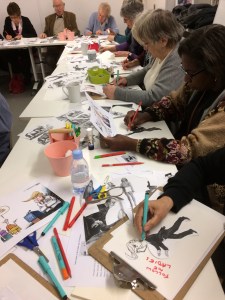
caricature-close-upAfter the tour participants returned to the classroom for a practical workshop led by professional illustrator Merlin Evans. Merlin taught participants how to exaggerate select facial features to create caricatures of today’s political target par excellence, Donald Trump. In addition to creating their own images students also cut and pasted Victorian illustrations to create hybrid images. (One of these, a glowing orange Trump head on the body of a woodcut dragon, was particularly popular.) For many of the participants drawing was a familiar but uncommon experience. According to one U3A member, ‘I have not drawn for 60 years and really enjoyed this’.

A number of participants talked about how much they enjoyed the chance to look at caricature from a variety of perspectives. ‘The background talk mixed with attempts to do our own [drawings] was a great way to learn’, said one member of Ealing U3A.

RIN is pleased to be able to build on the day’s success and bring members’ work on illustration to new audiences. We will partner with House of Illustration to provide a series of lecture-workshops like this one in 2017. First on the list is Susan Matthews on William Blake and Medical Illustration on February 14.

Romantic Antiquarianism

Romantic Antiquarianism: A Conference Celebrating Scott’s The Antiquary

Saturday 26 November 2016, 09.30–15.30

The Georgian Group, 6 Fitzroy Square, London

Co-organised by Fiona Robertson (Durham) and Peter Lindfield (Stirling)


This one-day conference in the heart of London celebrates the bicentenary of the publication of Sir Walter Scott’s novel, The Antiquary, by looking at the multi-faceted nature of antiquarianism in Georgian Britain. Leading scholars from across the UK gather to present new and engaging material on the topic.

Registration — at the time of writing only 10 places remain — (£30) includes teas/coffees and lunch in one of Robert Adam’s town houses.

Register at: https://www.eventbrite.co.uk/e/romantic-antiquarianism-a-conference-celebrating-scotts-the-antiquary-tickets-27322980771

Satire, prints and theatricality in the French Revolution

The Voltaire Foundation has recently announced the publication of Claire Trévien’s new book, Satire, prints and theatricality in the French Revolution. According to the Foundation:

Following an account of the historical and social contexts of Revolutionary printmaking, the author analyses over 50 works, incorporating scenes such as street singers and fairground performers, unsanctioned Revolutionary events, and the representation of Revolutionary characters in hell. Through analysing these depictions as an ensemble, focusing on style, vocabulary, and metaphor, Claire Trévien shows how prints were a potent vehicle for capturing and communicating partisan messages across the political spectrum. In spite of the intervening centuries, these prints still retain the power to evoke the Revolution like no other source material.

  1. Introduction: the other stage of the French Revolution
  2. Singing the scene: chansons and images in prints
  3. Le monde à l’envers: the carnivalesque in prints
  4. The spectacle of science: illusion in prints
  5. Théâtre de l’ombre: visions of afterlife in prints
  6. Conclusion

A blog post by Trévien and information on ordering are available here.