CFP: The Itinerant Illustrator

JOURNAL OF ILLUSTRATION/ /ILLUSTRATION RESEARCH/ /INDIA 2014

The Itinerant Illustrator

Srishti School of Art, Design and Technology, Bangalore, India

18th and 19th December 2014

Deadline for abstracts: Friday 4th July

The 5th International Illustration Research event joins forces with the peer reviewed Journal of Illustration and is hosted by Srishti School of Art, Design and Technology in Bangalore. The symposium this year will focus on the praxis of illustration in an expanded field, including histories of local/regional illustrative practices and the traversing of diverse media platforms.

Through talks, workshops, performances and exhibited works, we will consider the illustrator in terms of the ‘habitual travelling’ that he or she undertakes. The itinerant nature of the illustrator is evident in the praxis of illustration itself- the oscillation of thought between word and image, page and screen, hand and eye, dream and reality.

Occupying many roles and moving dynamically between them, the itinerant illustrator is an interpreter, a translator, an illuminator, as well as a storyteller, enquirer, performer and a pictorial juggler of ideas. The nomadic nature of the illustrator is to wander between disciplines, search for new contexts and to make images not on one, but several different platforms within an eternal evolution of technologies.

The multi-sited nature of illustration, along with illustrators’ journeys between several positions and places, also involves images that travel. We would like to investigate the fluidity of visual codes and languages, the translations, adaptations and hybrid practices that respond to the movement of cultures within the global village. How are images made and read within shifting regional and trans national contexts? How can we use illustration itself as a methodology to shed light on the praxis of illustration in these multiple contexts?

300 word proposals for 20 minute academic papers and practice based presentations are invited including (but not limited to) the following topics:
◦Illustration within local and hybrid cultures
◦Illustrated Narratives on transnational platforms
◦Image and space – murals, installations and other site-specific images
◦The illustration as palimpsest: reinterpretations of received bodies of knowledge
◦The itinerant storyteller – the book, the scroll, the kaavad
◦Illustration’s relationship to technology
◦Memory and place in illustration practice
◦Illustration as performance and dialogue
◦Local/Regional approaches to illustration practice
◦Post colonialism and illustration
◦The illustrator as tourist within global image culture

Please email abstracts along with your name, affiliation and email address to: Sandeep Chandra Ashwath (sandeep@srishti.ac.in), DesdemonaMcCannon (d.mccannon@mmu.ac.uk), and Anna Bhushan (abhushan@cardiffmet.ac.uk).

Selected papers and presentations will be considered for publication in forthcoming issues of the peer reviewed Journal of Illustration, published by Intellect books.
Report: 1st Reading Group Session

The inaugural meeting of the ‘Illustration: So What?!’ Reading Group took place on May 19th 2014 at the University of Roehampton, introduced by Mary L. Shannon and Susan Matthews. We convened for a varied and lively discussion, reflecting the nature of our chosen subject as well as the fields of scholarship represented at the table.

Susan Matthews opened the session with her observations regarding the etymology of ‘illustration’. The careful consideration given to the development of our contemporary usage of the word, in contract with its earlier meanings, emphasised just how much has the publishing industry and book design and decoration have evolved, even in recent times. This point is perhaps particularly poignant for the illustration scholar with a background as an illustrator, such as myself. As students – and scholars – it is often considered that illustration has existed since the earliest days of human creativity, and is at the heart of creative and intellectual development. The implication that in name at least this is not the case is quite profound; the acknowledgement that a timeless occupation is actually only 198 years-old (according to the OED definition) is a novel perspective. The idea that the Romantic illustrators were working in a newly named field, perhaps makes them more radical than was previously thought.

The core text, J Hillis Miller’s Illustration (1992), provided a number of interesting points for discussion. It was observed and agreed that Miller used ‘illustration’ with a multiplicity of meanings – with a particular penchant for added connotations of ‘light’. This, of course, married perfectly with discussion of pre-1816 definitions of ‘illustration’ as well as with the glowing glass books of Olafur Eliasson in his 2013 artwork A View Becomes a Window. Examination of Miller was as stimulating and varied as the contents of his book, with the group drawing parallels between all texts discussed as well as to fields as diverse as theatre and architecture.

The first meeting of the ‘Illustration: So What?!’ Reading Group did, as promised, throw new light on the idea of illustration. With future meetings planning to discuss texts just as varied as those considered here, and likely to be approached with the same enthusiasm and varied perspectives, I have no doubt that further light will be shed on this very rich area of study.

– Bee Hughes (PhD student, Liverpool John Moores)

The Political Economy of Book Illustration – 6/6/2014

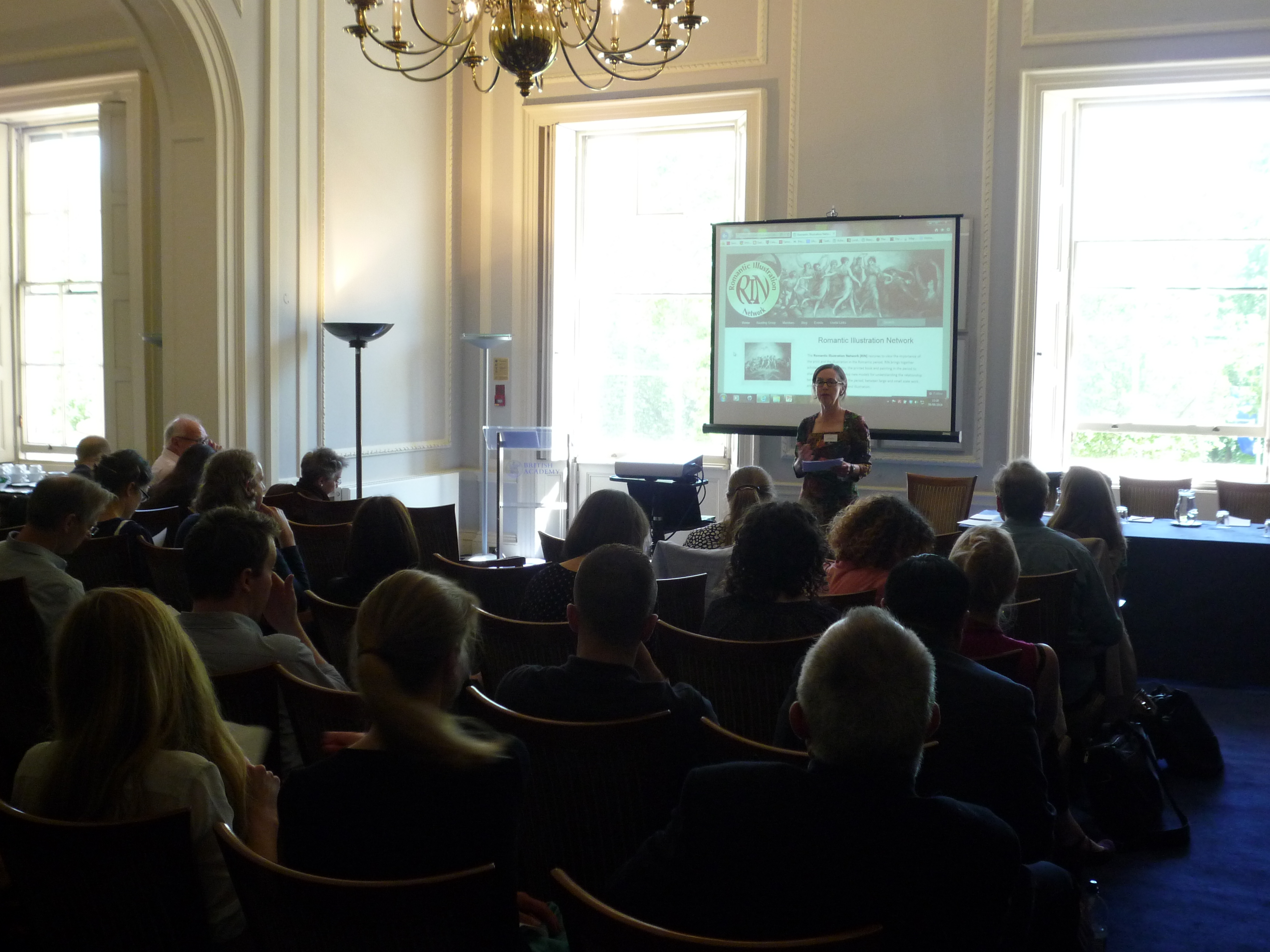
The Romantic Illustration Network held its opening event at the British Academy in London last Friday.

Leading and emerging scholars of eighteenth- and nineteenth- century visual culture gathered to discuss the materiality of the visual image and the printed text, in the beautiful surroundings of the British Academy’s Lee Reading Room.

RIN OpeningSusan Matthews (Roehampton) welcomed attendees, and used the OED’s definition of ‘illustration’ to suggest that the term itself is odder than we have come to believe it is. She pointed out that in the early nineteenth-century the word was used regularly in both its visual and its verbal senses, and proposed that the world of book illustration is one which is less straightforward than one might initially think.

This theme of the inter-relation of text and image in the illustrated book was picked up by William St Clair (IES, London) in his paper ‘Towards a Political Economy of Book Illustration’, c. 1800-1820. St Clair showed us how a focus on literature and art as material transactions can move us away from notions of ‘cultural emanation’ or ‘influence’, if we ask questions such ‘who had access to which texts at which time?’ and ‘how did images get from producer to consumer?’. He argued that expected demand, rather than supply, drove the publishers’ offerings of illustrated books. St Clair brought items from his own collection to display as a mini exhibition during the symposium.

Brian Maidment (Liverpool John Moores) took us into the next part of the century; he surveyed ‘Comic Illustration in the Marketplace 1820-40’ through a close reading of a series of comic caricatures, prints, and illustrations. He emphasised that the Victorians did not invent the serialised illustrated magazine, and that examples from the 1820s and 1830s are under-researched and understood. He also discussed questions of the democratic nature of popular serial culture, and made the point that any discussion of visual radicalism needs to recognise the willingness of artists such as Robert Seymour to work in multiple kinds of publications for money.

RIN DelegatesMoving into the Victorian period and digital materiality, Anthony Mandal, Julia Thomas, Nicky Lloyd, and Michael Goodman from Cardiff’s ‘Centre for Editorial and Intertextual Research’ presented three digital resources: the Database of Mid-Victorian Illustration (http://www.dmvi.org.uk/), the Victorian Illustrated Shakespeare Archive (under construction), and Lost Visions; Retrieving the Visual Element of Printed Books from the Nineteenth Century(http://cardiffbookhistory.wordpress.com/2014/02/09/lost-visions/). Together these papers demonstrated how practical and theoretical considerations must be tackled in tandem on such digital projects, and how online academic resources can be rigorous and scholarly as well as accessible.

The symposium closed with an open discussion which drew together various different strands from across the day, and also pointed towards profitable new lines of inquiry, before we all headed for a sociable drink nearby. Apart from the lively buzz at the event itself, if such Network-building events are to be judged by the resources shared and the connections made, then RIN has got off to a productive and promising start.

– Mary L. Shannon (Roehampton)